
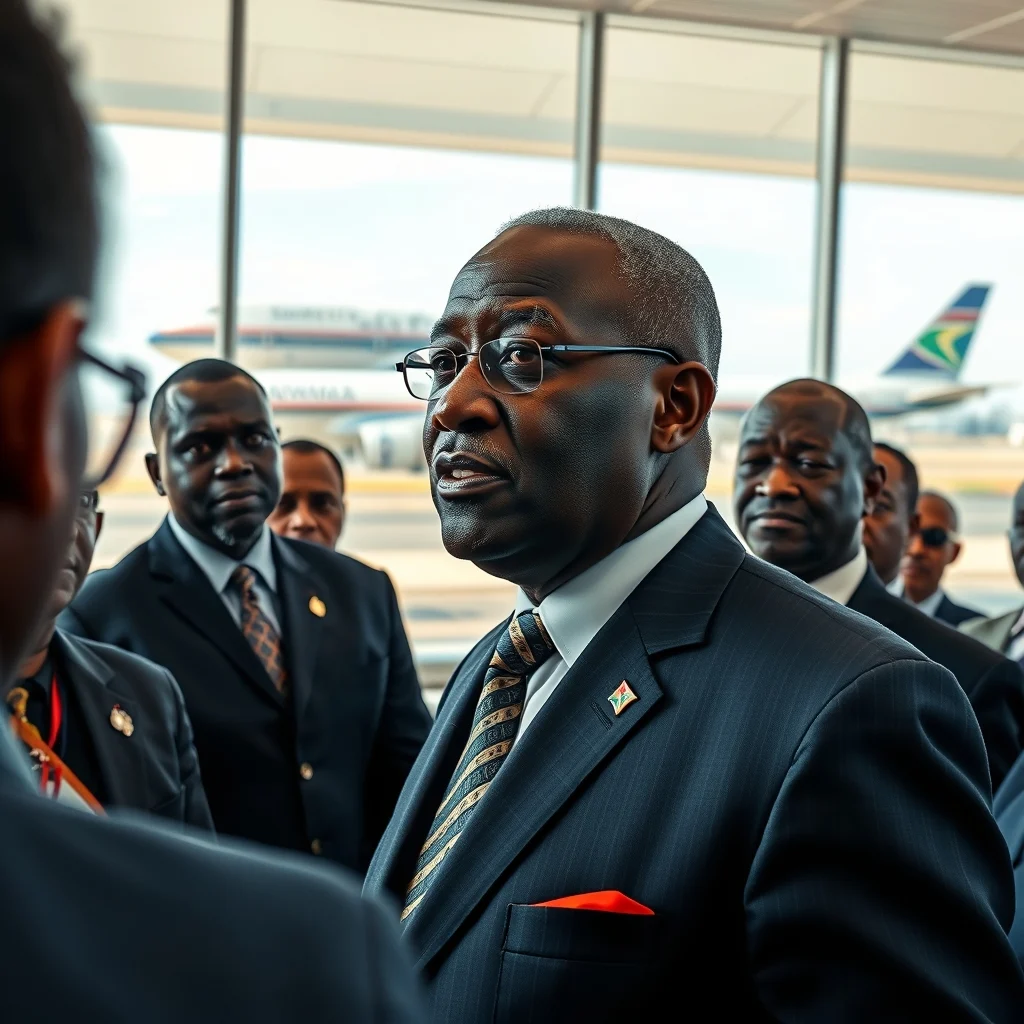
Accra, Ghana – Former President John Dramani Mahama experienced a brief but notable interruption at Accra International Airport on Tuesday when the loud roar of a departing South African Airways flight momentarily halted his post-trip address. The incident occurred as Mahama was briefing officials following his return from diplomatic engagements in the United Kingdom and Belarus, prompting a lighthearted observation that resonated with the current climate of continental discourse.
The former President was mid-speech, detailing the outcomes of his international visits, when the noise from the aircraft made it impossible to continue his remarks. He paused, waiting for the plane to clear the runway and the airspace before resuming his address.
Upon identifying the aircraft as belonging to South African Airways, Mr. Mahama injected a moment of levity into the formal briefing. He remarked, “That is an occupational hazard at the airport, and incidentally, it is a South African Airways,” a comment that elicited laughter from his assembled officials and briefly eased the atmosphere.
This seemingly minor incident occurred against a backdrop of heightened continental attention on xenophobia in South Africa. Recent months have seen a rise in anti-foreigner sentiment and violence, leading to the evacuation of several Ghanaian nationals from affected areas in South Africa. The former President’s offhand remark, therefore, carried an implicit weight, drawing a connection between the flight and the ongoing discussions surrounding South African Airways’ home country.
Mahama proceeded to continue his speech, transitioning back to the formal agenda of briefing officials on his diplomatic missions. The interruption, though brief, served as a subtle reminder of the interconnectedness of international travel and the socio-political climate of nations.
The context of this remark is crucial. Xenophobic attacks in South Africa have been a recurring issue, often flaring up and drawing condemnation from across Africa and beyond. These attacks, which target foreign nationals, have led to significant displacement, economic disruption, and, tragically, loss of life. Ghana, like many other African nations, has expressed deep concern and has undertaken measures to assist its citizens affected by the violence.
The presence of South African Airways, a prominent carrier from the nation grappling with these issues, at Ghana’s main airport provided an unintentional, yet potent, symbol. Mahama’s ability to find humor in the situation, while acknowledging the specific airline, demonstrated a nuanced approach to a sensitive topic. It allowed for a moment of shared understanding and perhaps a subtle critique, without derailing the official proceedings.
Data from various human rights organizations and news reports over the past decade consistently highlight the cyclical nature of xenophobic incidents in South Africa. These reports often detail the economic and social factors cited as underlying causes, alongside the devastating impact on individuals and communities.
For Ghanaians and other African nationals residing in or traveling to South Africa, these tensions create an environment of uncertainty and fear. The evacuations that have taken place underscore the real risks involved. Therefore, any mention, even a lighthearted one, of South Africa or its national carrier can evoke these anxieties.
The implications of such remarks, even in jest, extend beyond the immediate airport setting. They contribute to the ongoing public discourse about intra-African relations and the challenges of integration. Leaders and public figures often set the tone for national sentiment, and Mahama’s comment, while informal, could be interpreted in various ways, from a simple observation to a subtle political statement.
This incident serves as a reminder of how global events and local occurrences can intersect in unexpected ways. The infrastructure of international travel, symbolized by the departing flight, operates within a complex web of political and social realities. What to watch next will be how this incident, and the broader issue of xenophobia in South Africa, continues to shape diplomatic relations and public perception across the continent.






Leave a Reply