
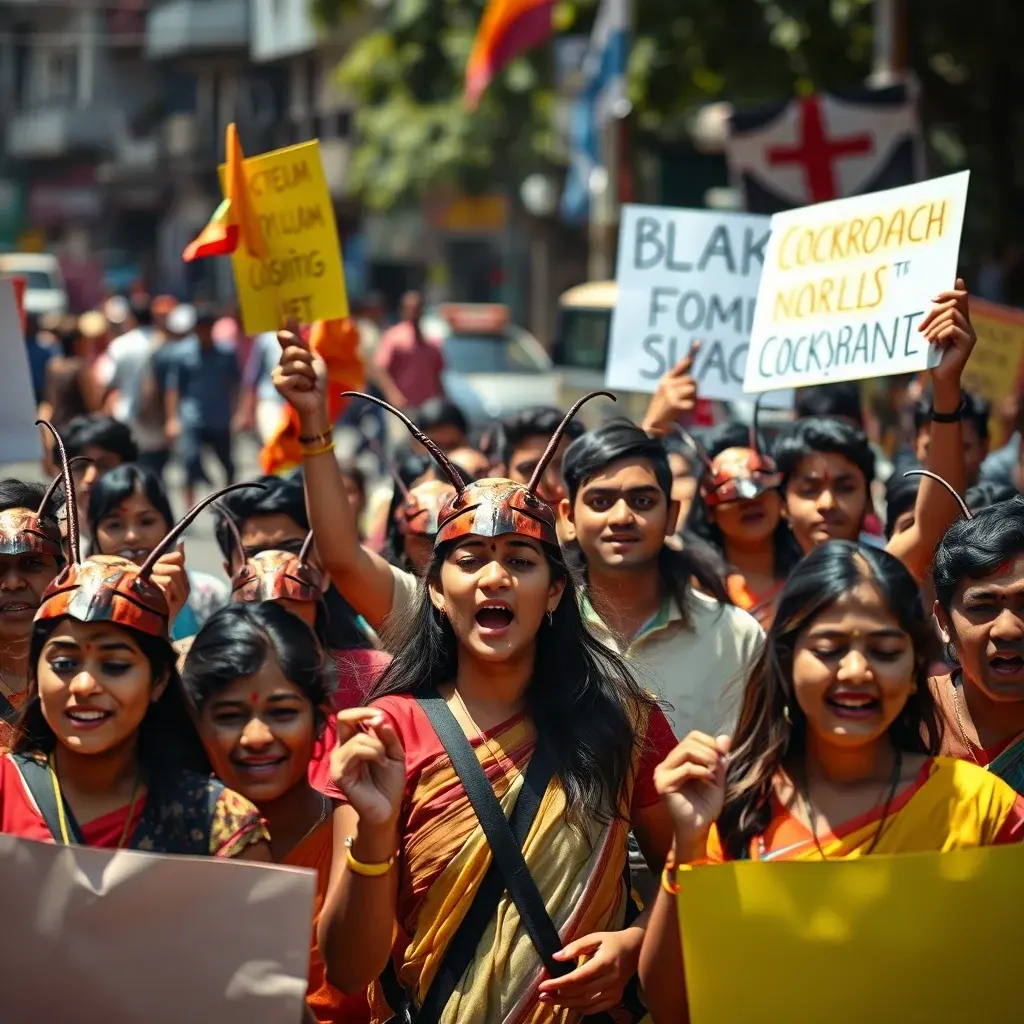
India’s satirical political group, the Cockroach Janta Party (CJP), has reportedly had its website blocked within the country, just days after its online launch. The group, which claims over 20 million followers, emerged as a parody following a controversial remark by India’s chief justice. The CJP’s website and its official X (formerly Twitter) page are currently inaccessible in India, with the latter displaying a message citing a “legal demand” for its withholding.
Origins of the Cockroach Janta Party
The CJP was established as a humorous response after India’s chief justice allegedly compared unemployed young people to cockroaches. Although the justice later clarified his remarks were aimed at individuals with “fake and bogus degrees,” the comparison sparked a viral movement. The group’s founder, Abhijeet Dipke, a political communications strategist and Boston University student, has publicly stated that Indian officials “taken down our iconic website.” He questioned the authorities’ apparent fear of the “cockroach” symbol, asserting that “Cockroaches never die” and that the group is already establishing a new online presence.
Dipke also reported that both his personal Instagram account and the CJP’s official Instagram account had been hacked. The CJP, which is not a registered political party, satirizes the name of Prime Minister Narendra Modi’s Bharatiya Janata Party (BJP). It positions itself as “the voice of the lazy and unemployed,” with tongue-in-cheek membership criteria such as being “chronically online” and possessing “the ability to rant professionally.” The group has effectively utilized AI-generated imagery for its online campaigns.
Explosive Online Growth and Public Engagement
The CJP’s online presence has seen remarkable growth, with its Instagram account amassing over 22 million followers, significantly surpassing the follower count of the ruling BJP. The movement has resonated with a large segment of the Indian youth, evidenced by the widespread adoption of the hashtag #MainBhiCockroach, meaning “I too am a cockroach.” This online surge has also translated into real-world visibility, with young volunteers appearing at public events and protests dressed as cockroaches.
Dipke has previously articulated that the group’s rapid popularity reflects a deep-seated discontent among young Indians concerning the nation’s high unemployment rate. He highlighted a prevailing sentiment that mainstream politics has largely ignored the concerns of this demographic. India boasts one of the world’s youngest populations, with approximately half of its 1.4 billion citizens under the age of 30. However, formal political participation for this group remains a significant challenge.
Broader Implications and Future Outlook
The blocking of the CJP’s website and X account, along with alleged hacking incidents, raises questions about freedom of expression and the digital space in India. The swift action against a satirical group, particularly one that has gained such a substantial following, suggests a sensitivity to online narratives that critique or parody established political entities. This incident could signal an increased government focus on controlling online dissent, even when presented humorously or satirically.
The CJP’s ability to mobilize millions of followers rapidly, using unconventional methods like AI art and parody, demonstrates the evolving landscape of political engagement, especially among the youth. The group’s resilience, as indicated by its founder’s promise of a new “home,” suggests that attempts to suppress online movements may not always be effective in the long term. The situation highlights the growing power of digital platforms in shaping public opinion and political discourse in India.
As the CJP seeks to re-establish its online presence, observers will be watching closely to see how authorities respond and whether similar satirical movements emerge. The incident underscores the ongoing tension between digital activism, political commentary, and regulatory oversight in India’s dynamic online environment. The future trajectory of the CJP and the government’s approach to online parody will be key indicators of the evolving digital governance landscape.










Leave a Reply