
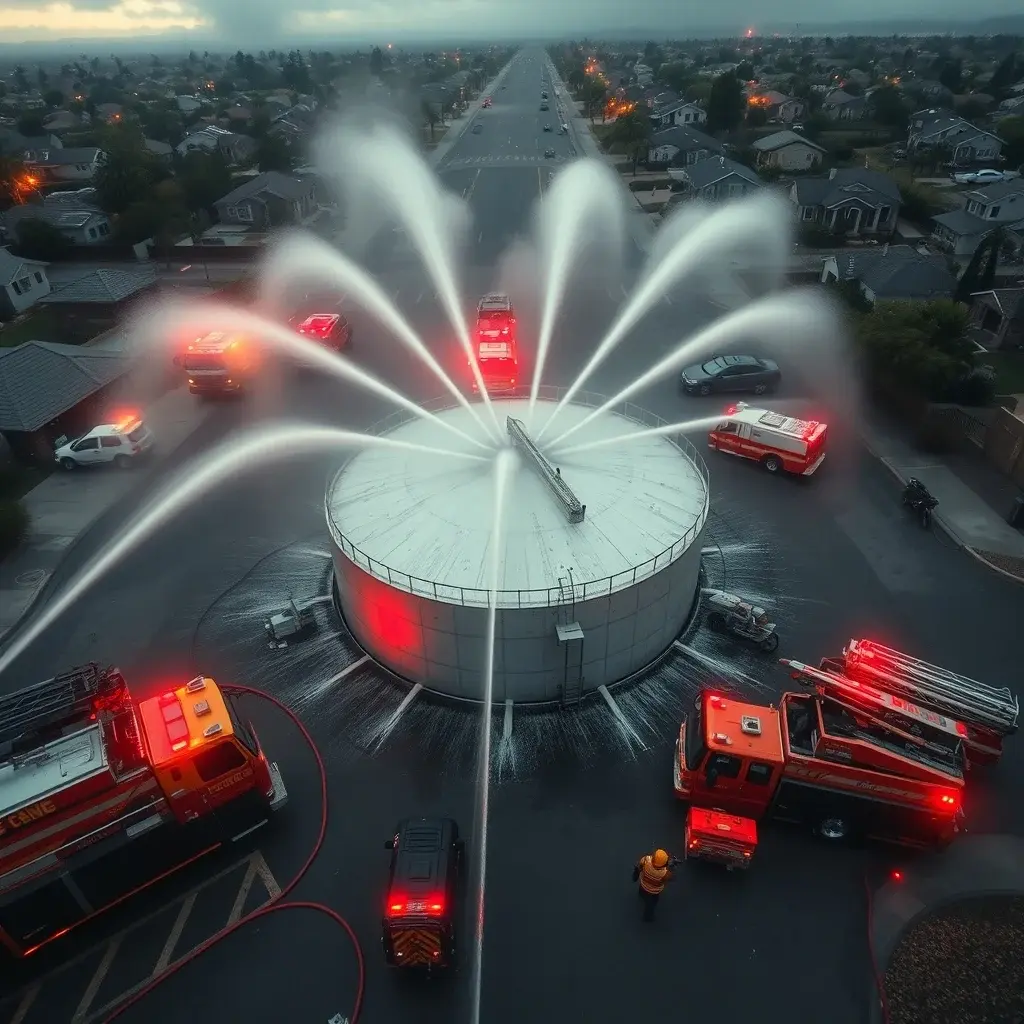
California Governor Gavin Newsom has declared a state of emergency as hazardous material crews work to contain a volatile chemical leak threatening to rupture or explode at a manufacturing facility in Orange County. The emergency declaration comes as thousands of Garden Grove residents remain under evacuation orders due to the escalating crisis involving approximately 7,000 gallons of methyl methacrylate, a highly flammable substance used in plastic production.
Escalating Threat at Aerospace Facility
Officials confirmed Saturday that the temperature within the compromised tank was significantly higher than initially estimated and continued to rise. Orange County Fire Authority division chief Craig Covey outlined the critical situation, stating, “We are planning for two scenarios: Does it rupture and spill, or does it blow up?” The facility, operated by UK-based GKN Aerospace, is located approximately five miles from Disneyland, though the theme park remains open as it is outside the evacuation zone.
The cause of the failing tank is currently under investigation. Emergency responders have been continuously spraying the tank with water in an effort to stabilize its temperature and slow the exothermic reaction occurring within. “An inoperable valve” has reportedly complicated containment efforts, creating “additional operational challenges,” according to officials.
By Saturday, the damaged tank’s internal temperature had reached 32°C (90°F) and was climbing approximately one degree Fahrenheit per hour. Earlier on Friday, external temperature readings taken by drones had suggested the tank was cooled to around 16°C (61°F). However, closer inspection revealed the true internal heat levels, highlighting the urgency of the situation.
Emergency Response and Evacuation
Covey expressed cautious optimism that emergency teams could mitigate the escalating chemical reactions and pressure buildup. “Letting this thing just fail and blow up is unacceptable to us,” he stated, emphasizing the development of “very aggressive plans” for potential failure scenarios. These plans include the construction of dikes and dams to contain any spills, aiming to prevent chemicals from reaching storm drains or the ocean.
As a precautionary measure, local schools have been closed, and several major road exits leading to the affected area have been shut down to restrict access. Orange County health officer Dr. Regina Chinsio-Kwong advised residents to report any “fruity and heavy smell,” indicating potential vapor release. While smelling the substance does not automatically equate to harmful exposure levels, authorities are working to prevent any public detection.
Inhaling the vapor can lead to respiratory issues, eye irritation, and dizziness, according to Chinsio-Kwong, who assured that individuals outside the one-mile evacuation zone should be safe. Residents who were evacuated, such as Mark Olsen, described being woken by sirens and the subsequent order to leave their homes. Olsen shared his frustration at the uncertainty surrounding the incident and the timeline for returning home, highlighting the personal impact of the emergency.
Company Response and Broader Implications
GKN Aerospace, a supplier of aircraft parts, issued a statement apologizing to local residents and affirming their commitment to collaborating with emergency services. “The situation remains ongoing and we are fully focused on working with emergency services, specialised hazardous material teams and the relevant authorities to ensure the safety of the local community, our employees and everyone else involved,” a company spokesperson said.
The incident underscores the inherent risks associated with storing and handling large quantities of volatile chemicals in industrial settings, particularly in densely populated areas. The proximity of the facility to residential neighborhoods and major attractions like Disneyland raises critical questions about industrial safety regulations, emergency preparedness, and community risk assessment.
The ongoing efforts to manage the chemical leak serve as a stark reminder of the potential consequences of industrial accidents and the importance of robust safety protocols. The response highlights the complex challenges faced by emergency services when dealing with hazardous materials, requiring specialized expertise, advanced equipment, and coordinated multi-agency efforts.
Looking Ahead
As the situation continues to unfold, attention will be focused on the effectiveness of the containment measures and the integrity of the tank. Investigations into the root cause of the valve malfunction and the escalating temperature will be crucial in preventing future incidents. Residents will be closely monitoring updates regarding the evacuation orders and the timeline for returning to their homes. The long-term implications for GKN Aerospace, including potential regulatory scrutiny and community relations, remain to be seen. The incident also prompts a broader conversation about industrial safety standards and emergency response planning in California and beyond.










Leave a Reply