
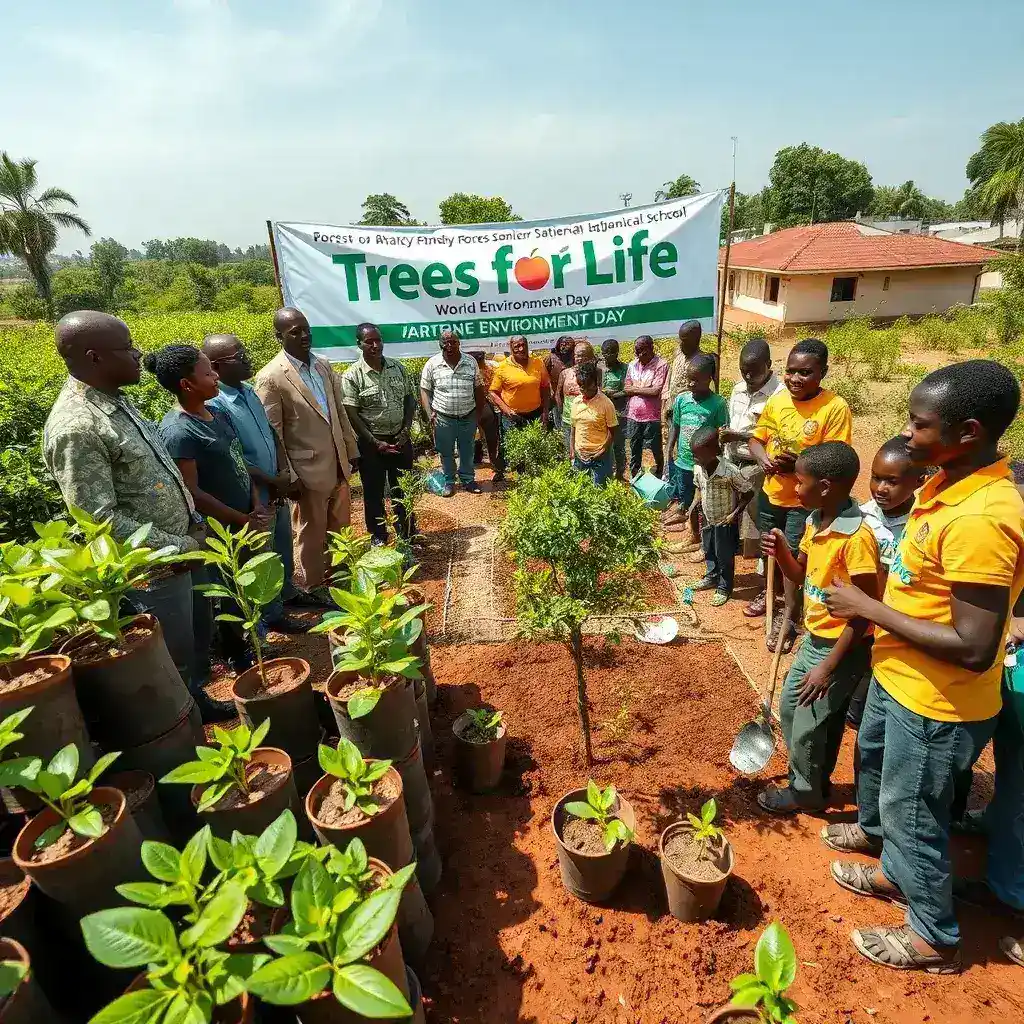
The Forestry Commission has initiated a month-long “Trees for Life” program in Ghana’s Ashanti region, aiming to plant 3 million trees by the end of June to combat forest degradation. The initiative focuses on restoring heavily degraded forest reserves, including Tano Offin, Jimira, and Offin Shelter Belt, with a priority on areas impacted by mining and other land-use changes. The launch event, held on World Environment Day at the Armed Forces Senior High Technical School, signals a concerted effort to re-green critical ecological zones.
Context of Forest Degradation and Restoration Efforts
Forest degradation in the Ashanti region, like many parts of Ghana, is a persistent issue driven by factors such as illegal mining, logging, and agricultural expansion. These activities deplete forest cover, leading to soil erosion, loss of biodiversity, and reduced water catchment capabilities.
The “Trees for Life” program is the Forestry Commission’s strategic response to reverse these trends. By targeting specific degraded forest reserves, the Commission aims to implement a more focused and effective restoration strategy. This approach ensures that limited resources are directed towards areas with the greatest need for ecological recovery.
Key Programmatic Changes and Focus Areas
This year’s “Trees for Life” campaign introduces a significant change in seedling distribution. According to Isaac Noble Eshun, the Ashanti Regional Manager of the Forestry Commission, the number of seedlings individuals can collect has been restricted to a maximum of five. This measure is in response to past observations where a substantial number of distributed seedlings were not planted or adequately nurtured.
“We are restricting the number of seedlings per individual to not more than five trees,” Eshun stated. “Unless you are able to demonstrate or show us that you have the requisite site to plant them, and then when you plant, it’s going to be well-nurtured and then ensured that it grows to maturity.”
The primary planting activities will occur within forest reserves managed by the Commission. This includes reclaimed mined-out areas and existing reserves identified as heavily degraded. The Commission will manage these planting sites directly to ensure proper implementation and monitoring.
Past Successes and Regional Performance
The Ashanti region has a history of successful reforestation efforts, boasting an 85 per cent seedling survival rate in previous years. Last year alone, the Commission distributed and planted approximately 2.5 million seedlings across both forest reserves and off-reserve areas.
Performance varied across districts. The Offinso Forest District was a top performer, planting 737,415 seedlings, while the Kumawu District planted the fewest at 81,000 seedlings. These figures highlight the need for consistent engagement and resource allocation across all districts to achieve regional targets.
Broader Community and Home Planting Initiatives
Beyond the forest reserves, there is a push to involve the wider community in tree planting. Ashanti Regional Minister, Dr Frank Amawakohene, expressed his commitment to encouraging home planting. He plans to discuss with Metropolitan, Municipal, and District Chief Executives (MMDCEs) the enforcement of tree planting in residential areas.
“We also want to encourage home planting of trees,” Dr. Amawakohene said. “Because here, you remember clearly, it’s known as the Garden City for the simple reason of having trees and lawns that beautify our homes.” He proposed that MMDCEs ensure trees are planted approximately 10 meters apart in front of homes and that lawns are maintained in unpaved areas.
This dual approach—focusing on critical forest reserves and promoting urban greening—aims to comprehensively address environmental degradation and enhance the region’s aesthetic appeal, potentially restoring Kumasi’s historical “Garden City” status.
Looking Ahead: Sustaining the Green Drive
The success of the “Trees for Life” program hinges on sustained public support and effective implementation by the Forestry Commission and local authorities. The emphasis on planting within reserves and stricter seedling distribution rules suggests a move towards quality over quantity in restoration efforts.
Residents of the Ashanti region can expect increased community engagement and potentially new local directives regarding tree planting in urban and peri-urban spaces. The coming months will reveal the effectiveness of these strategies in achieving the 3 million tree target and contributing to the long-term ecological health of the region.









Leave a Reply