
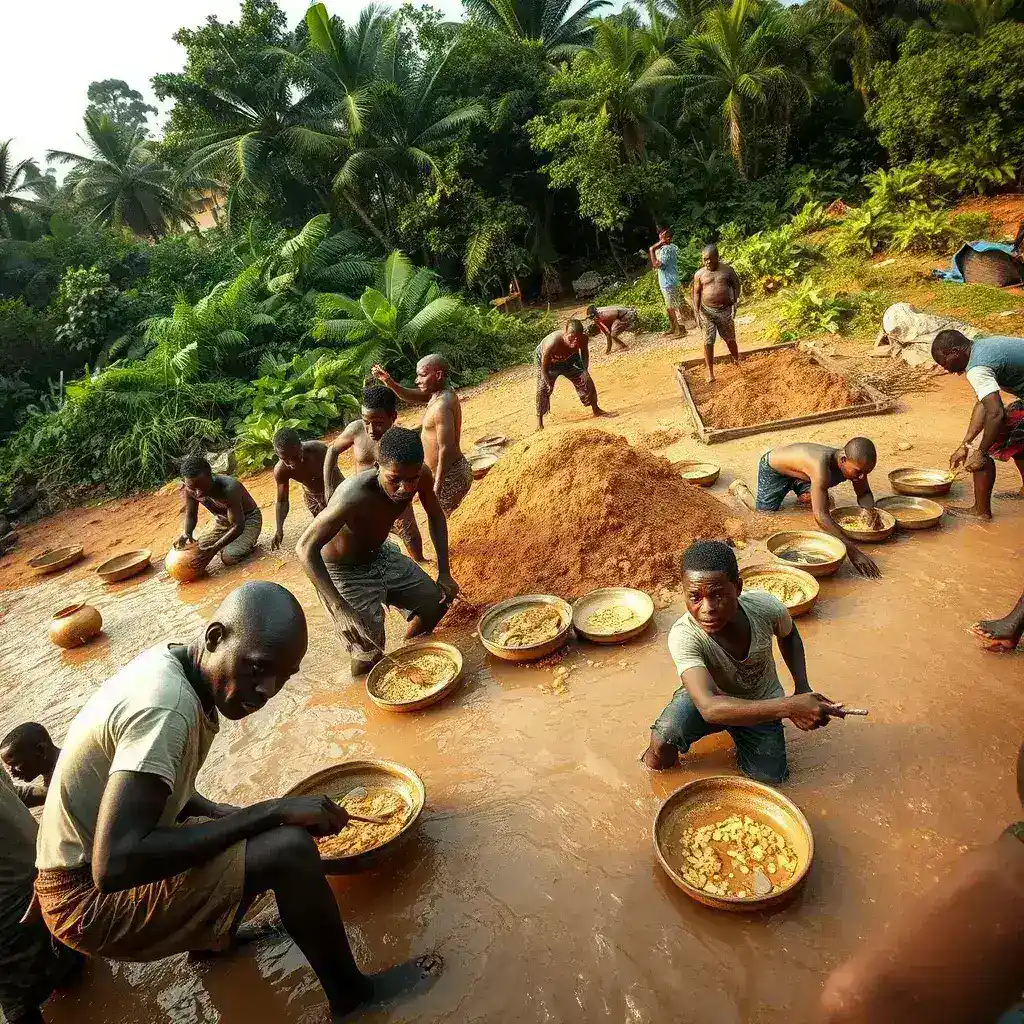
Ghana’s gold output surged by 23.41% to nearly 6 million ounces in 2025, primarily driven by a historic increase in small-scale mining, according to figures released over the weekend. This marks a significant shift in the West African nation’s mining landscape, with the small-scale sector now contributing over half of the national output.
Context of Ghana’s Gold Industry
Ghana has long been a major gold producer, with its mining sector forming a cornerstone of its economy. Historically, large-scale mining operations, often run by international companies, have dominated production. However, the artisanal and small-scale mining (ASM) sector, while significant, has often faced challenges related to regulation, environmental impact, and artisanal safety.
Recent years have seen the Ghanaian government implementing reforms aimed at formalizing and improving the governance of the ASM sector. These efforts include measures to increase transparency, promote responsible mining practices, and ensure that the benefits of gold extraction are more equitably distributed within the country.
Small-Scale Mining Drives Production Surge
In 2025, small-scale gold production saw a dramatic increase of 63.82%, rising from 1.90 million ounces in 2024 to 3.11 million ounces. This surge propelled the sector’s contribution to national output to 52.4%.
This growth is attributed, in part, to reforms such as the establishment of the Ghana Gold Board (GoldBod), an initiative designed to better manage and support the small-scale mining industry. The increased output from this sector has fundamentally altered the composition of Ghana’s overall gold production.
Large-Scale Mining Faces Contraction
Conversely, large-scale gold production experienced a decline of 2.98% in 2025. Output fell from 2.92 million ounces in 2024 to 2.83 million ounces in the following year. Consequently, the share of national output from large-scale operations decreased from 60.6% to 47.6%.
Member companies of the Ghana Chamber of Mines contributed 2.77 million ounces in 2025, a slight reduction from 2.86 million ounces in 2024. Production dipped across most of these operations, with notable exceptions including Asanko Gold Mine and AngloGold Ashanti’s Obuasi Mine, which were supported by Newmont’s Ahafo Mine, Cardinal Resources Limited’s Namdini Mine, and Zijin’s Akyem Mine.
Other non-Chamber large-scale mines saw a marginal increase in output, growing by 2.0% from 0.055 million ounces to 0.057 million ounces. However, their overall contribution to national output remained small, declining from 1.2% to 1.0%.
Economic Impact and Employment Gains
The overall increase in gold production translated into substantial economic benefits. Total mining revenue grew by 10.61% from GHS21.90 billion to GHS24.22 billion in 2025, according to Mr. Michael Edem Akafia, the immediate past President of the Chamber of Mines.
Gold’s contribution to Ghana’s Gross Domestic Product (GDP) also saw a significant rise, increasing from 7.97% in 2024 to 9.98% in 2025. This elevated gold’s status as the largest economic sub-sector in the country.
Employment within the mining sector also improved. Chamber member companies reported a 21.52% increase in their direct workforce, growing from 11,372 in 2024 to 13,819 in 2025. These direct jobs, in turn, supported an estimated 207,285 indirect and induced jobs through multiplier effects, highlighting the sector’s broad economic impact.
Expert Perspectives and Future Outlook
Mr. Akafia noted that for 2026, large-scale gold output is projected to range between 3.2 million and 3.4 million ounces, while small-scale output is expected to be between 2.9 million and 3.5 million ounces. He stressed that this outlook is contingent on several factors.









Leave a Reply