
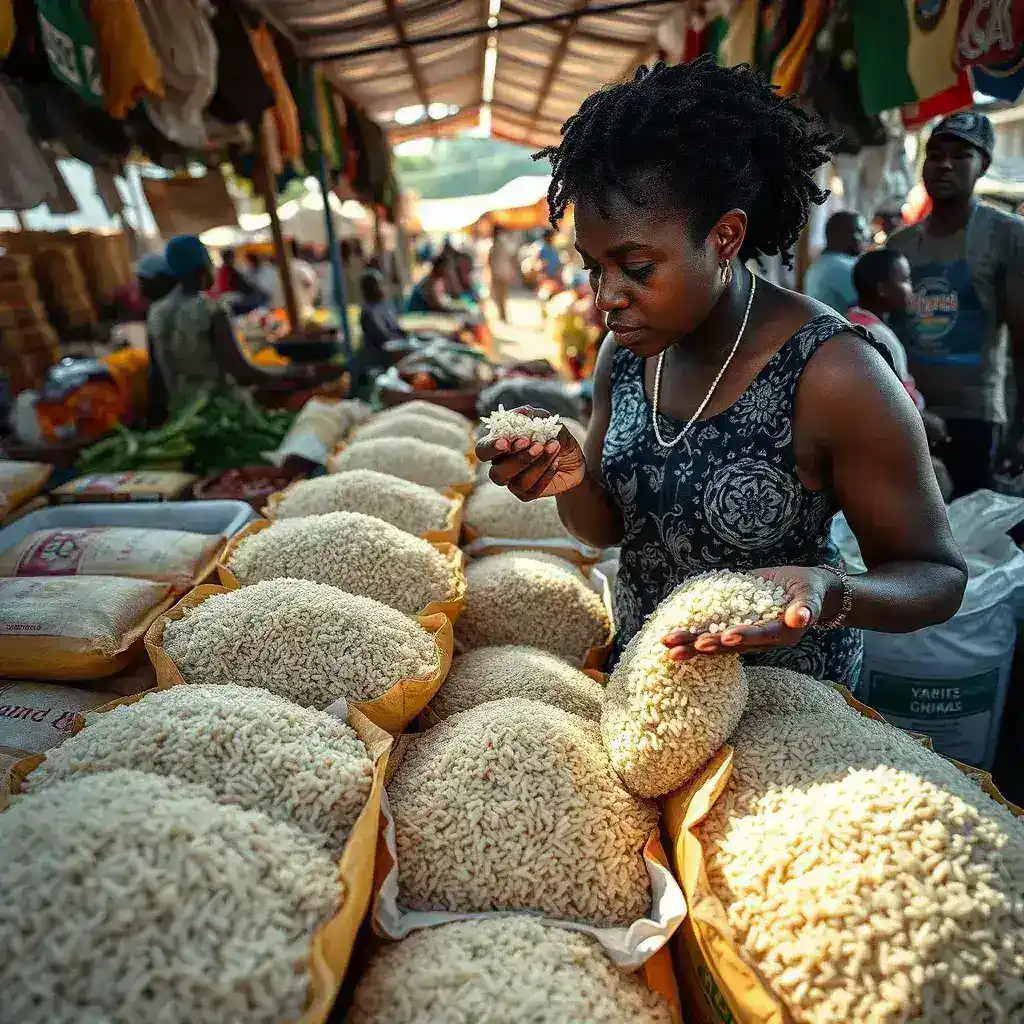
Ghana is grappling with a persistent rice importation crisis, struggling to meet its burgeoning domestic demand despite favorable agricultural conditions. While rice consumption soars, becoming the nation’s second most popular cereal, local production lags significantly behind consumer preference, leading to a heavy reliance on imports from countries like Thailand, Vietnam, and India. This situation, extending from everyday meals to formal ceremonies, highlights a complex challenge that goes beyond mere production volume or import restrictions, pointing instead to a critical disconnect between local supply and nuanced consumer demands, particularly within urban markets.
Rice has cemented its place as a staple in Ghana, with per capita consumption steadily increasing. Its convenience in preparation and storage, coupled with its versatility as a side dish for numerous Ghanaian soups and stews, ensures its growing dominance. Projections indicate rice is poised to overtake maize as the nation’s most consumed cereal, underscoring its profound importance to the Ghanaian diet and economy.
Despite possessing abundant fertile land, favorable weather, and water resources, Ghana has failed to capitalize on this internal demand. National campaigns and significant investments have not translated into local rice becoming the preferred choice. The prevailing narrative often blames imported rice and a preference for foreign goods for this shortfall. However, the reality is more intricate, involving a failure to consistently meet specific consumer standards rather than just a production deficit.
Understanding the Consumer Market
The key to unlocking Ghana’s rice self-sufficiency lies in understanding the distinct preferences of its consumers. The market can be broadly segmented into urban and rural consumers, each with unique needs and purchasing drivers.
Urban consumption is dominated by the hospitality sector—restaurants, hotels, and caterers—along with middle-class households. These consumers typically prefer long-grain rice that is aromatic, fluffy, and separates easily when cooked, characteristics consistently found in imported Thai and Basmati rice. This preference makes imported varieties the default choice for businesses catering to a wide clientele and for urban households seeking convenience and specific textures.
In contrast, rural consumers are generally more price-sensitive. They often opt for broken imported rice, which, when cooked in large quantities, becomes sticky and moist—similar to locally produced rice. For many in rural areas, local and broken imported rice are excellent substitutes, especially when prices are comparable. Fluctuations in imported rice prices can easily sway their purchasing decisions, contributing to periodic reports of rice gluts.
The Unmet Potential of Local Rice
Ghanaian rice possesses inherent advantages, often being more aromatic and possessing a richer, sweeter taste than its imported counterparts. Blind taste tests frequently reveal a consumer preference for the flavor of local rice. However, taste alone is insufficient to capture market share.
The primary drawbacks for local rice are its tendency to become sticky when cooked in large quantities and inconsistent quality control. Issues such as improper drying, the presence of broken grains, or mislabeling of grain length (medium or short grain passed off as long grain) deter urban consumers. Furthermore, impurities like stones or discolored grains often lead to outright rejection in favor of reliable imported alternatives.
These quality issues stem largely from post-harvest and production practices, particularly among smallholder farmers who constitute the majority of local producers. Inconsistent drying, mixing of varieties, and weak quality control systems throughout the value chain contribute to the problem. Farmers, as rational economic actors, often prioritize meeting the demands of the less discerning rural market, which offers immediate, albeit modest, profits, over the higher standards required by the more lucrative urban market.
Invisible Resistance and Market Quality
Local investors attempting to market Ghanaian rice to urban consumers often face an “invisible resistance.” They may mistakenly attribute this to cheap imports or a general preference for foreign goods, overlooking the fundamental issue: marketing a product designed for one consumer segment (rural) to another with different expectations (urban).
The lucrative restaurant and eatery segment is particularly difficult to penetrate due to the inconsistency in local rice quality. Some businesses attempt to bridge this gap by pre-financing farmers, but often encounter increased production costs due to a lack of ingrained standards, infrastructure, and a shared understanding of quality expectations between farmers and financiers.
The core problem is therefore a market-quality mismatch, not solely an import issue. Evidence suggests Ghanaians are willing to pay a premium for quality. Imported rice can retail for significantly more per kilogram than local varieties, indicating a clear willingness to pay for rice that consistently meets preferences. If Ghanaian rice could consistently separate when cooked, remain aromatic, be free from impurities, and maintain uniform quality, consumer perception would shift, driving demand and attracting investment.
Rethinking Interventions: Finance, Not Bans
Outright import bans, as implemented in some neighboring countries, are not the optimal solution for Ghana. Instead, the country could leverage imported rice to finance the development of its local industry.
A special development levy on imported rice, specifically earmarked for local industry investment, could generate substantial funds. A modest 5% levy on Ghana’s annual rice import bill could yield tens of millions of dollars annually. These funds could finance critical infrastructure, incentivize private investment (both local and foreign), and drive demand for locally grown rice.
Potential investments include acquiring and developing large irrigated land banks, establishing commercial farming zones, building centralized drying and warehousing facilities, and implementing timely payment schemes for smallholder farmers. Major rice importers could be incentivized to transition into local production through partnerships or direct investment, effectively becoming financiers of domestic capacity.
This approach transforms imported rice from a competitor into a funding mechanism for self-sufficiency. The standards set by imported rice can serve as a benchmark for local producers, pushing them to improve quality and potentially positioning Ghana as an exporter. Strict safeguards would be necessary to ensure fair allocation of land and prevent hoarding, requiring substantial security deposits and timely commencement of farming operations.
The path to ending rice importation dependency in Ghana requires a strategic, market-driven transformation. It hinges on consistently meeting consumer expectations through improved production, processing, and quality control. By intelligently leveraging import revenues to finance domestic expansion and fostering collaboration among government, technical institutions, and farmer organizations, Ghana can build a competitive rice industry capable of replacing imports and achieving national pride.










Leave a Reply