
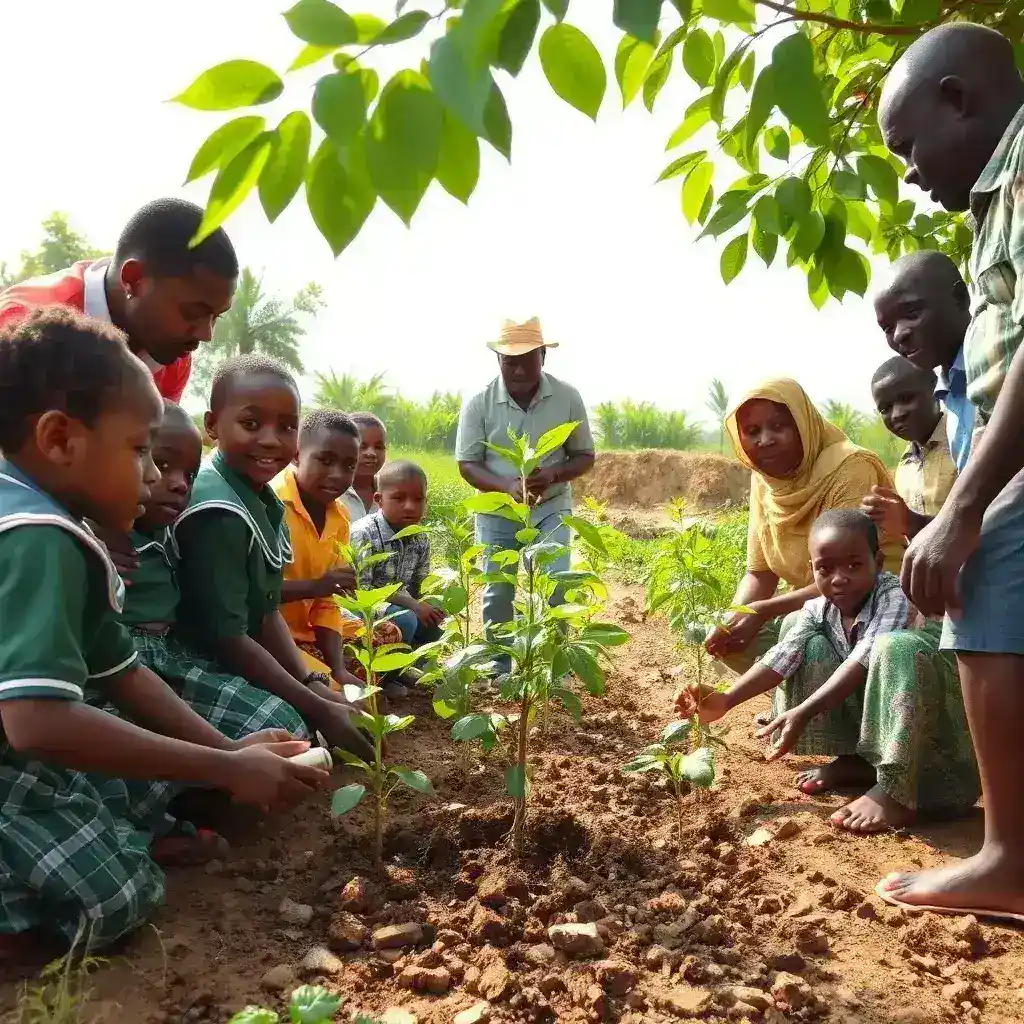
Residents of Drobonso in Ghana’s Ashanti region marked World Environment Day by planting trees, a symbolic act against the backdrop of escalating floods and extreme weather events nationwide. The initiative, a collaboration between the Environmental Protection Authority (EPA) and Miro Forestry, involved community members, schoolchildren, and local leaders to restore degraded land and enhance climate resilience.
Climate Change: A Present Threat
Louis Kofi Agbozoh, EPA Konongo Area Head, highlighted the urgency of environmental protection, stating that the increasing frequency of floods and severe weather across Ghana signifies that climate change is no longer a future concern but a present reality impacting livelihoods and communities.
“Every year, we use this occasion to conscientise the public on the need to preserve the environment for future generations,” Agbozoh stated. He pointed to the severe flooding in Accra and other areas during the current rainy season as a stark example of climate change’s tangible effects on socio-economic life.
This year’s World Environment Day observance specifically focused on the impact of climate change on livelihoods and the necessity of collective action for environmental security. “The celebration this year is to concentrate on the effect of climate change on our livelihood and how we can collectively ensure that our environment is secure for future generations,” he added.
Community-Led Restoration Efforts
Approximately 500 seedlings provided by Miro Forestry were slated for planting in designated areas. The initiative encourages schoolchildren and community members to take ownership of nurturing these seedlings until maturity, extending the effort beyond ceremonial planting.
These activities are part of broader strategies to increase Ghana’s tree cover, reclaim degraded landscapes, and fortify communities against climate change impacts. The EPA also plans to strengthen enforcement of environmental by-laws, particularly those mandating tree planting in residential developments, in collaboration with district assemblies.
“Every development, especially residential developments, is expected to support tree planting. Moving forward, we will work closely with the assemblies to ensure these by-laws are followed,” an EPA official confirmed. Trees are vital for environmental protection, absorbing carbon dioxide, improving air quality, and acting as natural buffers against high winds and storms.
Expanding Awareness and Restoration
Beyond tree planting, the EPA is launching environmental education and awareness campaigns in six districts under its Konongo Area Office. The focus will be on encouraging tree planting and, crucially, ensuring the survival and growth of newly planted trees.
“We are going to educate communities on the need to plant more trees. But it is not only about planting. We want people to understand the importance of taking care of the trees after planting them,” the official explained. Regular monitoring and support visits to planting sites are planned to ensure high survival rates.
The EPA also highlighted progress made under the Ghana Landscape Restoration Project, which has already restored about 127 hectares of degraded land through the planting of species like mahogany and coconut. This project aids in recovering lands affected by deforestation and environmental degradation, contributing to Ghana’s climate adaptation goals.
Partnerships for Sustainability
Despite challenges, EPA officials expressed optimism about ongoing conservation efforts. “We are making progress. We are in a zone that experiences both high rainfall and prolonged dry conditions, but because of the tree-planting activities being undertaken, we are seeing improvement,” Mr. Agbozoh noted.
Michael Adjei Ayeh, Environmental Manager at Miro Forestry, affirmed the company’s commitment to afforestation, aligning with World Environment Day objectives and the EPA’s agenda. “The mandate of World Environment Day and building climate-resilient communities through sustainable stewardship aligns with our focus on sustainable development through afforestation,” he said.
Miro Forestry manages approximately 23,000 hectares of afforested land and actively supports local development. Ayeh emphasized the company’s view of participating in such initiatives as both a corporate and community responsibility. “We believe it is both our corporate responsibility and our community responsibility to be part of activities like this. That is why we are happy to support and host this year’s programme,” he stated.
A Call for Long-Term Commitment
Environmental advocates are urging Ghanaians to view tree planting as a continuous commitment rather than a one-off event. The EPA encouraged greater environmental responsibility, asking citizens to speak out against environmentally destructive practices.
“Years ago, we used to say that when the last tree dies, the last person also dies. Let us return to making tree planting a priority. Let us protect our environment and ensure that future generations inherit a healthier and more resilient Ghana,” the authority urged. Nana Kwarteng Amanim, Akomuhene of Drobonso, reinforced this by encouraging residents to protect planted trees until they are mature enough to survive independently.
Looking ahead, the focus will be on the sustained enforcement of environmental by-laws and the long-term success of the tree-planting initiatives, including ensuring high survival rates through community engagement and regular monitoring. The EPA’s expanded awareness campaigns and ongoing restoration projects signal a determined, multi-faceted approach to building Ghana’s climate resilience.







Leave a Reply