
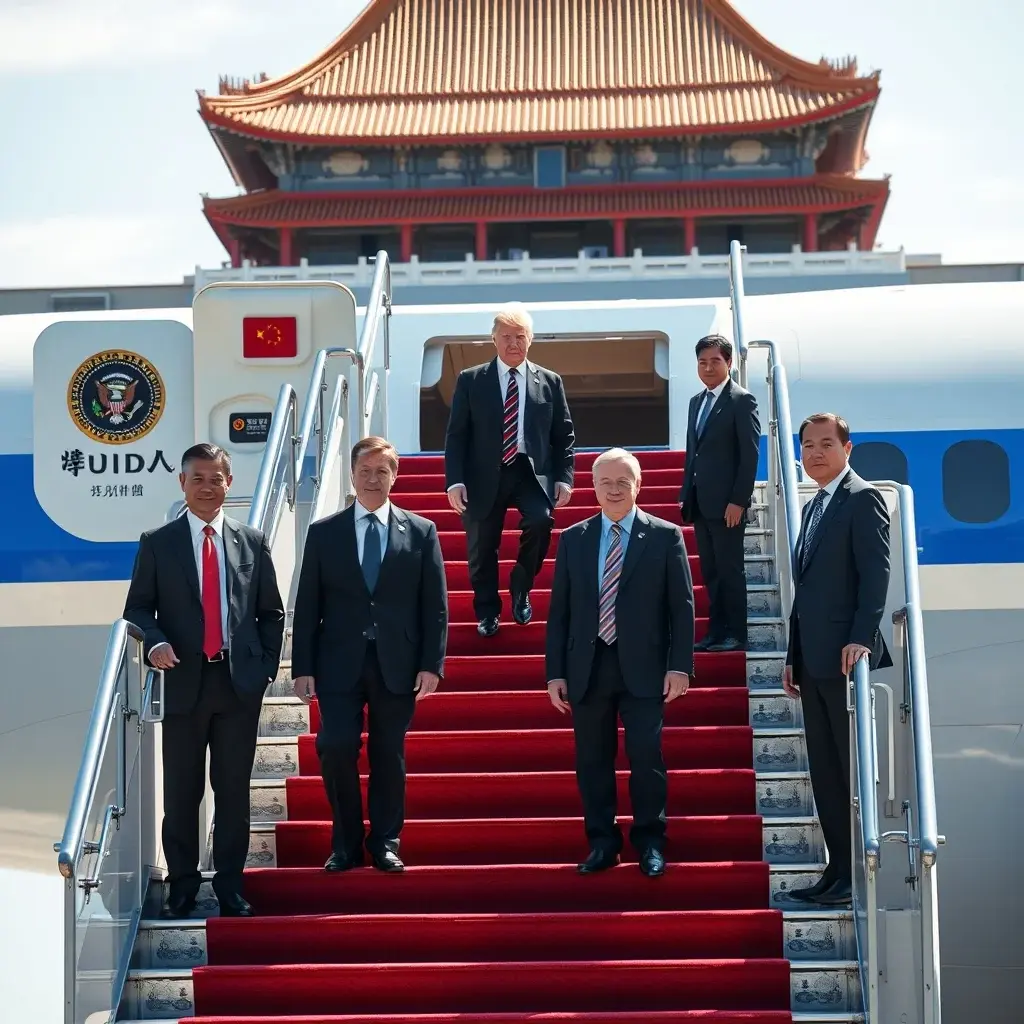
President Donald Trump embarked on a significant official trip to Beijing this week, accompanied by a delegation of over a dozen top US business and technology executives, including leaders from Nvidia, Apple, Tesla, and BlackRock. The visit, marked by growing economic and technological animosity between the US and China, aims to navigate a fragile trade truce and address geopolitical challenges.
High-Profile Delegation Aims to Foster Dialogue
The presence of prominent CEOs like Jensen Huang of Nvidia, Tim Cook of Apple, Elon Musk of Tesla and SpaceX, and Larry Fink of BlackRock underscores the critical role US industry leaders play in navigating complex international relations. Executives from Meta, Visa, JP Morgan, Boeing, Cargill, Blackstone, Citi, Coherent, GE Aerospace, Goldman Sachs, and Mastercard also joined the delegation. This diverse group represents a broad spectrum of US business interests, from advanced technology and finance to consumer goods and manufacturing.
The trip is particularly significant as President Trump meets with Chinese President Xi Jinping. It follows a period of escalating tariffs and trade disputes, with a fragile truce established in October 2025. The White House views this summit as a crucial opportunity to stabilize the relationship and explore avenues for cooperation amidst ongoing friction.
Semiconductors and AI: A Central Point of Contention
A notable aspect of the delegation is the inclusion of Nvidia CEO Jensen Huang. His company’s advanced artificial intelligence (AI) chips are at the forefront of the US-China technological rivalry. Huang’s last-minute addition to the Air Force One flight, reportedly at President Trump’s direct invitation after learning he was not initially listed, highlights the administration’s focus on the semiconductor industry.
“Jensen is attending the summit at the invitation of President Trump to support America and the administration’s goals,” a Nvidia spokesperson confirmed. This move came after President Trump publicly refuted media reports suggesting Huang was not invited, emphasizing his presence on the presidential aircraft.
The inclusion of Micron Technology CEO Sanjay Mehrotra is also significant. Beijing’s 2023 restriction on some Micron chips for national security reasons had previously impacted the company’s business in China. Semiconductors remain a central, albeit contentious, element of the US-China economic landscape, despite ongoing export controls and security concerns.
Geopolitical Undercurrents Shape the Agenda
Beyond trade and technology, the US-Israel war in Iran looms large over the upcoming discussions. China, a significant consumer of Iranian oil, is seen by the US as a potential mediator in de-escalating the conflict. President Trump is expected to press Beijing to facilitate an agreement between Tehran and Washington.
China also has a vested interest in ending the conflict, which has disrupted global oil supplies and impacted its own economy. While China’s energy reserves have provided some buffer against the fallout, regional stability remains a shared concern. The war’s ripple effects, including impacts on the buying power of countries importing Chinese goods, add another layer of complexity to the bilateral discussions.
Industry Perspectives and Future Outlook
Companies like Illumina view the trip as an opportunity to “strengthen relationships and shape the future of precision medicine,” according to a company spokeswoman. While many executives joined the delegation to represent their companies’ interests and support the administration’s objectives, the broader implications for global trade, technological development, and geopolitical stability remain to be seen.
The high-stakes nature of this visit, involving key industry leaders and addressing critical global issues, signals a pivotal moment in US-China relations. The outcomes of these discussions could significantly influence the future trajectory of international trade policies, technological innovation, and global security alliances. What remains to be watched is how these powerful business leaders, alongside government officials, will navigate the complex web of economic competition and geopolitical cooperation in the coming days and beyond.







Leave a Reply