
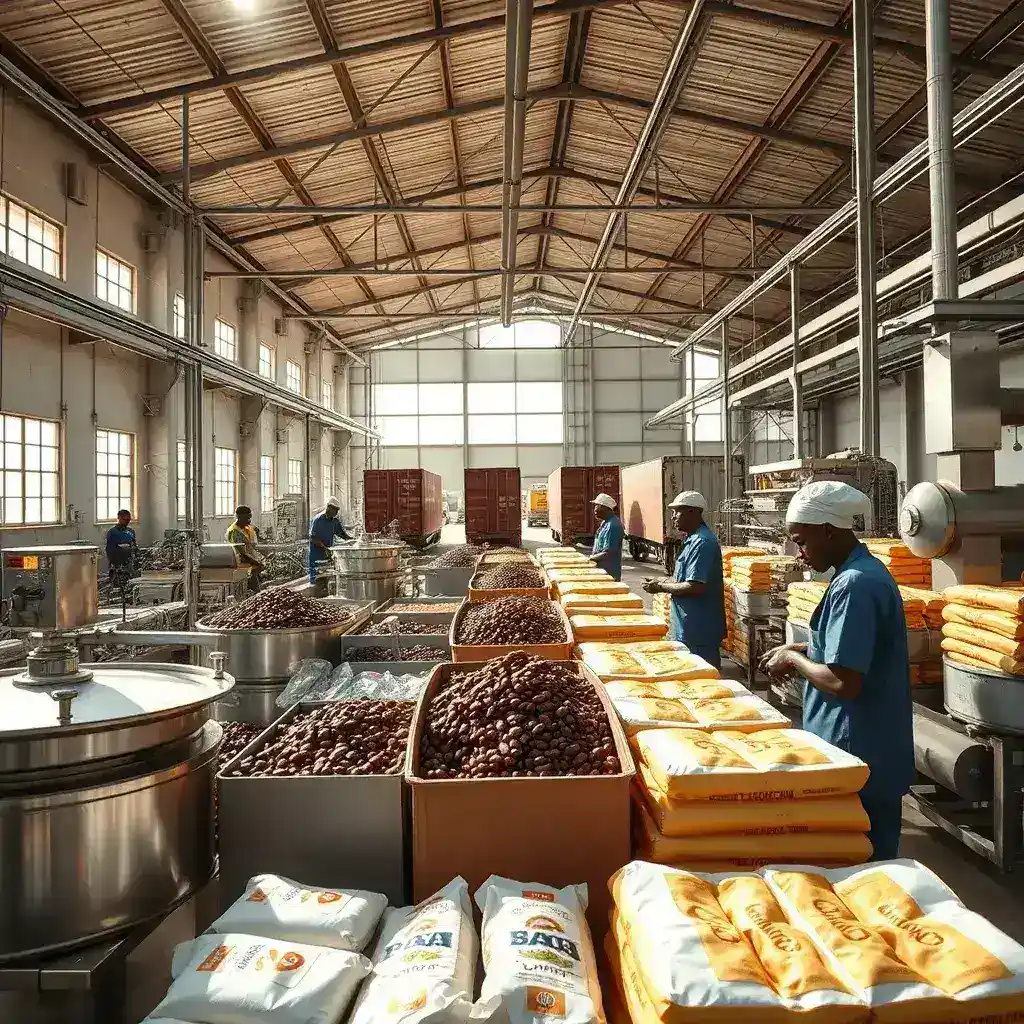
Ghana’s export story is undergoing a significant transformation, moving beyond its traditional reliance on raw cocoa beans. Recent data from the 2025 Non-Traditional Exports (NTE) Statistics Report reveals a structural shift towards value addition and industrial processing, with total NTE reaching US$5.01 billion in 2025, a 30.7% increase year-on-year. This growth is primarily driven by processed cocoa products and a surge in manufactured goods, indicating a deepening of economic value retained within the country.
Cocoa’s Evolving Role
While cocoa remains a cornerstone of Ghana’s export earnings, its form has fundamentally changed. In 2025, it was processed cocoa products, rather than raw beans, that fueled export growth. Cocoa paste alone generated nearly US$790 million, with cocoa butter and powder experiencing growth rates exceeding 100% compared to the previous year.
This shift to processed cocoa derivatives represents a significant economic advancement. Processing embeds industrial activity locally, creating demand for skilled labor, energy, packaging, logistics, and financial services. Each added stage of processing enhances value creation, boosts export margins, and strengthens economic interlinkages.
Manufacturing Takes the Lead
The composition of Ghana’s non-traditional exports clearly illustrates this structural change. Manufactured and semi-processed goods constituted approximately 83% of total NTE earnings in 2025, significantly outperforming agriculture and handicrafts. This indicates a robust industrialization drive.
Beyond cocoa derivatives, other products showing strong export performance include aluminium plates, sheets, and coils; articles of plastics; canned tuna; and shea-based products. These successes are attributed to sustained policy focus on industrialization, import substitution, and downstream value addition, notably through initiatives like the Accelerated Export Development Programme (AEDP) and the 24-Hour Economy agenda.
This manufacturing-led export growth also reshapes infrastructure and financing requirements. Processing-oriented businesses depend on reliable energy, efficient logistics, and accessible trade finance. Consequently, financial institutions, development banks, and state-linked enterprises are now pivotal in supporting Ghana’s export transformation.
Institutional Alignment for Value Addition
Ghana’s evolving export profile underscores the critical role of industrial and resource-based institutions in driving economic growth. Facilities for beverage processing, aluminum smelting, energy provision, and port operations are no longer supplementary but are essential enablers of value-added exports.
For the cocoa sector, increased local processing necessitates enhanced coordination among export promotion agencies, COCOBOD, energy planners, and financiers. A similar integrated approach is vital for the aluminum, plastics, and fisheries sectors, requiring alignment across mining, manufacturing, transport, and power supply chains.
Ultimately, contemporary export success hinges on the effective collaboration of key institutions, moving beyond isolated sectoral efforts.
Building a More Resilient Export Sector
The transition from raw material exports to processed goods cultivates a more resilient export sector for Ghana. Value-added products are generally less susceptible to commodity price volatility and can penetrate a broader spectrum of global markets. Evidence of this is Ghana’s expanding export reach across Europe, North America, and African markets, facilitated by the African Continental Free Trade Area (AfCFTA).
By retaining greater value domestically, Ghana strengthens its position in global value chains and reduces its vulnerability to external economic shocks, which frequently impact commodity-dependent economies.
The Path Forward
The 2025 export figures signal Ghana’s deliberate progression from a resource-exporting economy towards a value-creating, industrially anchored export model. To sustain this trajectory, efforts must focus on scaling up processing capacity, improving access to long-term financing, upholding quality standards, and integrating small and medium-sized enterprises into industrial value chains.
While cocoa will remain central to Ghana’s economy, its function is evolving. The future of export growth lies not in shipping raw beans, but in sophisticated processing, branding, and capturing value domestically. This transformation, rather than just the US$5 billion headline figure, represents the true essence of Ghana’s emerging export success.










Leave a Reply