
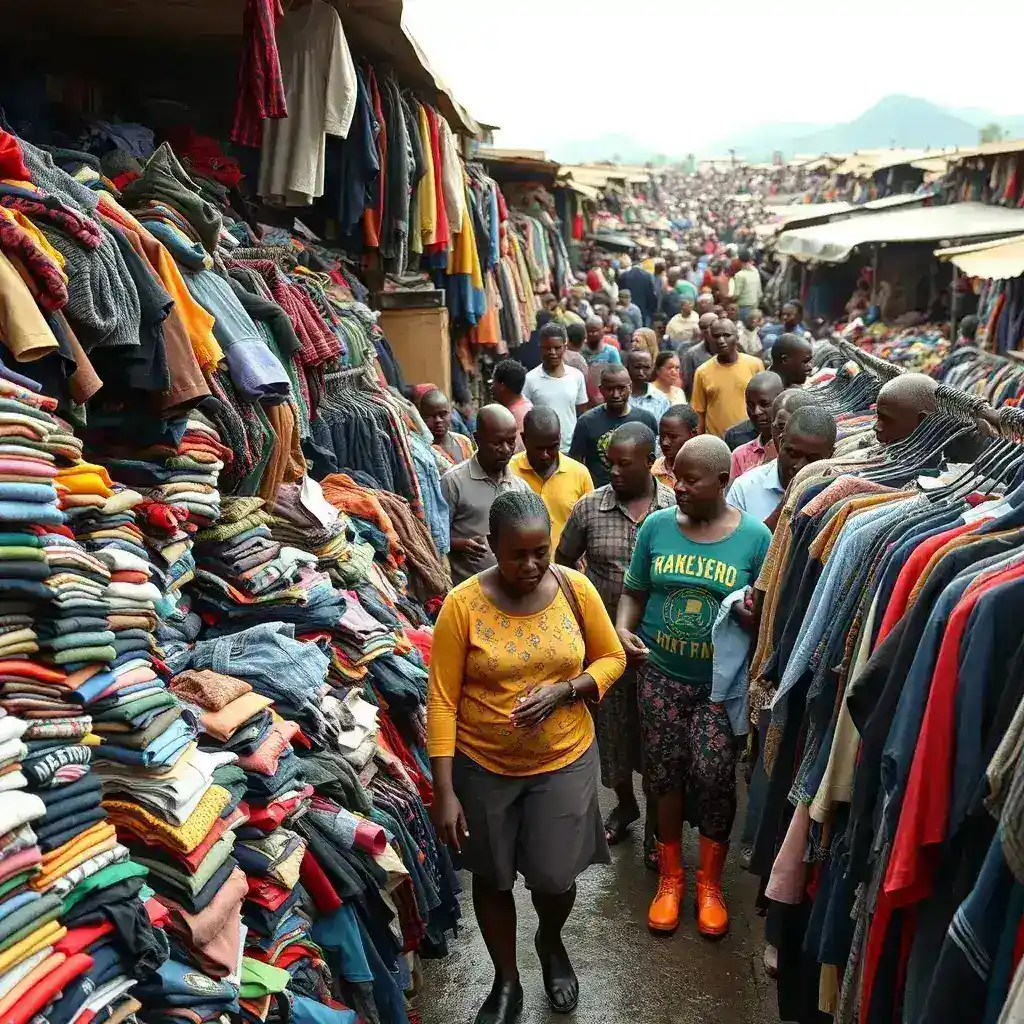
East African nations, including Kenya and Uganda, are intensifying efforts to curb the import of second-hand clothing, known locally as ‘mitumba,’ in a bid to foster domestic fashion industries and address environmental concerns. This renewed focus follows a decade-old attempt by the East African Community (EAC) to ban these imports, which was previously thwarted by international trade pressure.
The Ubiquitous Mitumba Trade
Markets like Gikomba in Kenya, one of East Africa’s largest open-air trading hubs, remain bustling despite challenging weather, underscoring the immense popularity of second-hand clothing. Shoppers, even in waterlogged conditions, navigate crowded pathways in search of affordable garments.
Local fashion entrepreneurs find it difficult to compete with the low prices of used clothing. “We’re competing with second-hand clothing, but we can’t compete on price,” states Zia Bett, founder of Kenyan womenswear brand Zia Africa. Elizabeth Paul, owner of Kuya Creations in Dar es Salaam, Tanzania, echoes this sentiment, noting that customers often opt for multiple second-hand items over a single new garment due to cost.
Renewed Policy Push and Tax Measures
Uganda has recently implemented a 30% tax on used clothing imports, aiming to stimulate its local garment industry and mitigate environmental impact. This move is in addition to existing import duties and VAT.
Kenya’s treasury attempted to revise its taxation system for used clothing, proposing a simplified approach for importers. However, this proposal faced significant public backlash, with concerns about potential price increases, leading to its swift withdrawal from the Finance Bill. Kenya already imposes a 30% customs duty on used clothing, which is higher than the duty on new clothing.
Economic and Employment Dimensions
Kenya is the leading importer of used clothing in Africa, receiving approximately 180,000 tonnes in 2022, a substantial increase from 2013, according to the Observatory of Economic Complexity (OEC) and UN trade data.
In Uganda, second-hand clothes are the most popular category, followed by imported new clothing and then locally manufactured items, as per a 2024 report by the Economic Policy Research Centre.
The new 30% environmental levy in Uganda is intended to address environmental degradation and promote domestic production, as reported by the Kampala Report. However, this has met resistance from mitumba traders like Aaron Sekky, who argues for a free economy and highlights the vast number of people employed in the second-hand trade.
Research commissioned by the Mitumba Consortium Association of Kenya (MCAK) suggests that up to 4.9 million people across East Africa depend on the used clothing trade for their livelihoods, encompassing importers, wholesalers, repairers, and market vendors.
Criticisms and Alternative Perspectives
Critics, such as Dr. Andrew Brooks, an academic at King’s College London, argue that the employment generated by the retail of imported goods is less impactful than that from production and manufacturing. He suggests that simply importing and selling contributes minimally to a nation’s economy.
Lisa Kibutu, a Kenya Fashion Council board member, describes many mitumba jobs as precarious, offering limited opportunities for growth. However, she also acknowledges the vital role used clothing plays in providing affordable and decent attire, particularly for lower-income populations.
Affordability remains a key driver, but the appeal of mitumba extends beyond the economically disadvantaged. Consumers like Najma Issa and Juma Awadh in Dar es Salaam praise the quality, durability, and uniqueness of second-hand garments.
Historical Context and International Pressures
In 2015, the EAC members planned to impose high tariffs and eventually ban mitumba imports. This initiative faltered when the United States, a major exporter, threatened to withdraw EAC countries from the African Growth and Opportunity Act (Agoa), a trade agreement offering duty-free access to US markets.
Rwanda was the sole EAC member to maintain its stance, leading to a 30% US tariff on Rwandan clothing imports. Rwanda reports that increased taxes on used clothing have led to a decrease in their import share and a rise in garment exports, indicating potential growth in its local industry.
Environmental Concerns and Future Outlook
Environmentalists highlight that a significant portion of used clothing exported to developing nations is of such low quality that it ends up in landfills. The Changing Markets Foundation estimated in 2023 that over a third of used clothing sent to Kenya falls into this category.
Greenpeace points to the lack of infrastructure for managing textile waste, with official dump sites already overflowing. Conversely, Teresia Wairimu Njenga of MCAK argues that mitumba sellers are environmental stewards, questioning the capacity of Kenya to manufacture equivalent volumes of new clothing.
The global classification of used garments as waste under the Basel Convention could lead to higher international taxes on these imports. Meanwhile, some East African designers, like Joel Okalany of Ekikumba Fusion, believe the region is not yet prepared for the complete cessation of mitumba imports, citing a lack of readiness in domestic manufacturing capabilities.
Rwanda’s 2022 report acknowledged domestic production gaps, leading them to hold back on a total ban. Furthermore, the influx of cheap new garments, particularly from China and Turkey, poses a significant challenge to both local industries and the mitumba trade.
Kenyan designer Zia Bett emphasizes the need to focus on brand building, storytelling, and quality to attract consumers beyond just affordability. The debate continues on whether second-hand and locally manufactured clothing can coexist, with some advocating for consumer choice.
Looking Ahead
The future of the used clothing trade in East Africa hinges on a complex interplay of economic development, consumer demand, environmental sustainability, and international trade relations. As countries like Uganda and Kenya navigate these challenges with new tax policies and domestic industry support, the effectiveness of these measures against established trade patterns and the persistent appeal of affordable fashion will be closely watched. The potential reclassification of used clothing as waste under international treaties could also introduce new global dynamics. Ultimately, the region’s ability to foster a robust, self-sufficient fashion industry while managing the socio-economic impacts of the mitumba trade remains a critical question for the coming years.










Leave a Reply