
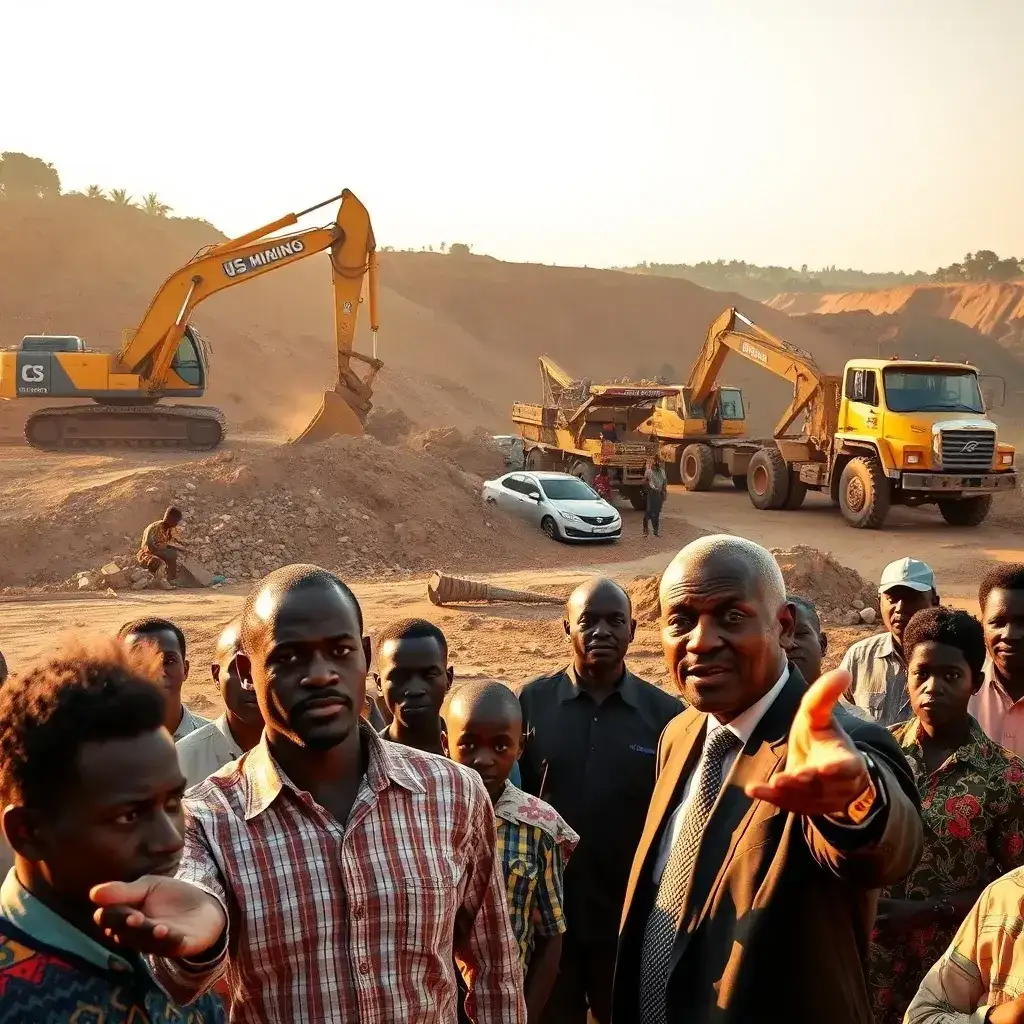
Accra, Ghana – Ken Ashigbey, Chief Executive Officer of the Ghana Chamber of Mines, has highlighted a significant imbalance in the nation’s mining revenue structure, revealing that multinational mining companies, despite contributing a smaller share of overall gold production, are paying a disproportionately higher percentage in royalties. This disparity, observed in 2025 data, suggests a need for urgent reform in how Ghana leverages its mineral wealth.
Understanding the Discrepancy
Ashigbey’s analysis, presented on the JoyBusiness RoundTable, indicates a complex relationship between foreign ownership, production volume, and royalty contributions from various mining entities operating in Ghana. The data contrasts the output and royalty payments of companies based on their majority ownership, shedding light on potential inequities within the sector.
Companies with majority ownership from the United States, for instance, accounted for 12% of Ghana’s total gold production in 2025. However, these same firms contributed a substantial 23% of the total royalties collected. This suggests that for every unit of gold produced, US-majority owned companies paid nearly double the royalty compared to their proportional output.
Similarly, Chinese-owned firms were responsible for 10% of the country’s gold output, yet they also contributed 23% in royalties. This mirrors the situation with US-based companies, indicating a pattern where certain foreign-owned entities bear a heavier royalty burden relative to their production volume.
South African companies presented an even more striking case. They accounted for 18% of Ghana’s gold production but paid a considerable 37% of the total royalties. This means that for a larger share of output than US or Chinese firms, South African companies paid a significantly higher proportion of the collected royalties.
Canadian and Australian companies, while representing smaller portions of the production pie at 2% and 3% respectively, each contributed 5% in royalties. While the absolute numbers are lower, the ratio of royalty contribution to output is still notably higher than their production share.
The Role of Local and Small-Scale Mining
In contrast, the data reveals a different dynamic for Ghanaian-owned large-scale mining companies and the broader local sector. Ghanaian-owned large-scale miners contributed only 4% to total production, with the wider local sector contributing 7%. These figures suggest a limited participation of domestic entities in the large-scale mining arena.
A particularly concerning revelation is the contribution of the small-scale mining sector. This sector, responsible for a significant 52% of Ghana’s total gold production, paid virtually nothing in royalties. This stark difference raises questions about the effectiveness of royalty collection mechanisms and enforcement within this segment of the industry.
Implications for Revenue and Development
Mr. Ashigbey argues that these figures underscore an imbalance in Ghana’s mining economy. The current system, he contends, is not optimizing value for the state or ensuring adequate benefits reach host communities. The concentration of royalty payments among a few multinational groups, while a large portion of production contributes minimally, points to systemic issues.
Beyond royalty payments, Ashigbey also addressed the distribution of collected mineral revenues. He noted that a vast majority of royalties, 78%, are directed into the Consolidated Fund. Only 2% goes to the Minerals Income Investment Fund (MIIF), with the remaining 20% shared among various state institutions and beneficiaries.
Crucially, only 8% of mineral royalties are disbursed directly into mining areas. This centralization of funds in Accra, the capital, leaves mining communities with limited direct resources for local development projects, despite bearing the environmental and social impacts of mining operations.
Despite public perceptions, Ashigbey emphasized that multinational mining firms remain vital contributors to government revenue through various taxes and royalties. However, the current structure warrants a re-evaluation to ensure these contributions translate into equitable development and maximum benefit for the nation.
A Call for National Dialogue
The findings necessitate a broad national conversation on how Ghana can enhance its benefits from its rich mineral resources. This includes exploring reforms to the royalty structure, improving revenue collection and distribution mechanisms, and ensuring that mining activities contribute to sustainable development in affected communities.
The Ghana Chamber of Mines is advocating for a more equitable distribution of mining revenues, particularly directing a larger share to the communities directly impacted by extraction. This could involve policy changes that allocate a greater percentage of royalties to local development funds or specific community projects, fostering a more inclusive and beneficial mining sector for all stakeholders.
What to Watch Next
The coming months will likely see increased pressure on the government to address these concerns. Stakeholders will be watching for potential policy proposals aimed at revising the mining fiscal regime, including adjustments to royalty rates, improved enforcement in the small-scale sector, and a re-evaluation of the revenue distribution formula. The success of these reforms could significantly impact Ghana’s ability to translate its mineral wealth into tangible development and economic prosperity for its citizens.





Leave a Reply