
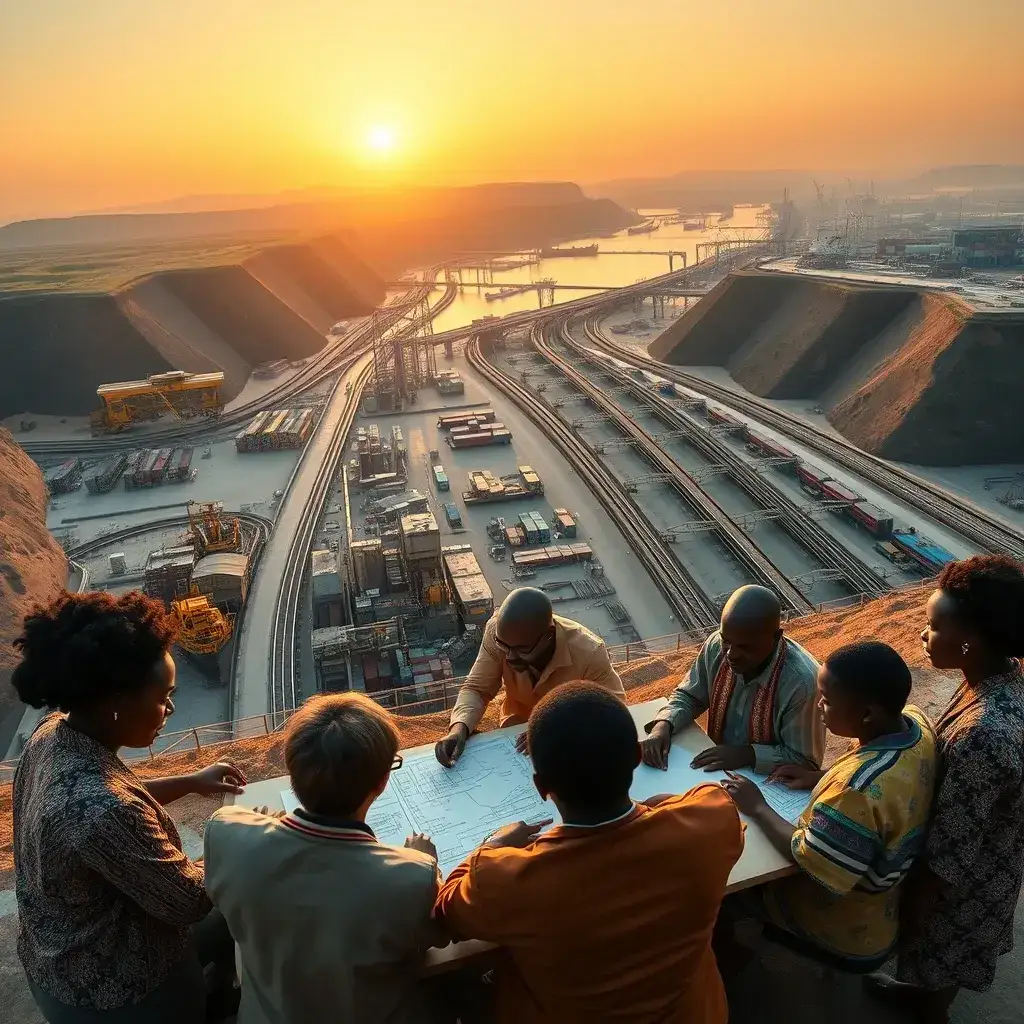
As the global demand for critical minerals like lithium, copper, and manganese surges for the clean energy transition, a significant financial disconnect is hindering Africa’s ability to capture value beyond raw material extraction. Despite supplying substantial mineral resources, African nations are struggling to secure the necessary financing for industrial processing, manufacturing, and the essential infrastructure required to move up the value chain, raising concerns about whether the transition will be truly just for the continent.
Africa’s role in the global energy transition is currently defined by its rich mineral deposits, which are crucial for technologies powering decarbonization. Countries across the continent are major suppliers of key minerals. However, the global financial architecture has proven hesitant to fund the downstream processing and manufacturing capabilities that would allow these nations to benefit more significantly from their resources.
This imbalance is starkly illustrated by Africa’s share of global energy investment, which remains disproportionately low compared to its population. The cost of capital for energy projects in African countries is significantly higher than in developed economies, a challenge that extends to critical mineral value addition. Developing industrial capacity requires not just mines and processing plants, but also reliable electricity, robust transport networks, access to water, industrial inputs, skilled labor, and long-term finance capable of absorbing initial risks.
Ghana serves as a prime example of both the potential and the financing hurdles. The nation’s long-standing goal to establish an integrated bauxite-to-aluminium industry faces substantial obstacles. While Ghana possesses high-quality bauxite and an existing aluminium smelter, realizing a fully integrated industry demands significant investment in competitively priced power, extensive rail infrastructure, port access, and substantial upfront capital expenditure. The missing element is not ambition, but bankable industrial finance on appropriate terms.
The experience with Ghana’s aluminum ambitions underscores that value addition is an integrated industrial undertaking, not an afterthought. If energy is too costly, logistics are inadequate, or financing is short-term, industrial ventures become uncompetitive before they even begin. Analysis by the Natural Resource Governance Institute (NRGI) highlights that Ghana’s hydropower capacity could be fully consumed by its aluminum value chain ambitions unless new, competitively priced electricity sources are developed, a structural issue unlikely to be solved by private investors alone.
Similarly, Ghana’s lithium sector faces a financing dilemma. While there is strong public support for domestic lithium refining to avoid repeating the pattern of exporting raw materials, recent analysis indicates that a refinery built in the near future would encounter challenges. These include limited feedstock, higher operational costs compared to major competitors, particularly in China, and uncertain demand conditions outside of China. Under certain scenarios, domestic refining could yield significantly less revenue than exporting concentrate and create a limited number of direct jobs.
This finding is not an argument against value addition itself, but a caution against pursuing it prematurely without adequate financing and market conditions. Ghana’s lithium case serves as a warning that an improperly structured financing approach can transform a popular industrial concept into a fiscal burden. NRGI’s modeling suggests that refineries paying market prices for feedstock might incur losses, while below-market prices effectively mean government subsidies through reduced mining revenues. Direct state intervention through grants or loans would shift risk to the public balance sheet.
Effective financial governance is paramount, alongside the volume of finance. Ghana’s Ewoyaa lithium agreement includes provisions for a stronger public stake, such as royalties and taxes. However, the potential for companies to seek concessions during global price downturns, as seen in recent discussions, highlights the need for transparent, targeted, and conditional support to investors. Governments must retain the flexibility to adjust terms, but any support should be clearly defined and conditional.
The challenges faced by Ghana are mirrored across the continent. The International Energy Agency (IEA) notes that while mining operations in parts of Africa can be cost-competitive, refining costs are often higher due to more expensive or less reliable energy, logistics, and industrial inputs. The IEA’s analysis on copper refining indicates that upfront project costs in Africa can be more than four times higher than elsewhere, with energy costs representing a substantial portion of production expenses. Africa requires investment that fundamentally alters the economics of industrial production.
Consequently, climate finance, development finance, and private capital must be reoriented. The current financial system prioritizes mines over the industrial ecosystems necessary for mineral upgrading. However, the logic of a just transition dictates that the infrastructure supporting African mineral processing—such as power generation, transmission, gas pipelines, rail, ports, water systems, industrial parks, and skills development—should be considered integral to the transition, not peripheral commercial extras.
Development banks and climate funds should establish specialized financing mechanisms for mineral value addition and enabling infrastructure. These should feature longer loan tenors, concessional funding, guarantees, foreign exchange risk mitigation, and robust project preparation support. The strategy should also extend beyond isolated national projects, encouraging integrated regional industrial corridors where economies of scale can reduce unit costs and enhance project bankability.
The Africa Group of Negotiators (AGN) has a critical opportunity to advocate for key principles in global forums. They should emphasize that Africa’s critical minerals agenda is a matter of a just transition, not solely supply security for importing nations. Climate and development finance must support the industrial foundations of value addition, not just extraction. Public de-risking measures should be accompanied by robust public safeguards to ensure African states benefit from resource wealth, not just bear the risks. Concessional and blended finance should foster commercially viable initial ventures, while allowing governments flexibility to adjust strategies when projects prove uneconomical.
Africa requires a commodity transition that builds productive capabilities, not just another boom leaving behind limited infrastructure and missed opportunities. Ghana’s experiences illustrate the difficulties: missing infrastructure, high capital costs, and unbalanced risk distribution can stall value addition or lead to fiscal damage. Conversely, patient finance, integrated infrastructure planning, and built-in public safeguards can make the promise of a just transition more tangible. For Africa, climate finance must extend beyond the mine gate to encompass and finance its industrial future.









Leave a Reply