
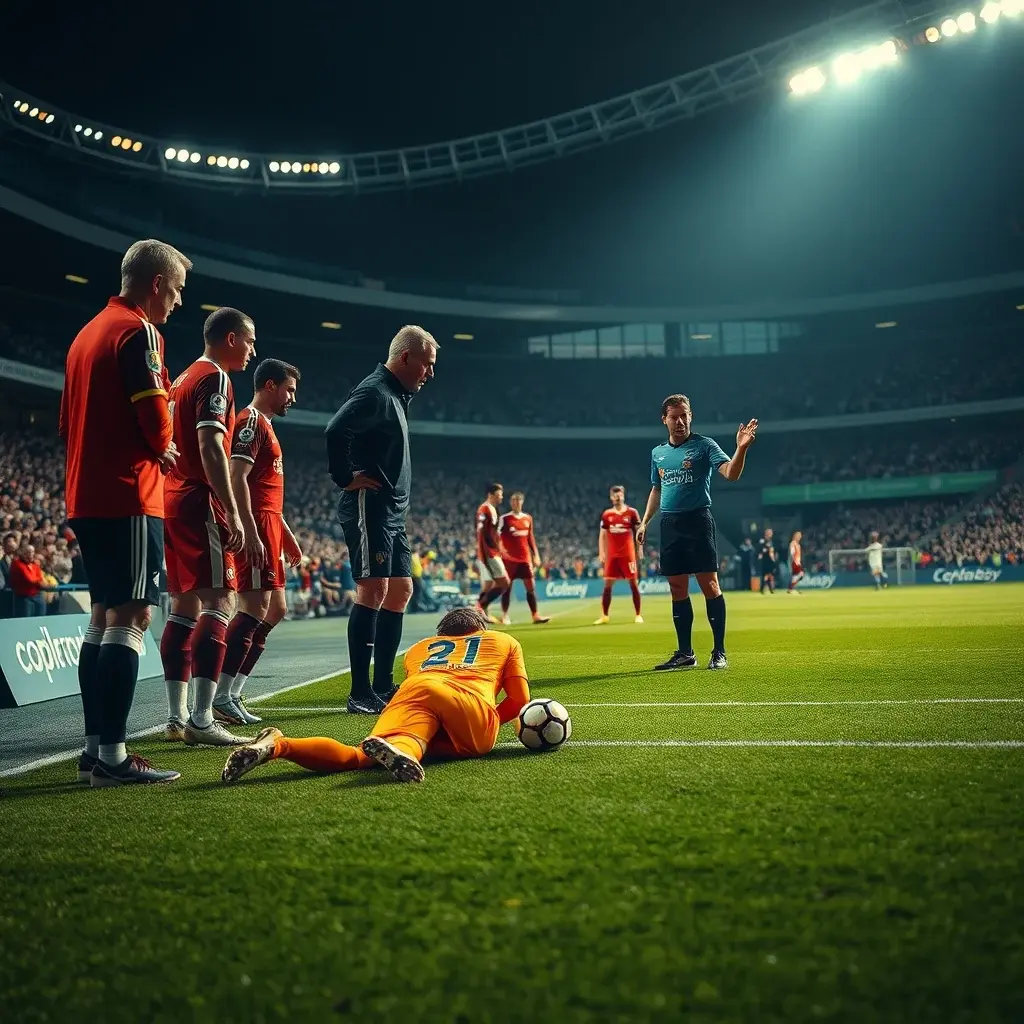
FIFA referees’ chief Pierluigi Collina announced that players will be prohibited from leaving the field to consult with coaches during goalkeeper injuries at the 2026 World Cup. This change, alongside an updated VAR protocol allowing reviews of attacking fouls before the ball is in play, aims to eliminate tactical delays and ensure fairer play.
End of the ‘Goalkeeper Tactical Timeout’
The practice of goalkeepers feigning injury to allow teammates to receive tactical instructions from the bench has become increasingly prevalent. This tactic, often referred to as a ‘goalkeeper tactical timeout,’ has drawn criticism for its potential to disrupt game flow and unfairly influence momentum.
Daniel Farke, Leeds United manager, notably accused Manchester City’s goalkeeper of employing this tactic to ‘bend the rules’ and break up play. The method typically involves a goalkeeper signaling for a physio, prompting other players to gather near the technical area for a team talk, only for the goalkeeper to recover quickly and resume play.
While the International Football Association Board (IFAB) has been examining the issue, no formal law change has been agreed upon. Instead, leagues have been invited to conduct trials throughout the 2026-27 season to find definitive solutions.
The National Women’s Soccer League (NWSL) in the United States has already implemented a temporary measure. In the NWSL, if a goalkeeper is injured, all players must remain in their positions or gather at the center circle, preventing sideline consultations.
Collina confirmed that FIFA will adopt a similar approach, preventing players from approaching the touchline. However, he acknowledged this measure does not fully address the tactic of disrupting opposition momentum.
“We had a workshop with all the coaches of all the 48 teams, and we told them that referees will be proactive,” Collina stated. “They will not allow the two teams to go to the benches when a goalkeeper is lying on the ground injured.”
He emphasized that while goalkeepers have a right to be injured, players do not have the right to leave the field for extended team talks. Collina described the current situation, where all players except the referee, physio, and injured goalkeeper leave the pitch, as “not good.”
VAR Protocol Update for Attacking Fouls
In a significant shift, the VAR protocol will be updated to allow reviews of attacking fouls that occur before the ball is in play. This change was prompted by incidents where goals were scored following fouls that were not reviewable under previous regulations.
Collina cited the example of England’s goal against Uruguay in March, where Adam Wharton appeared to foul Jose Maria Gimenez before Cole Palmer took a corner. Under the old rules, this foul, occurring before the ball was put into play, could not be reviewed by VAR, leading to controversy.
The IFAB has now accepted Collina’s request, permitting VAR intervention for any foul before the ball is in play that directly impacts a goal, penalty kick, or disciplinary sanction resulting from a corner or free-kick.
“We think this is very unfair, that the goal is given when the defender is prevented from being able to defend,” Collina explained. “A clear, illegal block made by an attacker. The only objective was to prevent the defender from being able to defend on his opponent.”
This new protocol will be implemented for the World Cup and reassessed afterward. It is important to note that this rule change applies only to attacking fouls, not defensive infringements like holding or pulling.
Other Rule Adjustments for the World Cup
Beyond the goalkeeper timeout and VAR changes, several other rule adjustments are set to be implemented at the World Cup, primarily focused on speeding up the game and reducing time-wasting tactics.
These include a five-second countdown for throw-ins and goal-kicks, with deliberate delays potentially resulting in the opposing team being awarded possession. Substitutions will be time-limited to 10 seconds, requiring players to leave the field promptly to avoid their team playing with 10 men.
Players receiving off-field treatment will need to remain sidelined for 60 seconds, with exceptions for goalkeepers and certain game situations. Furthermore, players covering their mouths during confrontational interactions with opponents will now face a red card, a response to a controversial incident in a Champions League match.
Collina also highlighted that referees will be more vigilant regarding grappling in the penalty area, with officials equipped with data on teams’ tactical approaches. While hydration breaks will ensure three minutes of stoppage time in each half, these new measures aim to make overall stoppage time more reflective of actual game time, potentially avoiding the lengthy delays seen in the 2022 World Cup.
Implications and Future Watch
These rule changes signal a strong intent by FIFA and IFAB to curb unsporting tactics and enhance the flow and integrity of the game. The ban on goalkeeper tactical timeouts and the expanded VAR review for attacking fouls are expected to lead to more fluid matches and fairer outcomes.
The introduction of stricter time limits for restarts and substitutions, along with off-field treatment protocols, suggests a move towards a more continuous and dynamic style of play. The red card offense for covering the mouth during confrontations addresses concerns about player conduct and potential unsavory communication.
Football fans and participants will be watching closely to see how effectively these changes are implemented and enforced at the highest level during the 2026 World Cup. The success of these measures could set a precedent for future rule adjustments across global football, potentially reshaping the tactical landscape of the sport.








Leave a Reply