
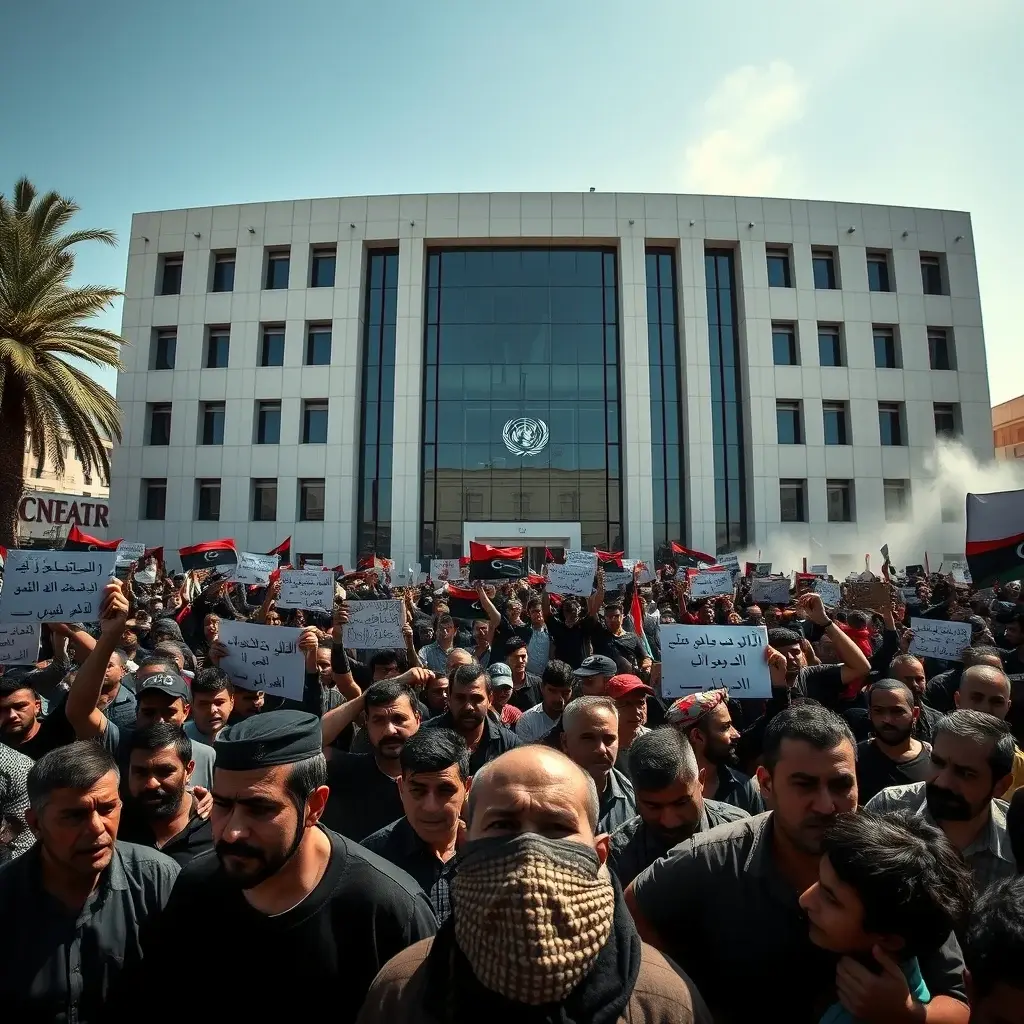
The United Nations expressed deep concern Friday over violent protests targeting its offices in Tripoli, Libya, this week, attributing the unrest to social media-driven disinformation campaigns that misrepresent the organization’s work in the country. Hundreds of demonstrators gathered Thursday outside the U.N. refugee agency (UNHCR) offices, protesting against migrants who use Libya as a transit point for work or passage to Europe.
Context of Growing Tensions
The protests represent the largest in a series of recent demonstrations against migrants. Some Libyans hold migrants responsible for exacerbating social and economic problems, issues that have become more pronounced amidst 15 years of conflict and political fragmentation in the North African nation. These tensions highlight the complex socio-economic pressures facing Libya since the 2011 uprising.
UN Condemns Violence and Misinformation
U.N. spokesperson Stephane Dujarric addressed the situation from New York, stating, “We are deeply concerned by the violent protests that took place yesterday outside the UNHCR and UNSMIL headquarters in Tripoli.” He emphasized the U.N.’s stance, adding, “The U.N. strongly condemns any attack or threats against personnel or premises.” Dujarric specifically pointed to the “spread of misinformation and disinformation regarding the work of the United Nations in Libya” as a significant concern.
Addressing the challenge of combating false narratives, Dujarric noted that countering disinformation in Libya is “extremely challenging.” He called for increased cooperation from social media platforms to help mitigate the spread of harmful content.
Clarifying UN’s Role in Libya
The United Nations Support Mission in Libya (UNSMIL) issued a statement on Thursday to clarify its operations. UNSMIL explicitly stated that there is no U.N. resettlement program operating within Libya. Instead, UNHCR’s mandate focuses on assisting individuals fleeing conflict and war.
UNHCR’s efforts involve seeking durable solutions outside of Libya, which can include evacuations to third countries or facilitating voluntary returns when conditions on the ground permit. This clarification aims to correct the record amid the circulating misinformation.
Libya’s Role as a Migrant Transit Hub
Since the NATO-backed uprising in 2011 that led to the overthrow of Muammar Gaddafi, Libya has become a critical, albeit perilous, transit route for hundreds of thousands of migrants. These individuals often flee conflict and poverty in sub-Saharan Africa, undertaking dangerous journeys across the desert or the Mediterranean Sea in pursuit of safety and opportunity.
The nation’s oil-dependent economy also attracts migrants seeking employment. Many find work in sectors like cleaning and construction, taking on roles that are often less desirable to the local Libyan population. This economic dynamic adds another layer to the complex migration situation within the country.
Implications and Future Watch
The U.N.’s statement underscores the growing global challenge of combating online disinformation, particularly in fragile states like Libya where it can incite real-world violence and undermine humanitarian efforts. The incident raises critical questions about the responsibility of social media platforms in moderating content and preventing the amplification of false narratives that endanger international personnel and exacerbate local tensions. As the situation evolves, continued monitoring of disinformation campaigns and the U.N.’s strategies to counter them will be crucial. Furthermore, the effectiveness of calls for platform cooperation and the potential for localized solutions to address migrant-related grievances will be key factors to watch in the coming months.



Leave a Reply