
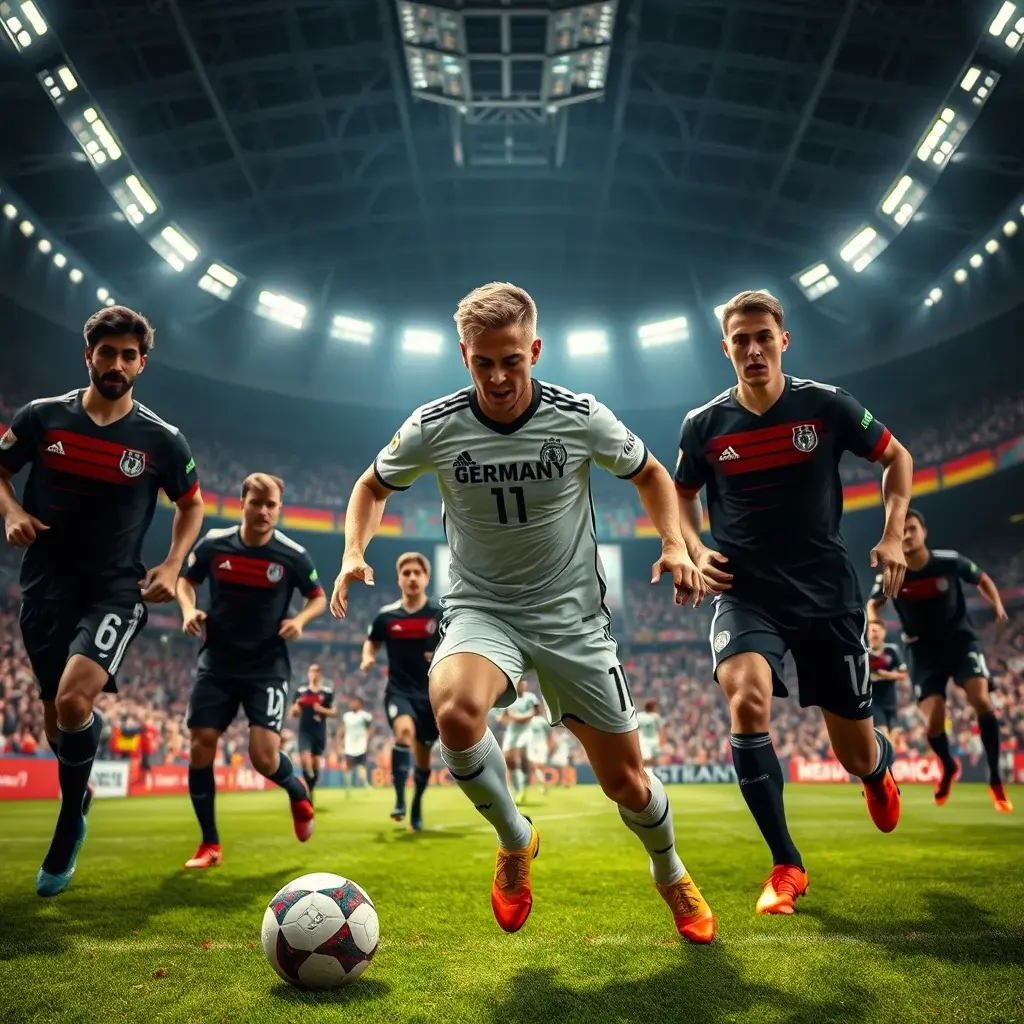
Germany’s national football team, under the often-volatile leadership of Julian Nagelsmann, is gearing up for the 2026 World Cup with a tactical approach that remains fluid, a stark contrast to their past successes. Nagelsmann, known for his passionate touchline demeanor and frequent system changes, has experimented extensively, leading to a mixed bag of results in qualifying, including a concerning 2-0 defeat to Slovakia. However, a dominant 6-0 victory in the return fixture showcased the team’s potential and secured their group convincingly, setting the stage for their campaign in the United States, Mexico, and Canada.
Tactical Fluidity and Bayern’s Influence
Nagelsmann’s likely strategy will center on the successful lineup from the Slovakia match, emphasizing an emotionally charged style of play. “We have to play with emotion,” Nagelsmann has stated, reflecting his reputation as a tactical obsessive.
Historically, Germany has often drawn strength from the successes of Bayern Munich, a formula that yielded World Cup titles in 1974 and 2014. With Bayern enjoying a strong domestic season, Nagelsmann is expected to lean on key players from the club, including Jonathan Tah, Aleksandar Pavlović, Joshua Kimmich, Leon Goretzka, Jamal Musiala, and impact substitute Lennart Karl. Manuel Neuer, the veteran goalkeeper, has also returned to the international fold, aiming for his fifth World Cup appearance.
However, questions linger about the reliability of this Bayern core. Musiala has shown inconsistent form, and Goretzka, despite limited recent starts for Bayern, appears set to feature prominently for the national team. Kimmich’s role is also a point of concern, as he is slated to play at right-back for Germany, a departure from his usual central midfield position for Bayern, introducing an element of risk.
The Challenge of Individual Class
A broader issue facing German football is a perceived lack of individual brilliance. While Kimmich embodies traditional virtues, his defensive shortcomings in tackles and one-on-one situations fall short of legendary predecessors like Lothar Matthäus or Philipp Lahm. This deficiency extends to other areas, with a noted absence of midfield strategists akin to Toni Kroos or Mesut Özil, and questions surrounding the current quality of goalkeepers and defenders, despite Neuer’s return at the age of 40.
Hope on the Horizon: Attacking Prowess
The primary hope for Germany lies in their attacking midfield. Nagelsmann possesses a wealth of talent in the No. 10 role, with Florian Wirtz, Musiala, Kai Havertz, and the emerging Lennart Karl all boasting exceptional skills. Havertz is likely to be deployed as a deep-lying center-forward, leveraging his technical ability, though his efficiency in front of goal remains a key question, particularly after Euro 2024. With Niclas Füllkrug and Nick Woltemade yet to establish themselves as consistent goalscorers, Germany arguably lacks a traditional striker.
Nagelsmann: A Coach Under Scrutiny
Julian Nagelsmann faces growing criticism within German football circles. Uli Hoeneß, honorary president of Bayern Munich, recently questioned Nagelsmann’s understanding of his role, stating, “Our national coach thinks he wins the match. No, the team wins the match.” Nagelsmann’s tenure has been marked by inconsistent results and occasional public disputes, such as his rebuke of Deniz Undav after a match against Ghana. Despite his early promise as a young coach who saved Hoffenheim from relegation and led them to the Champions League, the 38-year-old’s potential has yet to be fully realized on the international stage.
Florian Wirtz: The Star Player’s Burden
Much of Germany’s success will hinge on Florian Wirtz’s performance. Nagelsmann praises Wirtz for his work rate and versatility, noting he is not a passive playmaker but an active contributor. While Wirtz’s season at Liverpool was not disastrous, it fell short of expectations given his talent and transfer fee. His impact for the national team mirrors this inconsistency; he can dominate against weaker opponents but must consistently perform against top-tier nations for Germany to succeed in the World Cup.
Lennart Karl: The Young Sensation
A player to watch is the prodigious 18-year-old Lennart Karl. Despite an early trial at Real Madrid, he chose to stay in Germany. His confidence and flair are evident in his dynamic dribbling, which has made him a feared opponent. Having debuted for the national team in March, Nagelsmann has noted his surprising calmness under pressure, suggesting the hype has not affected him.
Jonathan Tah: The Unsung Defensive Rock
While Nico Schlotterbeck and Antonio Rüdiger often garner more attention, Jonathan Tah is arguably Germany’s most crucial defender. His strength in tackles and composure on the ball are vital. Set to play in his first World Cup at 30, Tah has evolved into a formidable presence, describing himself as “even more unpleasant” to play against due to his constant defensive pressure and tactical awareness.
Probable Starting XI
Germany’s likely starting formation is a 4-2-3-1, featuring Neuer in goal, a defense of Kimmich, Tah, Schlotterbeck, and Raum. The midfield will likely consist of Pavlović and Goretzka, with Sané, Musiala, and Wirtz supporting Havertz up front.
Fan Expectations and Atmosphere
German football chants are often traditional, and Nagelsmann has previously expressed a desire for more vocal fan support. The DFB (German Football Association) even established a working group, AG Stimmung, to enhance the atmosphere at matches. However, the cost and logistics of attending the 2026 World Cup in North America may limit the number of German supporters compared to previous tournaments, though a presence is still anticipated.
This article is part of JoySports’ collaboration with The Guardian, providing comprehensive coverage of the FIFA World Cup 2026.










Leave a Reply