
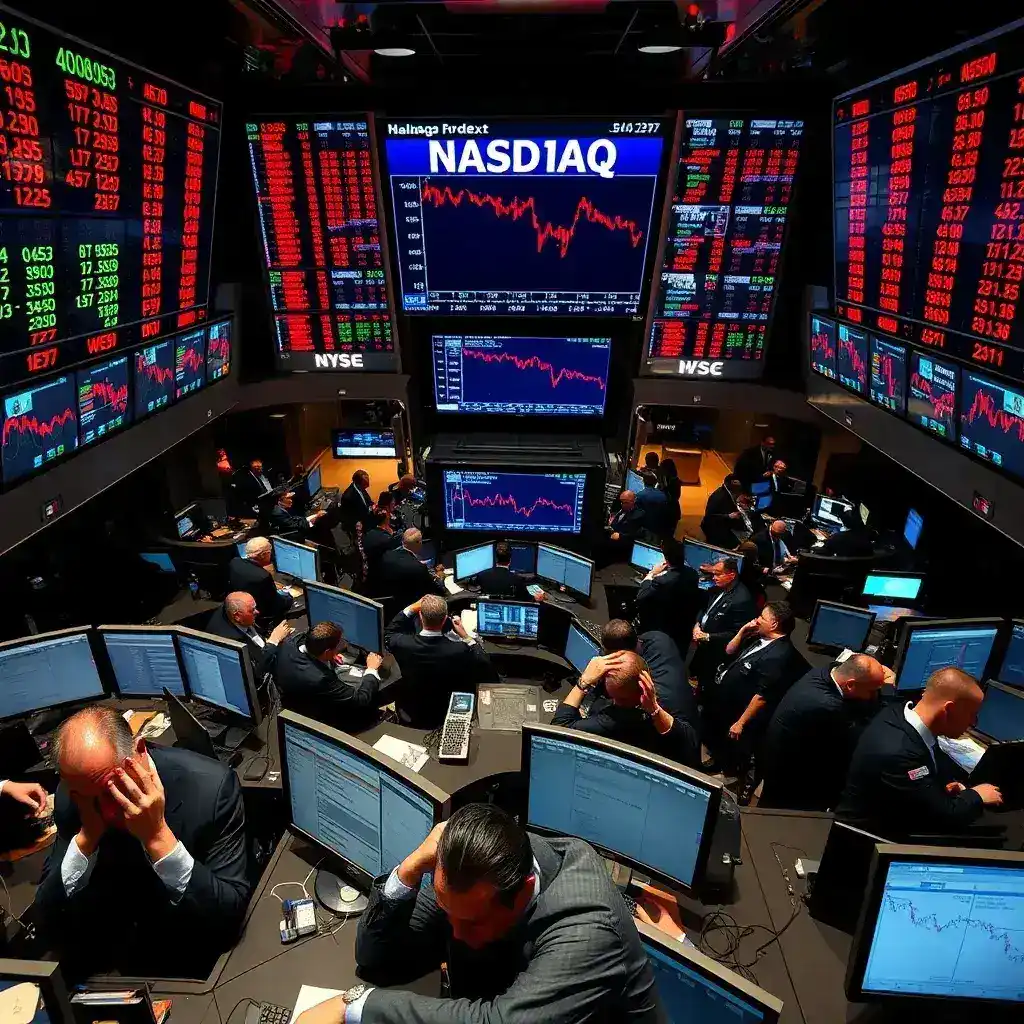
US stock markets experienced a significant downturn on Friday, with the technology-focused Nasdaq index recording its largest single-day decline since April 2025. A surprisingly robust US jobs report for April fueled a broad sell-off, raising investor concerns about the sustainability of year-to-date gains and prompting a shift away from riskier assets.
Jobs Report Sparks Fed Rate Hike Fears
The April jobs report, which indicated stronger-than-expected employment growth, heightened fears among investors that the Federal Reserve may maintain higher interest rates for an extended period. Stubborn inflation figures accompanying the positive jobs data suggest the central bank might be less inclined to cut borrowing costs in the near future.
In response to the news, the Nasdaq index plummeted by over 4%, while the S&P 500 closed 2.6% lower, and the Dow Jones Industrial Average saw a 1.35% drop. This market reaction underscores the sensitivity of investors to monetary policy expectations.
David Doyle, head of economics at Macquarie Group, commented that the jobs report was potentially “too good” given the current inflationary environment. He suggested the figures increase the probability of the Federal Reserve implementing further interest rate hikes this year, directly contributing to the stock market’s decline.
This development forced investors who had anticipated rate cuts to rapidly reassess their strategies and portfolios.
Big Tech Sell-Off and Shift to Safer Havens
While Friday’s sell-off marked a significant market event, it did not signal a global market panic. Instead, the trend indicated a rotation away from technology stocks, which some analysts have warned are overvalued and susceptible to a correction akin to the dot-com bubble of the early 2000s.
Major investment funds reportedly withdrew capital from companies involved in artificial intelligence and microchip manufacturing, sectors that have witnessed substantial share price appreciation in recent years. This outflow suggests a growing caution regarding the future growth prospects of these high-flying tech firms.
In contrast to the tech sector’s decline, investors sought stability by reallocating funds into traditionally safer investment categories. Sectors such as healthcare, utilities, and consumer staples, represented by companies like Kraft Heinz and Keurig Dr Pepper, experienced a boost as traders prioritized capital preservation.
The sharp market drop highlighted the increasing vulnerability of large-cap technology stocks. A concentrated market, where a few major tech companies represent a significant portion of overall market capitalization, means that shifts in investor sentiment can disproportionately impact the broader market indexes.
President Trump’s Reaction and Future Tech Discussions
Reacting to the market’s performance, US President Donald Trump criticized the negative interpretation of the jobs report, stating that “too much emphasis is placed on inflation.” He expressed a desire for the market to recognize positive economic data, such as strong job growth, as a reason for market advancement rather than decline.
Looking ahead, technology and policy are set to be central themes. President Trump has invited leading AI executives to the White House to discuss a novel proposal: the US government potentially acquiring public stakes in their companies. The stated aim of this initiative is to reshape public perception of AI and ensure that ordinary Americans can “benefit from the success of AI.” This development signals a potential new direction in government-industry relations concerning cutting-edge technology.
The market’s reaction to economic data and the ongoing debate surrounding tech valuations and potential government intervention will be key factors to monitor in the coming weeks.










Leave a Reply