
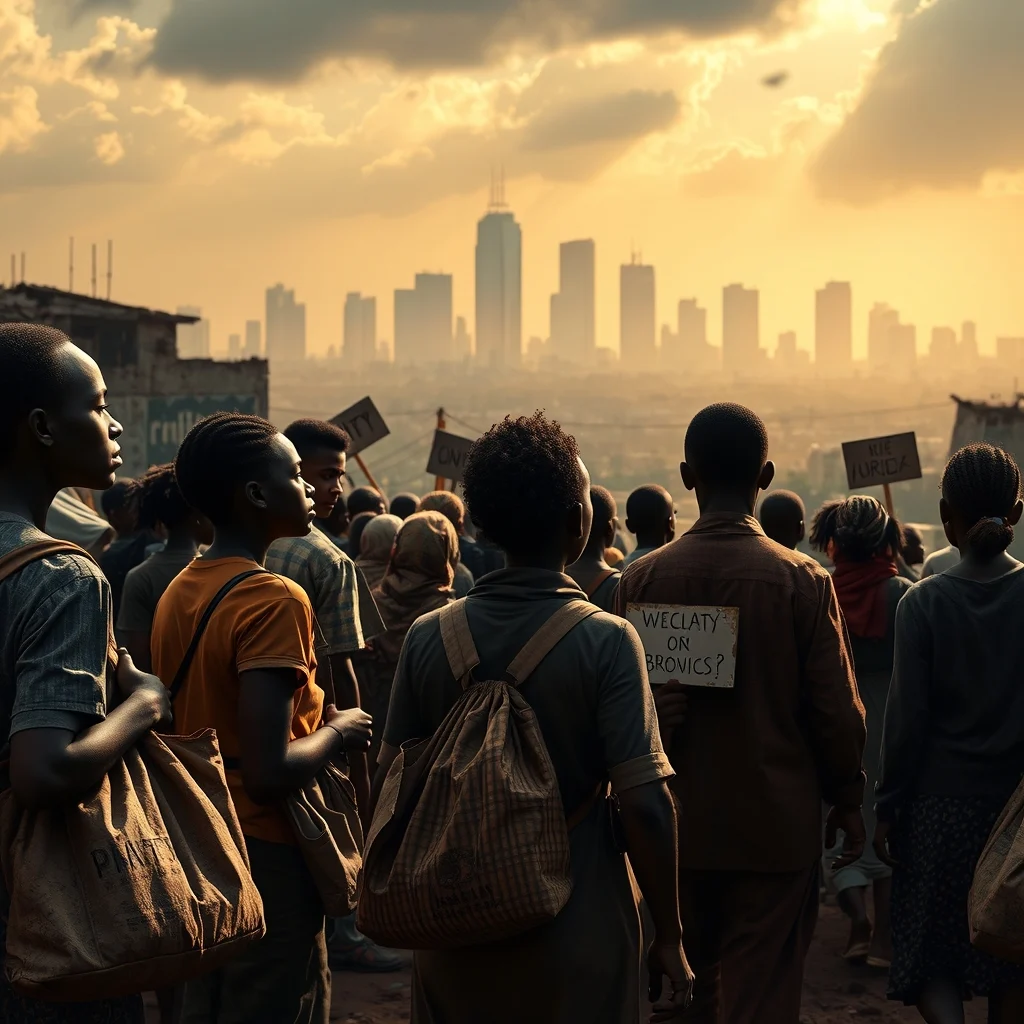
Violent attacks against Africans in South Africa have sparked widespread horror and condemnation across the continent and beyond. This surge of xenophobia, occurring in recent weeks and months, highlights deep-seated issues that demand more than emotional reactions, pushing for a sober analysis of the underlying socio-economic conditions.
Context of African Migration and Social Unrest
The pressures created by irregular migration are a complex challenge for any society. Governments hold a fundamental responsibility to secure their borders and maintain order. However, this responsibility does not grant any entity the right to resort to extra-judicial violence against individuals, regardless of their citizenship status or the legality of their presence.
The atmosphere across Africa has become increasingly charged. Many outside South Africa have reacted with unqualified condemnation to the vigilante terror seen in some townships, leading to broad caricatures of entire populations as inherently violent and xenophobic. This, in turn, has left many South Africans reeling from the denunciations.
Inadequate Responses and Historical Parallels
Institutions like the African Union have been largely perceived as inert in addressing the crisis. The South African government, under President Cyril Ramaphosa, has issued perfunctory appeals but has been criticized for limited concrete action, appearing more capable of intervening in distant conflicts than governing domestic institutions effectively.
Frustration among South Africans, fueled by high unemployment and the de facto collapse of policing, has led some to claim the necessity of vigilante action. However, in their fury, they often fail to address who bears responsibility for fixing the systemic issues within the police system.
This phenomenon is not unique to South Africa. In 1969, Ghana’s Prime Minister Kofi Abrefa Busia expelled thousands of Nigerians amidst domestic pressure during Nigeria’s civil war, an event described by some as a “stupendous blunder.” Later, in 1983 and 1985, Nigeria reciprocated by expelling hundreds of thousands of Ghanaians under traumatic conditions. More recently, Cameroon has seen flashes of xenophobia targeting Nigerians.
Pan-Africanism and the Need for Material Basis
The rhetoric surrounding the South African crisis has been sharp, with some labeling South Africa ungrateful and a betrayal of African unity ideals. However, this perspective overlooks the continent’s historical struggles and its failure to seriously study its own contemporary history. The analysis often settles on the sensational, pathologizing South Africans without historical context.
True Pan-Africanism, as envisioned by leaders like Amílcar Cabral, cannot be built on rhetorical euphoria or romantic notions alone. The early idealistic approach to African unity, like Kwame Nkrumah’s in 1963, proved insufficient. Similarly, the notion of a “rainbow nation” emerging from apartheid, while emotionally appealing, lacked analytical stability and a concrete foundation.
Nkrumah himself revised his approach after his overthrow, recognizing the need for revised methods to achieve his objective of African unity. The romantic idea of a united nation emerging from mass misery, as was the case with post-apartheid South Africa, is analytically unsteady. No nation can truly unite around widespread suffering.
Socio-Economic Roots of Xenophobia
Deprivation and mass migration converge to create explosive social brews. Extreme inequality inherently produces violence. When large migrant populations live alongside economically abandoned and stranded indigenous populations, migrants often become convenient scapegoats.
The failure of the African National Congress (ANC) government, particularly over the last fifteen years, to improve the well-being of the majority has created a combustible mix. South Africa, surrounded by other struggling nations, faces a potent combination of inequality, unemployment, and institutional decay.
Implications and the Path Forward
Africans face a choice: continue to attack each other, or confront the reality that a purely metaphysical Pan-Africanism offers false hope. This latest xenophobic crisis necessitates a new conversation that acknowledges a fundamental truth: the historical task before Africa is to eliminate extreme poverty and improve the material conditions of millions.
Poverty breeds desperation and can lead to brutalization. Genuine unity requires that the overwhelming majority of people have the means to live with dignity. The scenes of violence are not new and not uniquely South African. Unless the structural roots of these crises—in education, media, faith systems, and politics—are confronted, Africa risks facing even greater fires in the future.









Leave a Reply