
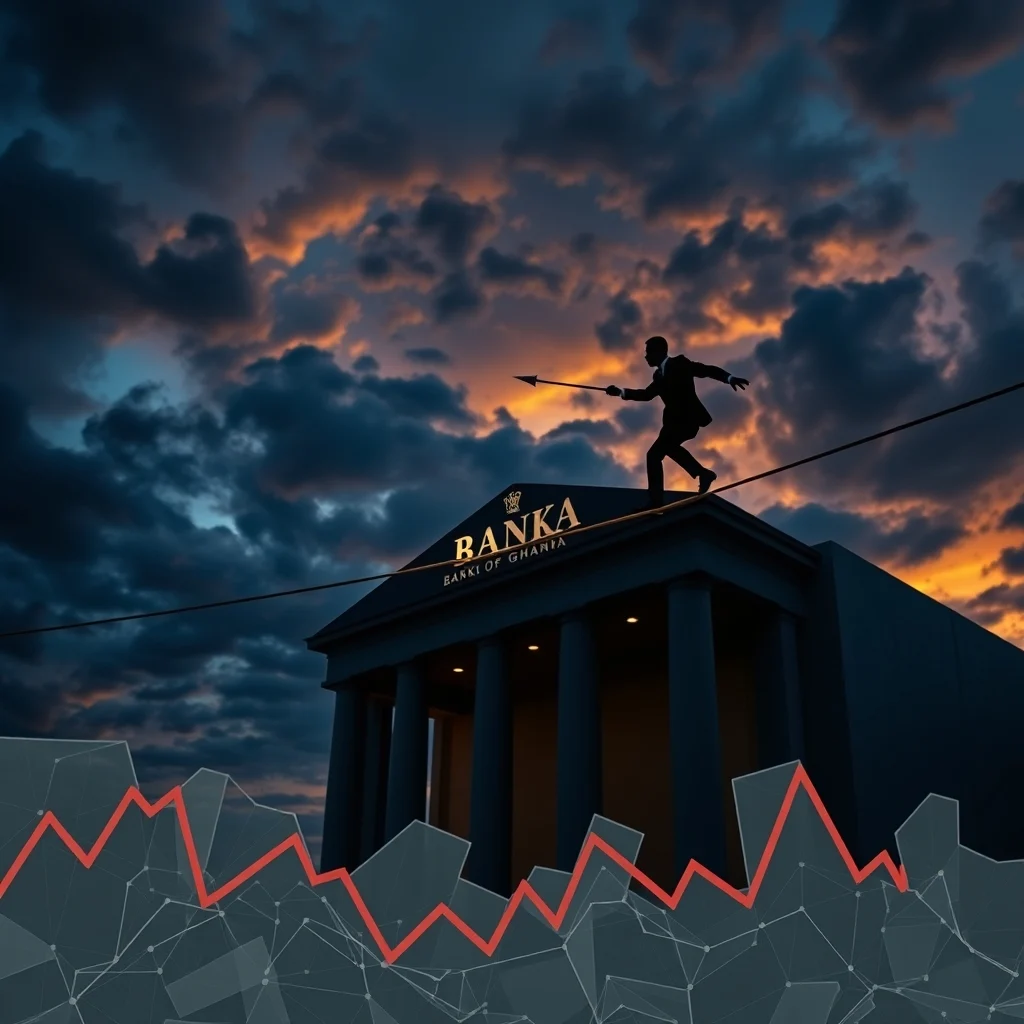
On April 30, 2026, the Bank of Ghana (BoG) released its audited 2025 financial statements, significantly past the statutory March deadline. The delay was attributed to a change in auditors from Deloitte to KPMG, requiring more time to review the accounts, and increased scrutiny on gold operations and exposure to the Ghana Gold Board (GoldBod). The statements, approved just before the extended deadline, revealed a net loss of $1.25 billion for 2025, igniting political debate.
Further analysis showed that additional comprehensive income charges of $1.55 billion, largely due to the cedi’s appreciation reducing the value of foreign assets, pushed total comprehensive losses to $2.80 billion. This widened the cumulative negative equity, often termed a “hole” in the BoG’s capital base, to approximately $9 billion by the end of 2025, a stark increase from $3.99 billion a year prior. This negative equity, representing about 8% of GDP, places the BoG among central banks with the largest such positions globally, a situation sustained over multiple years.
Understanding the Mechanics of Central Bank Losses
The Bank of Ghana’s financial performance is a result of its core operational mandate, primarily involving the management of foreign reserves and domestic liquidity. The process begins with the creation of money to acquire gold, a key strategy to bolster dollar reserves.
Ghana, as Africa’s largest gold producer, sees the Bank of Ghana purchasing significant quantities of gold from miners. This involves creating new cedis to pay for the gold, effectively injecting liquidity into the economy. In 2025, the BoG acquired approximately 2.9 million fine ounces of gold, valued at around $7.6 billion. The funds used for these purchases were largely generated through this money creation process.
The acquired gold is then refined and either held as a reserve asset or sold internationally for dollars. In 2025, sales of refined gold and gold under the “Gold for Reserves” program generated approximately $3.6 billion. This inflow contributed to a record high in Ghana’s foreign reserves, which grew from about $6.5 billion in early 2024 to $13.8 billion by end-2025.
A critical consequence of creating cedis to buy gold is the need to manage the resulting increase in domestic money supply to prevent inflation. The BoG employs a process called “sterilisation,” where it issues short-term bills (Open Market Operation – OMO bills) to commercial banks, essentially borrowing back the created cedis and locking them up with interest.
By the end of 2025, the outstanding OMO bills reached approximately $9 billion, nearly tripling from $2.22 billion a year earlier. The interest paid on these bills, at rates ranging from 21.5% to 27% through most of 2025, amounted to $1.34 billion. This sterilisation cost alone exceeded the Bank’s total operating income from sources like interest on securities, fees, and foreign exchange trading, which was about $1.01 billion.
When combined with operating expenses of $507 million and gold program losses of $724 million, the total operating expenses reached $3.03 billion against total operating income of $1.78 billion, resulting in the $1.25 billion annual loss. This loss further deepens the existing negative equity.
Policy Solvency and Questionable Income Streams
The Bank of Ghana emphasizes “policy solvency,” which assesses whether its operating income covers the costs of its primary objectives, such as inflation control and exchange rate stability, rather than profit generation. For 2025, the BoG reported a policy solvency surplus of $440 million. However, this figure is misleading as it includes a one-off gain of $766 million from the sale of half of the country’s gold reserves.
Stripping out this non-recurring gain, the Bank actually posted a policy solvency deficit of approximately $326 million. This indicates that core recurring income fell short of the costs associated with managing domestic liquidity and maintaining exchange rate stability.
Concerns also arise from the “other operating income” line, which saw a significant jump from $28 million in 2024 to $190 million in 2025. A substantial portion of this increase, around $172 million, was reported as reimbursement from the Ministry of Finance for fees and charges related to Ghana’s International Monetary Fund (IMF) Special Drawing Rights (SDR) allocation. This reimbursement appears disproportionately high compared to the stated interest costs of $35.6 million on SDR allocations, raising questions about accounting practices and potential efforts to artificially inflate income.
Furthermore, “other assets” increased significantly to $2.51 billion, partly due to unsettled dollar proceeds from the Gold for Reserves program. Outstanding receivables from counterparties raise concerns about counterparty risk and the liquidity of reported reserves.
Implications of Negative Equity
While central banks can operate with negative equity, as seen in countries like the Czech Republic, Chile, and Australia, it is not without consequences. The Bank of Ghana’s situation presents several potential risks.
The “sterilisation” process can become a self-perpetuating cycle, where annual losses necessitate more borrowing at high interest rates, leading to further losses. This “passive money creation” occurs when operating losses inject new cedis into the economy without corresponding withdrawal, creating a structural inflationary impulse.
A significant mismatch exists between the high domestic interest rates (15-27%) at which the Bank borrows for sterilisation and the lower international rates (4-5%) earned on its assets, resulting in a negative carry on its portfolio. This structural issue is exacerbated by Ghana’s risk premium keeping domestic rates elevated.
The traditional source of central bank income, seigniorage (profit from issuing currency), is diminishing as Ghana’s economy becomes more digital. Additionally, the Bank’s annual losses represent quasi-fiscal deficits, weakening the consolidated fiscal position of the public sector and potentially masking the true extent of government liabilities.
Recapitalisation Challenges and Future of Gold Programs
A Memorandum of Understanding signed in January 2025 outlines a phased recapitalisation of the BoG by the government between 2026 and 2032. Restoring the Bank’s equity to the new statutory minimum of $96 million from its current negative $9 billion requires approximately $9.1 billion, translating to about $1.5 billion annually. This figure represents a substantial portion of government revenue and competes with critical fiscal demands such as debt reduction, recapitalisation of commercial banks, energy sector debts, and essential infrastructure and social spending.
The government may resort to issuing non-tradeable bonds, which would improve the equity figures on paper but not address the underlying operational profitability issues. This approach would also add to public debt, contradicting IMF program targets.
The Domestic Gold Purchase Programme (DGPP), now rebranded as the Ghana Accelerated National Reserve Accumulation Programme (GANRAP), faces structural risks. These include the “rate gap” between market and official gold prices, high sterilisation costs that erode reserve gains, exposure to GoldBod counterparty risk, and diminishing marginal returns from reserve accumulation. The current pace of reserve accumulation incurs significant costs for modest strategic benefits.
Alternative approaches to reserve accumulation, such as mandating gold royalty payments in-kind, channeling purchases through a fiscal agent, slowing the accumulation pace, or restructuring the gold channel with private sector involvement, could offer lower financial costs. However, these alternatives face formidable political economy barriers due to vested interests in the current system.
Looking Ahead: Key Issues for Citizens to Monitor
Citizens should monitor several key issues related to the Bank of Ghana’s financial health and operational model. The “sterilisation treadmill” poses an inflation risk if OMO bills cannot be rolled over, potentially releasing excess liquidity back into the economy. Elevated OMO yields can also crowd out private credit, leading to higher borrowing costs for businesses and households.
Any government recapitalisation effort will divert funds from essential public services. Furthermore, the sustainability of the cedi’s recent appreciation is partly linked to the financially unsustainable OMO operations. A reduction in sterilisation could lead to currency depreciation, eroding purchasing power and increasing the cost of imports.
While the Bank of Ghana has achieved notable successes in controlling inflation and building reserves, the operating model’s sustainability is questionable. The significant losses, reliance on one-off asset sales, escalating OMO liabilities, and potential opacity in financial reporting warrant close attention. The Bank’s balance sheet, burdened by the costs of stabilization, may have reduced capacity to handle future economic shocks.










Leave a Reply