
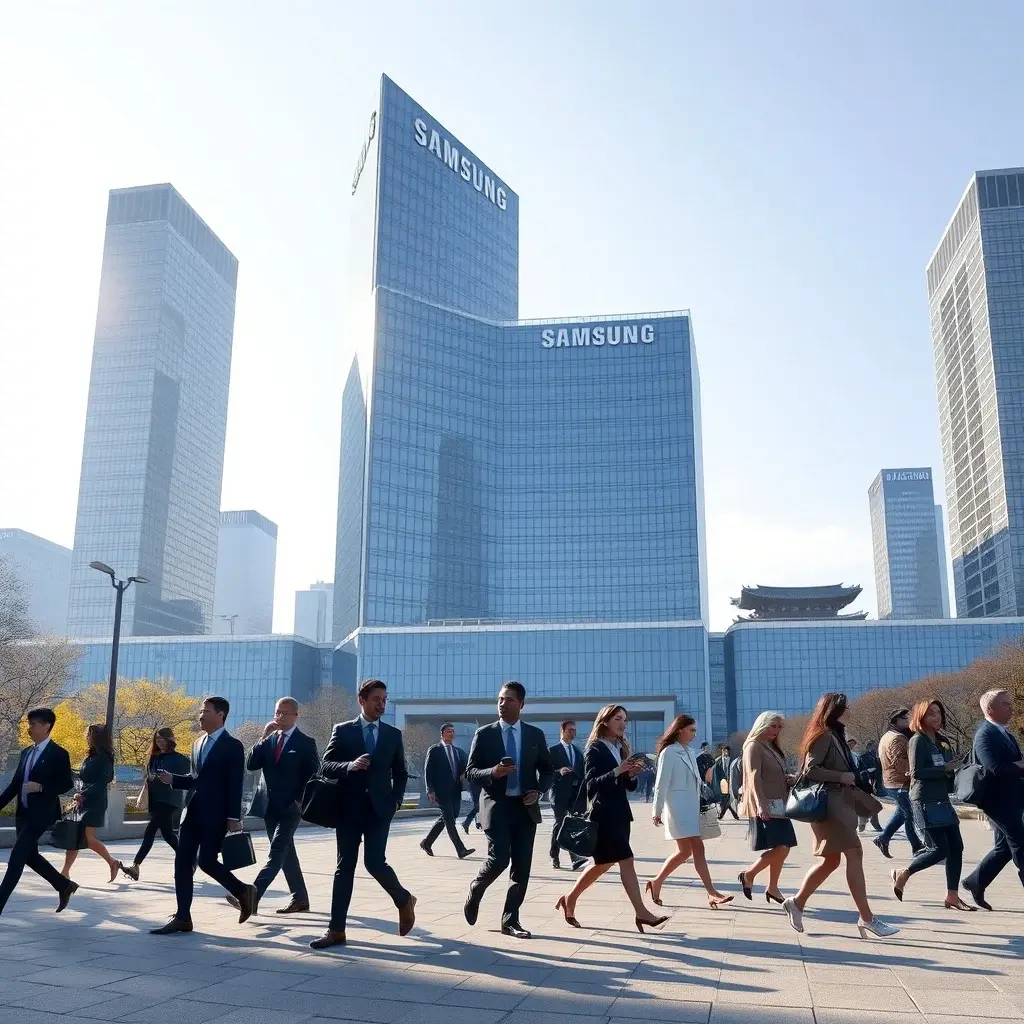
The family controlling South Korean conglomerate Samsung has concluded its payment of a 12 trillion won ($8 billion USD) inheritance tax, the largest such settlement in the nation’s history. Chairman Lee Jae-yong and other family members, including his mother Hong Ra-hee and sisters Lee Boo-jin and Lee Seo-hyun, fulfilled this obligation through six installments over the past five years. The substantial tax liability stemmed from the estate of the late Samsung chairman Lee Kun-hee, who passed away in October 2020.
Background of a Corporate Giant
Samsung stands as South Korea’s preeminent ‘chaebol,’ a large family-owned business group with diverse operations. These span critical sectors such as electronics, heavy industry, construction, and financial services. The late Lee Kun-hee’s estate was valued at approximately 26 trillion won, encompassing significant holdings in shares, real estate, and a notable art collection.
At the time of the inheritance, the family issued a statement affirming that “paying taxes is a natural duty of citizens.” Samsung officially confirmed the final tax payment on Sunday. The company highlighted that the sum paid is roughly equivalent to one and a half times the entirety of South Korea’s projected inheritance tax revenue for 2024.
High Stakes and Global Impact
South Korea imposes one of the highest inheritance tax rates globally, standing at 50%. The management and settlement of this significant tax bill were keenly observed by investors. Concerns existed that the tax burden could potentially impact the Lee family’s ability to maintain control over the Samsung empire.
In a move to manage the estate and fulfill obligations, portions of Lee Kun-hee’s valuable assets were distributed. His renowned art collection, featuring works by masters like Pablo Picasso and Salvador Dali, was donated to prominent cultural institutions, including the National Museum of Korea.
Financial Fortunes and Market Dynamics
The Lee family’s collective net worth is estimated to exceed $45 billion, according to Bloomberg Billionaires Index data. Notably, their wealth has seen a dramatic increase, more than doubling in the past year. This surge is largely attributed to the booming global demand for computer chips, fueled by the artificial intelligence (AI) industry.
This increased demand has significantly boosted the stock market valuation of Samsung Electronics, a core subsidiary. Beyond its leading role in semiconductor manufacturing, Samsung Electronics is also recognized as one of the world’s largest smartphone producers and a major manufacturer of televisions.
Legacy and Future Leadership
The Samsung Group’s origins trace back to 1938, founded by Lee Byung-chul, the grandfather of the current leader, Lee Jae-yong. The successful settlement of this record inheritance tax clears a significant financial hurdle and solidifies the family’s continued stewardship of the global technology giant.
The implications of this tax settlement extend beyond the family’s financial standing. It ensures stability for Samsung’s corporate governance and strategic direction. Investors will likely monitor how the family utilizes its strengthened position to navigate future market challenges and opportunities, particularly in the rapidly evolving tech landscape driven by AI and advanced chip technology.










Leave a Reply