
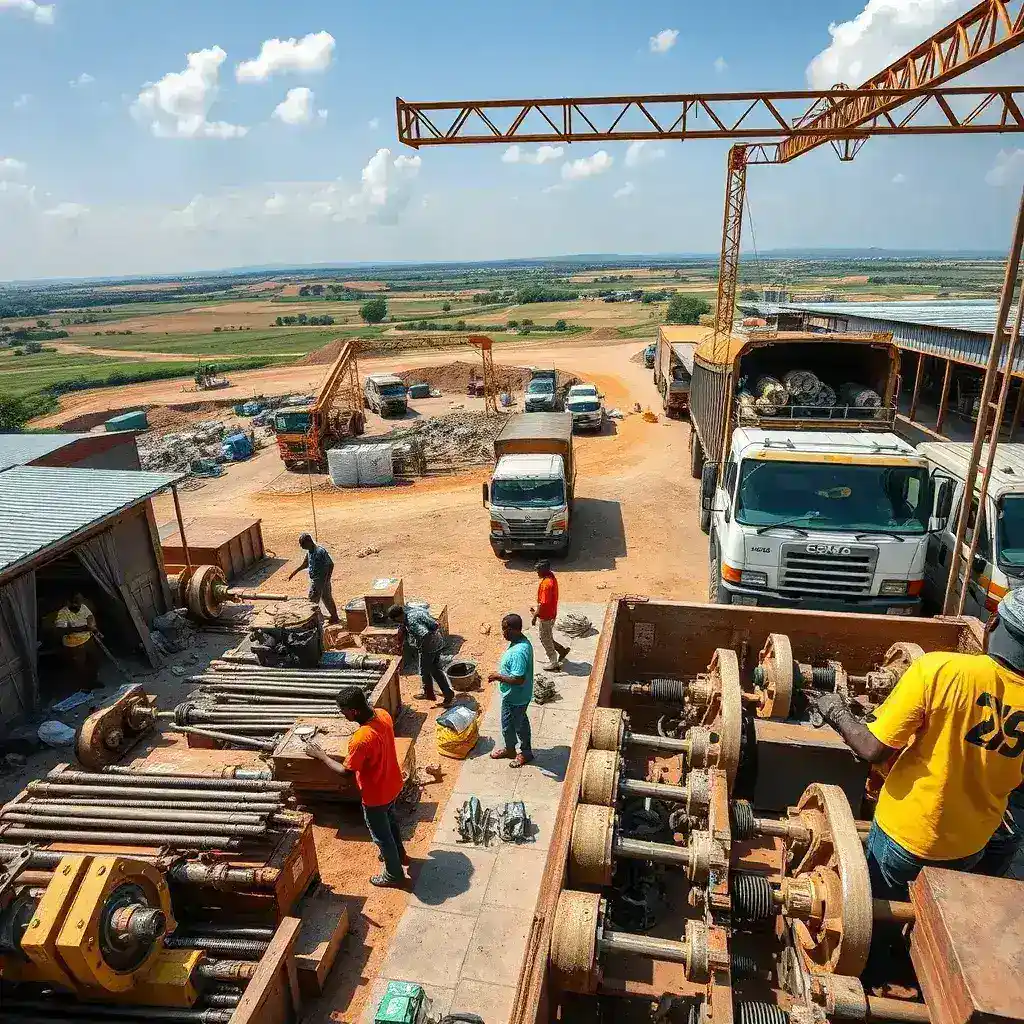
Ghana, a nation heavily reliant on its mining sector for over a century, is exploring strategies to maximize the economic benefits derived from its mineral wealth. Despite contributing significantly to GDP, export earnings, and employment, the full developmental potential of mining remains largely untapped. The focus is shifting from merely increasing ownership stakes in mining companies to fostering industrial development around the sector, aiming to retain billions of dollars in annual spending within the country.
Context: The Economic Backbone of Mining
Mining has long been a cornerstone of Ghana’s economy. It accounts for over 7% of the nation’s Gross Domestic Product (GDP) and generates more than US$6 billion in annual export earnings, providing employment for thousands directly and indirectly.
However, the narrative of success is tempered by the reality that the full developmental impact of this vital industry is yet to be realised. This has prompted a re-evaluation of how Ghana can best leverage its mining resources for broader economic growth.
Ownership Versus Industrialisation
Recent discussions have centred on increasing Ghana’s ownership in mining firms, a move that offers control, influence, and a share of profits. Yet, experts argue that ownership alone is insufficient to drive national industrialisation.
Reliance solely on ownership means Ghana’s economic gains would be subject to market fluctuations and company performance. Dividends and equity returns can be inconsistent, leaving the nation’s development vulnerable to external economic factors.
The true opportunity, therefore, lies beyond simply holding equity. It involves cultivating industries and services that support the mining sector, thereby creating more stable and substantial economic value.
Capturing the Supply Chain Value
Mining companies operating in Ghana spend approximately US$2.5 billion annually on goods and services. This includes everything from heavy machinery and chemicals to safety equipment and maintenance services.
A significant portion of this expenditure currently flows out of the country, meaning Ghana mines gold but imports the necessary inputs for extraction. If Ghana could locally produce even 40% of these required inputs, it could retain around US$1 billion each year.
This potential retained revenue could surpass the gains derived from minor adjustments to royalties or increased minority ownership stakes. The critical question shifts from ‘Who owns the mine?’ to ‘Who supplies the mine?’
Moving Up the Value Chain in Local Content
Ghana already boasts over 400 local suppliers serving the mining sector. While these suppliers play a crucial role, many are concentrated in logistics and distribution.
The next strategic imperative is to transition these local businesses into manufacturing, engineering, and technical services. These areas offer higher value addition, foster skill development, and create more substantial employment opportunities.
The difference is stark: supplying lunch or transport for mining operations versus manufacturing the actual equipment or providing complex engineering solutions.
Policy Alignment for Coordinated Growth
Achieving industrialisation through mining requires a coordinated national effort. Trade policy, investment strategy, and industrial planning must be harmonised across government bodies.
Institutions such as the Ministry of Trade, Agribusiness and Industry, the Ghana Investment Promotion Centre, and the Minerals Commission need to operate as a unified team, rather than in silos.
This coordinated approach should include incentives for local manufacturing, guaranteed markets for local suppliers through mining companies, the development of industrial zones near mining hubs like Tarkwa and Obuasi, and targeted efforts to attract investors into mining-related industries.
Without such alignment, policies may appear beneficial on paper but fail to yield practical economic outcomes.
Tangible Opportunities in Mining-Linked Industries
The opportunities for developing industries around mining are concrete and achievable. These include:
- Equipment Manufacturing: Producing drill rods, bolts, and spare parts locally.
- Chemical Production: Manufacturing inputs like cyanide, ammonium nitrate, lubricants, and oils.
- Protective Gear: Supplying boots, uniforms, and safety equipment, including locally tailored PPE.
- Engineering Services: Establishing robust local fabrication and maintenance clusters.
These are not merely theoretical industries; they represent avenues for job creation, skill enhancement, and export potential.
Ghana as a Regional Mining Supply Hub
Beyond domestic benefits, Ghana has the potential to become a regional hub for mining supplies. West Africa’s mining sector imports approximately US$10 billion in inputs annually.
Capturing even 10% of this regional market would translate to US$1 billion in exports for Ghana. This positions the country to export the tools and services powering mining across the region, elevating its economic standing significantly.
Transformational Impact for Ghana
Successfully implementing these strategies could be transformational for Ghana. It could lead to the creation of up to 50,000 new jobs, boost the GDP contribution from mining-linked industries, and generate more stable and diversified tax revenues.
Furthermore, it would strengthen Ghana’s regional trade relationships and influence. Essentially, mining would evolve from a purely extractive sector into a powerful engine for national development.
The Future of Mining: Building Around Resources
The future prosperity of Ghana’s mining sector hinges not just on ownership percentages or royalty rates, but on the industries it helps to build. While gold in the ground and gold exports are valuable, the establishment of robust industries around mining offers true economic transformation.
Continuing to overlook these opportunities means leaving substantial value on the table—a luxury Ghana, a resource-rich nation, can no longer afford.








Leave a Reply