
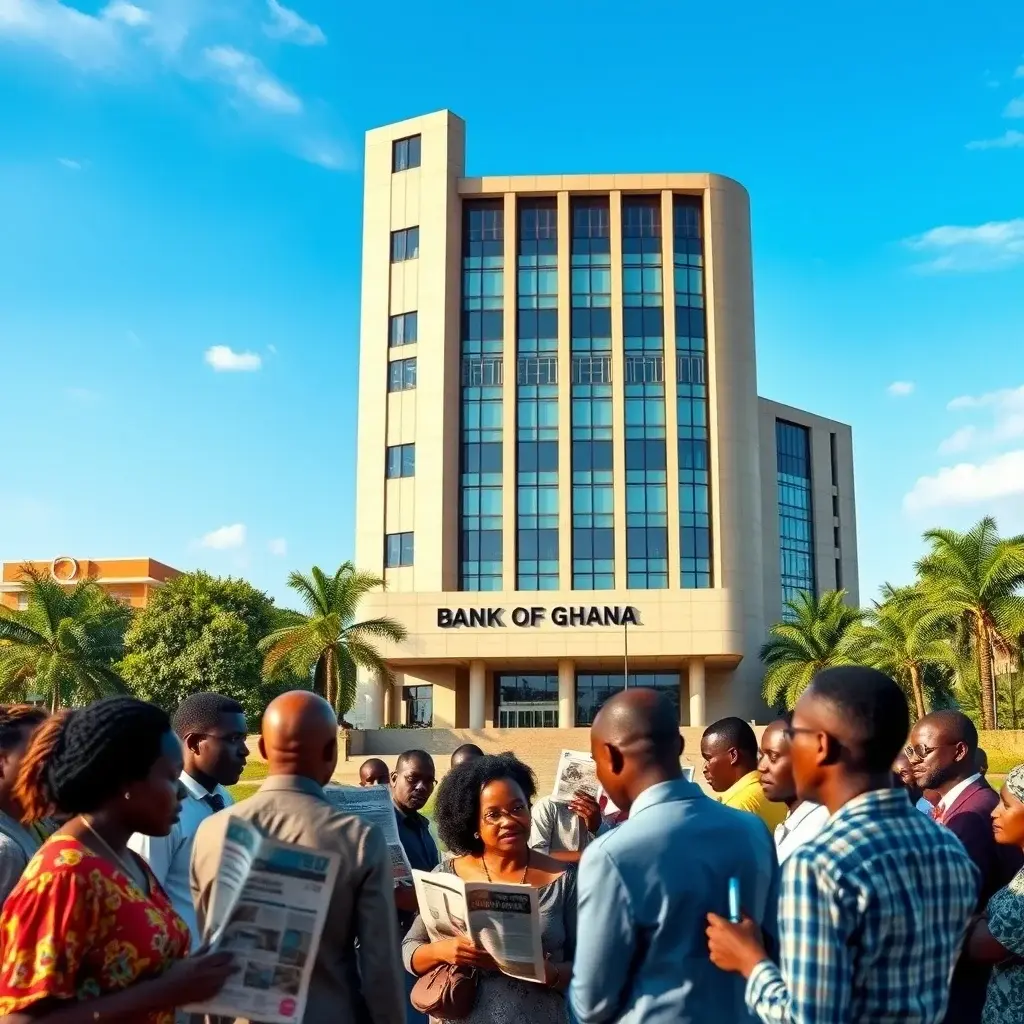
Accra, Ghana – The governing National Democratic Congress (NDC) has strongly refuted claims made by the opposition New Patriotic Party (NPP) regarding substantial financial losses at the Bank of Ghana (BoG). The NDC asserts that the NPP’s figure of GH₵44 billion in losses is propaganda aimed at destabilizing public confidence during a period of economic recovery.
Context of the Dispute
The controversy erupted following statements by the NPP alleging significant financial mismanagement at the central bank. These accusations have placed the Bank of Ghana under scrutiny, with the opposition questioning its financial health and operational effectiveness.
The Bank of Ghana, as the nation’s central bank, holds a critical role in maintaining monetary stability, regulating financial institutions, and managing the country’s foreign exchange reserves. Its financial performance and operational decisions directly impact the broader economy.
NDC’s Defense and Reinterpretation
At a recent press conference, the NDC’s Deputy National Communications Officer, Godwin Ako Gunn, presented the central bank’s recent GH₵15.6 billion in financial commitments not as losses, but as strategic investments. These interventions, he argued, are essential for stabilizing the Ghanaian economy.
“The Bank of Ghana’s serious commitment to carrying out its core mandate to stabilise the economy should be viewed as a strategic investment rather than a loss,” Gunn stated, emphasizing the proactive role of the central bank.
He further contended that these interventions have demonstrably contributed to a more stable macroeconomic environment. According to his claims, inflationary pressures have eased, and the national currency, the Ghana cedi, has shown strengthening trends.
Economic Indicators and Expert Views
The NDC’s defense hinges on the assertion that inflation has seen a significant reduction. This, they argue, directly translates to eased cost-of-living pressures for ordinary Ghanaians. Official inflation figures from the Ghana Statistical Service would typically be the benchmark for such claims.
While the Bank of Ghana’s financial statements are publicly available, their interpretation often becomes a subject of political debate. Analysts note that central bank balance sheets can reflect complex financial operations, including interventions in currency markets or support for the banking sector, which may appear as large figures but are intended to achieve specific economic policy goals.
Some economic commentators suggest that large financial commitments by central banks, especially during periods of economic turbulence, are often necessary to prevent systemic collapse or to manage exchange rate volatility. Without these interventions, the economic consequences could be far more severe.
Implications for the Economy and Public Trust
The ongoing debate surrounding the Bank of Ghana’s financial standing has implications for investor confidence and public perception of economic management. Clear communication and transparent reporting from the central bank are crucial to navigating such political narratives.
For the average Ghanaian, the key concern is the impact on their daily lives – inflation, job security, and the general cost of living. The NDC’s argument suggests that the central bank’s actions, despite their appearance on financial statements, are ultimately aimed at improving these conditions.
What to Watch Next
Attention will now turn to the Bank of Ghana’s upcoming financial reports and official statements to provide clarity on its balance sheet and the nature of its financial commitments. The NPP is likely to continue pressing for detailed explanations and may present its own analysis of the central bank’s financial health. Investors and the public will be watching to see how these differing narratives are reconciled and what further steps the Bank of Ghana takes to ensure economic stability and transparency in its operations.










Leave a Reply