
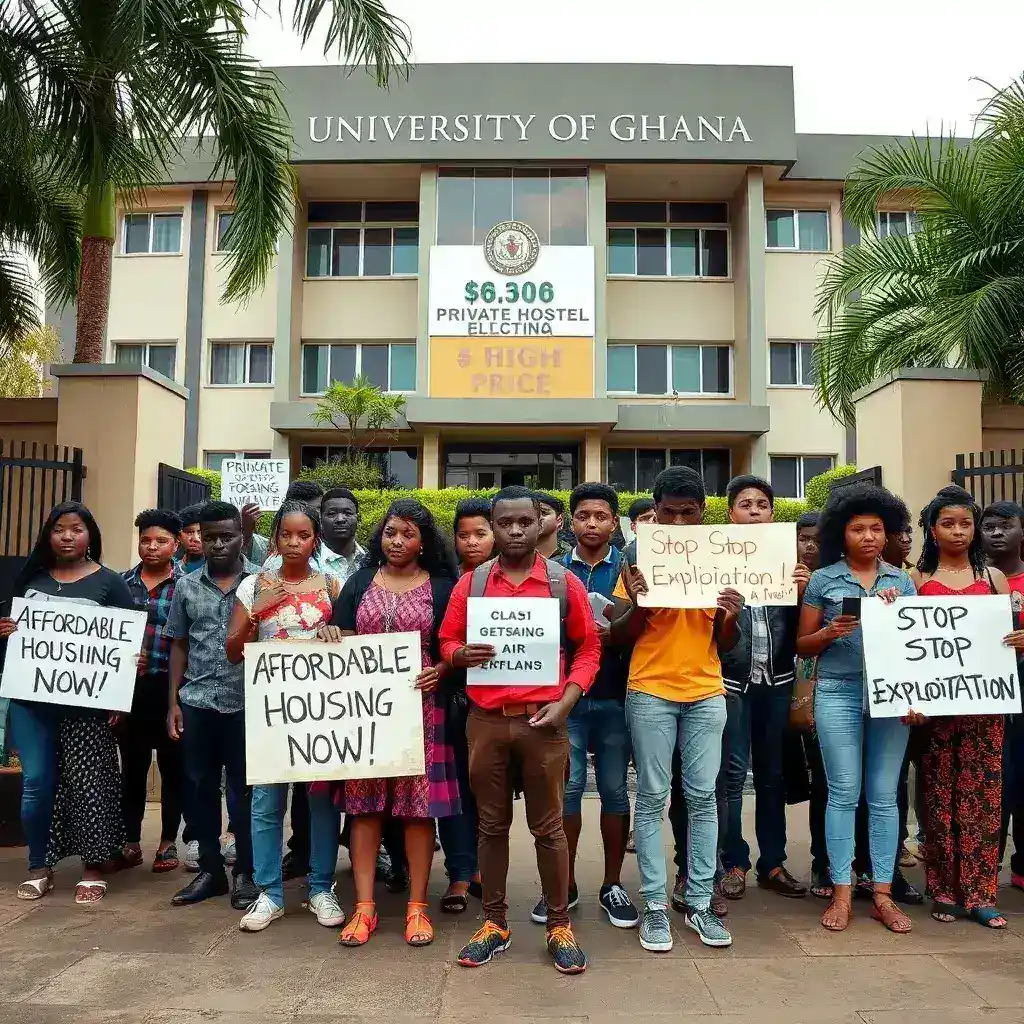
The Students Command of the Economic Fighters League (EFL) has publicly condemned the exorbitant accommodation fees at the University of Ghana (UG), Legon, labeling them as “outrageous exploitation” of students. This strong stance, articulated in a statement released on Saturday, May 9, supports Mr. Frederick Opoku and the Rent Control Department in their efforts to address what the group deems a rigged housing market for Ghanaian students.
Context of the Housing Shortage
The University of Ghana, like many higher education institutions, faces a significant deficit in on-campus student housing. This shortfall has historically driven students to seek accommodation in private hostels and rental facilities in the surrounding communities. Over time, the growing student population and limited affordable options have created a fertile ground for private developers to set accommodation prices with minimal oversight.
Prohibitive Costs Spark Outcry
The EFL highlighted a deeply concerning trend where private hostel operators are allegedly charging astronomical fees. These costs reportedly reach as high as GH₵24,000 for a single-occupancy room. Even for students opting for shared accommodations, the prices remain prohibitive, with some individuals being charged GH₵10,000 each for a spot in a crowded room.
These figures, according to the EFL’s Students Command, are not simply a reflection of market forces. They represent a systemic failure that effectively transforms higher education into an exclusive privilege for the wealthy. “A situation where students are forced to pay as much as GH₵24,000 for a single room, or GH₵10,000 each in shared rooms, is not merely a market issue. It is a social crisis,” the statement declared. “Education cannot become the preserve of the wealthy while ordinary students and families are crushed under predatory accommodation costs.”
Call for Regulatory Intervention
The group commended Mr. Frederick Opoku for his public advocacy against what they term housing injustice. However, the EFL stressed that mere condemnation is insufficient. They are actively demanding that the government empower the Rent Control Department with robust regulatory tools. These tools, they argue, are necessary to enforce price caps and penalize instances of profiteering by hostel operators.
The EFL issued a stark warning: without immediate governmental intervention, the escalating cost of living around the university campus could lead to a surge in student dropouts. Furthermore, it could force students to seek out unsafe and substandard housing alternatives, jeopardizing their well-being and academic pursuits.
“We urge government to back these efforts with stronger regulation, enforcement, and policies that protect students from profiteering. Housing is a right, not a luxury for the privileged few,” the Command asserted in their statement.
Broader Implications and Future Actions
The situation at the University of Ghana is symptomatic of a wider national shortage of adequate and affordable student housing. This ongoing crisis has enabled private developers to operate with considerable autonomy, often setting prices without significant accountability. As the number of students seeking higher education continues to rise, the disparity between available housing and affordable rates widens, leaving many students vulnerable to the practices of what the EFL terms “hostel moguls.”
The Economic Fighters League has indicated that if the government fails to address these “predatory” charges effectively, they may resort to mobilizing students. Such mobilization could take the form of more direct actions aimed at demanding the fundamental right to affordable housing.








Leave a Reply