
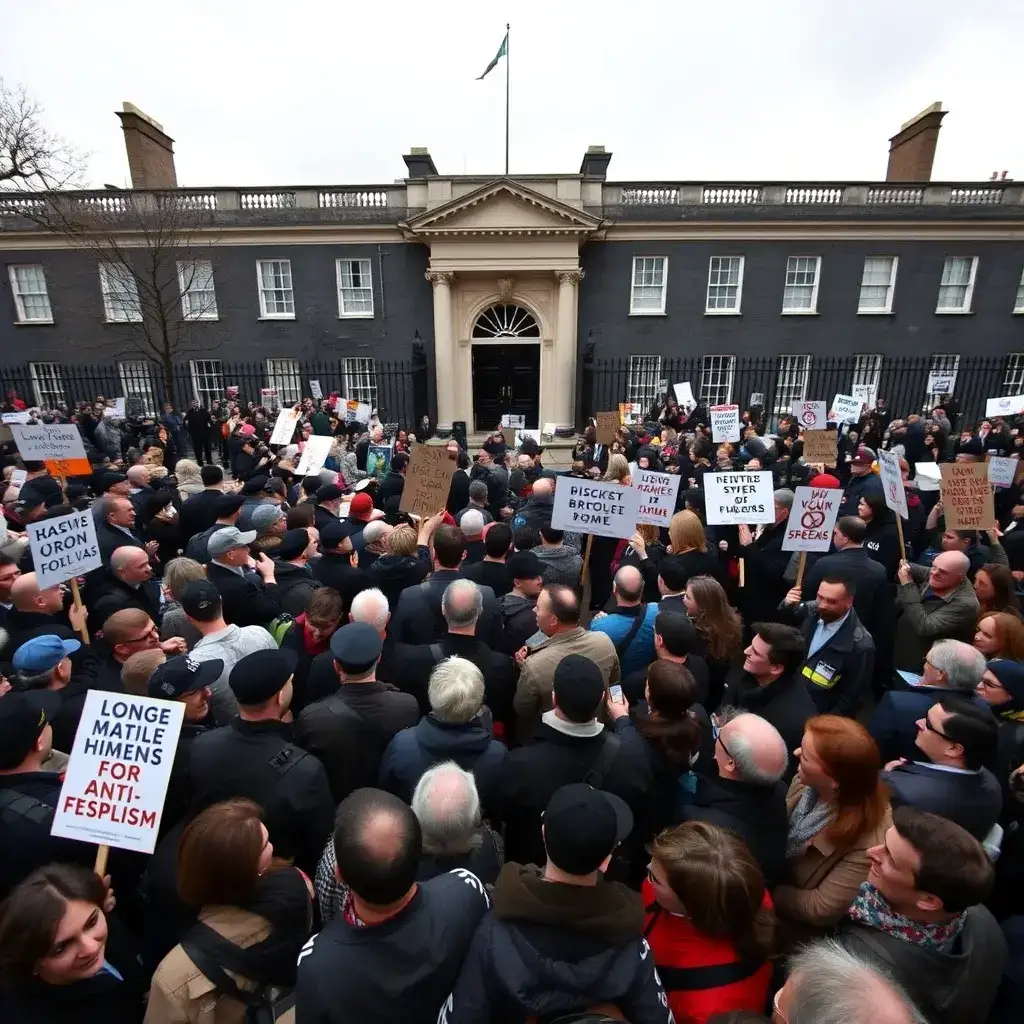
Thousands of people, including leaders from major Jewish community organizations and political figures, gathered outside Downing Street on Sunday to protest a surge in antisemitism. The rally was called in response to a recent increase in anti-Jewish hate incidents across the UK, including attacks on synagogues and violent assaults.
Context of Rising Hate
The demonstration occurred against a backdrop of escalating antisemitic incidents. In recent months, synagogues and Jewish sites have faced a string of attacks. These include the stabbing of two Jewish men in Golders Green a fortnight prior to the rally, and earlier incidents such as arson attacks on ambulances outside a synagogue in March and various synagogue vandalisms.
In the lead-up to the protest, an open letter signed by religious leaders from diverse faiths, as well as prominent figures in business, sport, and media, was published. This letter condemned antisemitism as a shared problem requiring collective action, stating, “This country belongs to you as much as any of us.” The signatories expressed deep concern over the return of violent acts reminiscent of past eras, such as stabbings, killings, and firebombings.
Rally Highlights and Speaker Reception
An estimated 5,000 attendees heard speeches from various religious leaders and politicians. The rally saw a mixed reception for speakers, reflecting underlying frustrations with perceived government inaction on the issue. While some politicians received applause, others faced heckling.
Work and Pensions Secretary Pat McFadden was reportedly booed and heckled when he expressed solidarity, stating, “I am with you, I want to fight antisemitism.” In contrast, Conservative leader Kemi Badenoch received loud applause for her promise to “stand with you” and affirmed Britain’s role as a “sanctuary for Jewish people.” Reform UK’s deputy leader, Richard Tice, was also applauded. Sir Ed Davey, leader of the Liberal Democrats, initially faced jeers that subsided after it was noted he was a supporter of the community.
Call for Action and Security Concerns
Chief Rabbi Sir Ephraim Mirvis addressed the crowd, emphasizing that extremism and hatred pose a threat to everyone and confronting it is a “national responsibility.” He specifically called for the expulsion of the Iranian ambassador to Britain and a ban on the Iranian Revolutionary Guards Corps (IRGC), citing potential Iranian links to some of the arson attacks.
Security was a significant concern at the event, with police implementing search arches. Three arrests were made: a man in his 30s was detained after a knife was detected, and two men in their 60s were arrested on suspicion of carrying batons as part of broader security patrols.
Diverse Support and Personal Testimonies
The presence of non-Jewish attendees underscored the broad coalition against antisemitism. Mary Rendle, who attended to support her husband’s Jewish family, stated it was “the right thing to do.” She shared her distress, saying, “I hate the fact my step-daughter has to hide her Star of David because we are scared for her safety.”
Zoe Korsner, another attendee, voiced a desire to demonstrate that “love was stronger than other people’s hate.” She expressed the emotional toll of feeling unsafe, stating, “We don’t want to feel frightened as Jewish people. I feel like I have to hide it, it’s something to be embarrassed about and ashamed.”
Legal Responses and Ongoing Incidents
The rally follows a period of heightened concern and legal action. The Crown Prosecution Service announced that hate crime prosecutions would be fast-tracked in response to the spate of incidents. Recent legal developments include guilty pleas for making antisemitic threats, verbally abusing a Jewish man for social media content, and threatening to kill Jewish children.
The article also notes specific recent incidents: a guilty plea in Salford for antisemitic threats, two men pleading guilty to hate crimes involving verbal abuse, a man charged with threatening to kill Jewish children and making gas chamber references, and two arrests on Sunday over a suspected arson attack at a former synagogue, alongside a man charged with assault and making antisemitic threats.
Implications and Future Watch
The significant turnout and the broad coalition of support signal a strong public demand for action against antisemitism. The mixed reception of political speakers highlights the pressure on government and political parties to address the issue effectively and demonstrate tangible commitment. The call for specific actions against Iran and the increased police presence at the rally indicate a growing focus on both domestic and international factors contributing to anti-Jewish hate.
Moving forward, attention will be on how effectively the fast-tracked hate crime prosecutions are implemented and whether the diplomatic and security measures called for by community leaders are adopted. The sustained engagement of non-Jewish allies and the response from educational institutions, workplaces, and online platforms will also be crucial in determining the long-term impact of this rising tide of hate.










Leave a Reply