
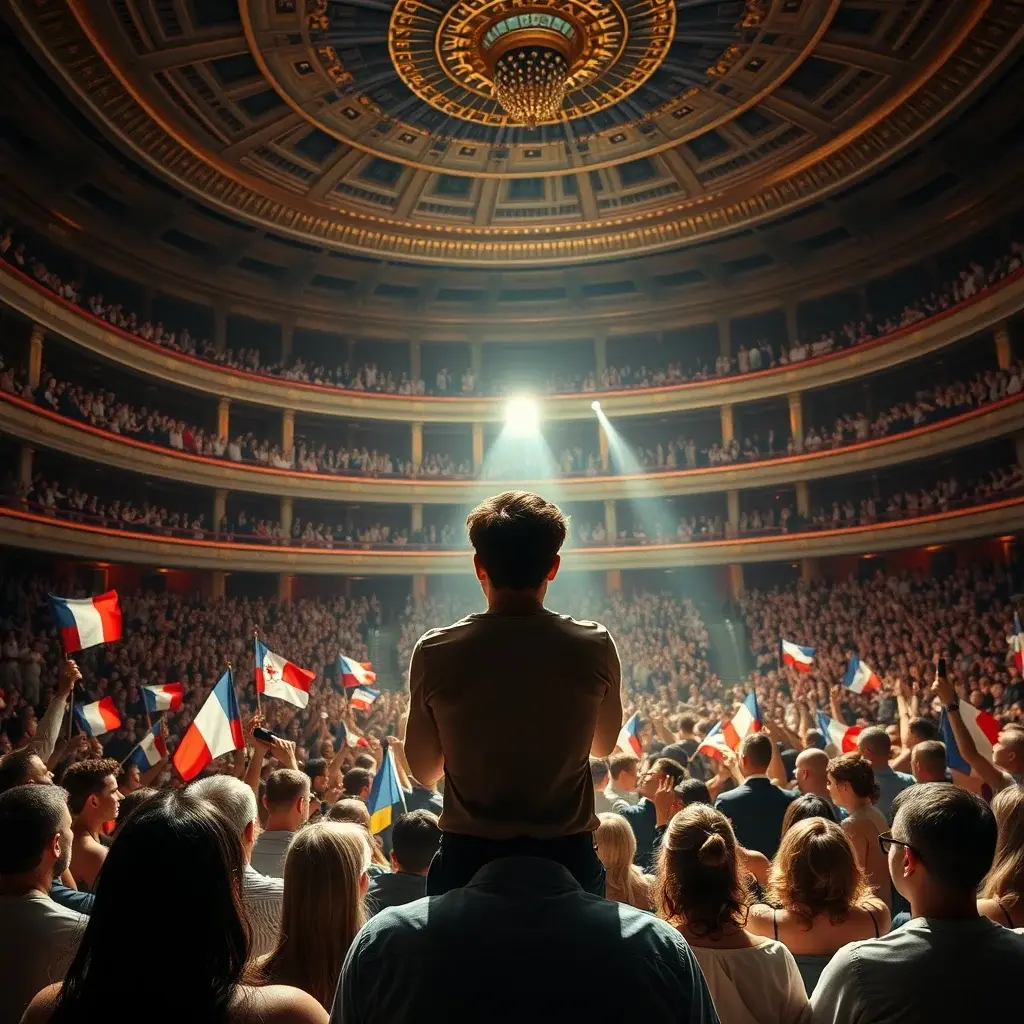
Israel has secured a spot in the Eurovision Song Contest final, with Noam Bettan’s song “Michelle” qualifying from the first semi-final held in Vienna. The festive atmosphere of the competition has been overshadowed by controversy surrounding Israel’s military actions in Gaza, leading to boycotts from five countries, including Ireland. Bettan faced a divided audience during his performance, with some booing and others cheering.
Context of Controversy
The Eurovision Song Contest, a highly anticipated annual event, has found itself at the center of geopolitical tensions. The ongoing conflict in Gaza has prompted several nations to withdraw from the 2024 competition, highlighting the delicate balance between entertainment and international relations. This year’s contest has seen a significant increase in political undertones, impacting the traditional celebratory mood.
Semi-Final Performance and Audience Reaction
During Tuesday’s semi-final, Noam Bettan performed “Michelle,” a song described as a “lovestruck pop song.” The reception from the audience was notably mixed. Audible boos and anti-Israeli slogans were captured on the broadcast, prompting a statement from the Austrian broadcaster ORF and the European Broadcasting Union (EBU). They confirmed that disruptive audience members were removed by security for disturbing the proceedings.
Bettan, a 28-year-old performer, had expressed his intention to focus on the music and disregard criticism as “background noise” prior to the show. The EBU and ORF acknowledged that the disruptions occurred both before and during Israel’s performance. Security intervened due to continued disturbances, with a total of five individuals removed from the arena for disruptive behavior.
Qualifiers and Notable Exits
Ten countries advanced to Saturday’s grand finale from the first semi-final. Among the qualifiers are the Finnish duo Pete Parkkonen and Linda Lampenius with their song “Liekinheitin” (Flamethrower), which is currently a favorite to win. Other qualifying nations include Belgium, Croatia, Greece, Lithuania, Moldova, Poland, Serbia, and Sweden.
However, the semi-final also saw the elimination of several countries, including Estonia, Georgia, Montenegro, Portugal, and San Marino. British pop star Boy George, who appeared as a guest performer for San Marino’s entry, did not advance to the final as his country’s song failed to qualify. This marks a disappointment for the Culture Club singer.
Acts and Performances
The semi-final opened with a heartwarming film celebrating Eurovision’s 70th birthday, featuring a journey through the contest’s history and iconic winners. The performances themselves showcased a diverse range of musical styles and staging. Moldovan singer Satoshi delivered an energetic set with “Viva, Moldova!” while Swedish singer Felicia presented a dance track with a masked persona.
The Croatian band Lelek offered a powerful performance with “Andromeda,” addressing themes of female suppression. Greek singer Akylas delivered an ambitious staging for “Ferto,” incorporating cultural references and contrasting modern materialism with past struggles. Italy’s Sal Da Vinci performed “Per Sempre Si,” a disco track dedicated to his wife.
Lithuania’s Lion Ceccah appeared in silver paint for “Sólo Quiero Más,” a song exploring human-machine themes. The Finnish duo’s performance of “Liekinheitin” was notable for Linda Lampenius playing a 19th-century Gagliano violin live on stage, a rare occurrence in recent Eurovision history. The night concluded with the Serbian band Lavina, bringing a heavy rock sound with their song “Kraj Mene.”
Voting Reforms and Future Implications
The qualification process, determined by a combination of public votes and jury scores, was subject to changes this year following accusations of voting irregularities in the previous contest. New measures include a limit of 10 votes per viewer and requiring credit card details for online voting to ensure votes originate from the country of submission. These reforms aim to enhance the integrity of the competition.
The second semi-final is scheduled to feature prominent acts from Denmark and France, alongside the debut of Australian star Delta Goodrem. As the competition progresses, the intersection of music, politics, and audience reaction will likely remain a key narrative.







Leave a Reply