
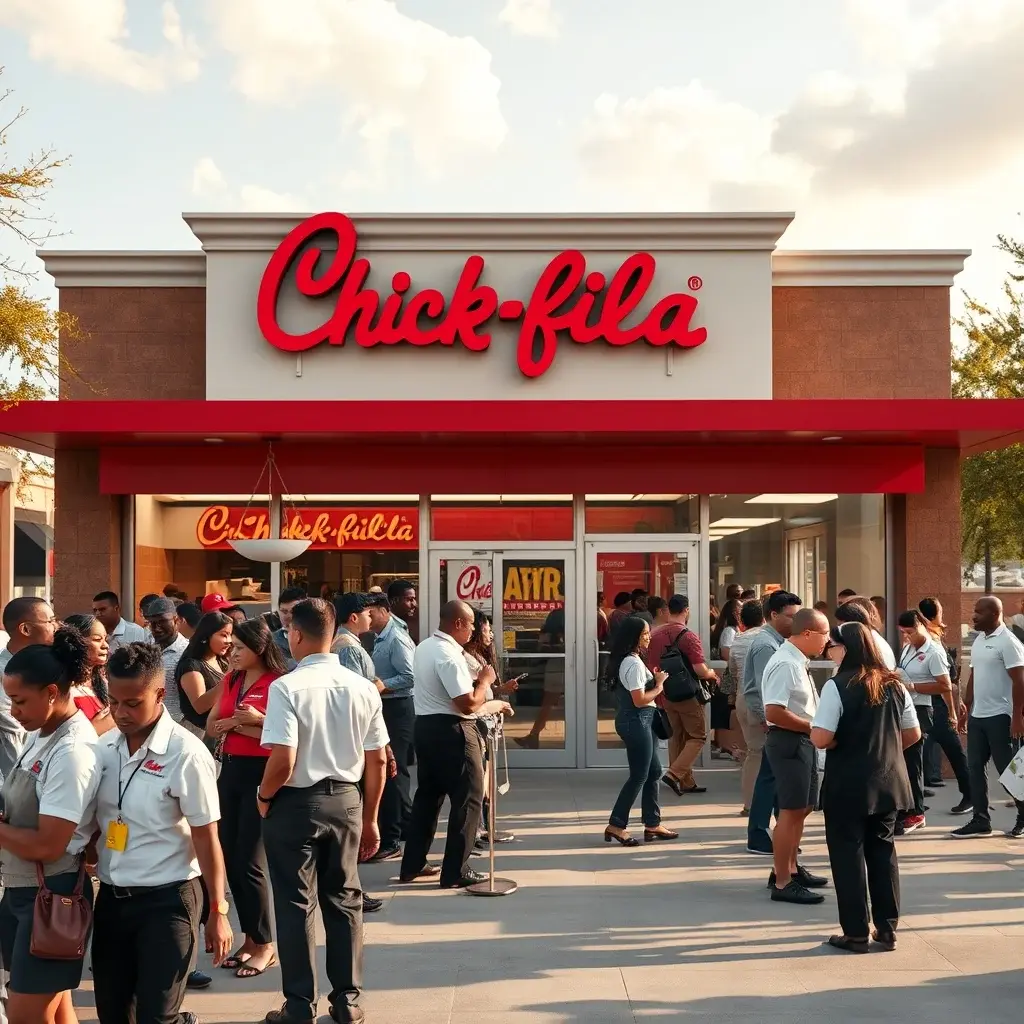
The U.S. government, through the Equal Employment Opportunity Commission (EEOC), has filed a lawsuit against a Chick-fil-A franchisee, Hatch Trick Inc., in Austin, Texas. The suit alleges that the company unlawfully discriminated against an employee by denying her request to observe her Sabbath on Saturdays, violating federal anti-discrimination laws.
Background of the Case
The employee, a member of the United Church of God, observes the Sabbath from Friday sundown to Saturday sundown. This religious practice requires abstaining from work on Saturdays.
According to the EEOC complaint, the employee initially informed Hatch Trick of her religious needs during her job interview in August 2023. For a few months, the franchisee accommodated her request, scheduling her to work Monday through Friday, with some Sunday hours.
Allegations of Discrimination
The situation reportedly changed in February 2024 when Hatch Trick allegedly began requiring the employee to work Saturdays. The employee held a managerial role responsible for overseeing delivery drivers at one of the franchise’s locations.
When the employee appealed for a religious accommodation, management allegedly presented her with an ultimatum. She was informed that she could not retain her managerial position without working Saturdays. The alternative offered was a demotion to a delivery driver role, which would involve reduced pay, fewer hours, and diminished benefits.
The EEOC claims the employee proposed several reasonable accommodations. These included having another driver handle dispatch duties on Saturdays or working only after sundown on Saturdays. Hatch Trick allegedly rejected these proposals.
The lawsuit asserts that when the employee refused to accept the demotion and continued to request accommodation for her religious observance, Hatch Trick terminated her employment.
Legal Framework and Employer Obligations
The EEOC, a federal agency tasked with enforcing workplace discrimination laws, is representing the employee. The lawsuit centers on Title VII of the Civil Rights Act of 1964, which prohibits employment discrimination based on religion.
“Religious discrimination in the workplace is unlawful, and employers must make reasonable accommodations for employees’ sincerely held beliefs,” stated Norma Guzman, EEOC San Antonio Field Office Director. This principle requires employers to modify work schedules or job duties to allow employees to practice their religion, unless doing so would cause undue hardship to the business.
Company Policies and Franchisee Responsibility
Chick-fil-A corporate policy famously includes closing all restaurants on Sundays to allow employees to rest, worship, or spend time with family. This policy is often cited as an example of the company’s respect for religious observance.
However, Chick-fil-A has stated that its restaurants are independently owned and operated by franchisees. In response to the lawsuit, a Chick-fil-A spokesperson told KVUE, “It’s important to know that, as a franchise business, all employment decisions are solely the responsibility of each individual restaurant owner.” This indicates that Hatch Trick Inc. is solely accountable for the employment practices at its specific locations.
Potential Implications
This lawsuit highlights the complexities of religious accommodations in the workplace, particularly within franchise models where operational control can be decentralized.
It underscores the legal obligation for employers, even franchisees, to engage in an interactive process to find reasonable accommodations for employees’ religious practices. Failure to do so can result in significant legal penalties.
The case will likely draw attention to how well franchise owners understand and implement federal anti-discrimination laws, and whether corporate guidance or training is sufficient to prevent such incidents.
Moving forward, businesses, especially those with flexible religious policies like Chick-fil-A’s Sunday closure, will be watched to see how they handle requests for accommodations on other days of the week. The outcome of this lawsuit could set a precedent for how religious accommodation claims are handled within the fast-food industry and beyond.








Leave a Reply