
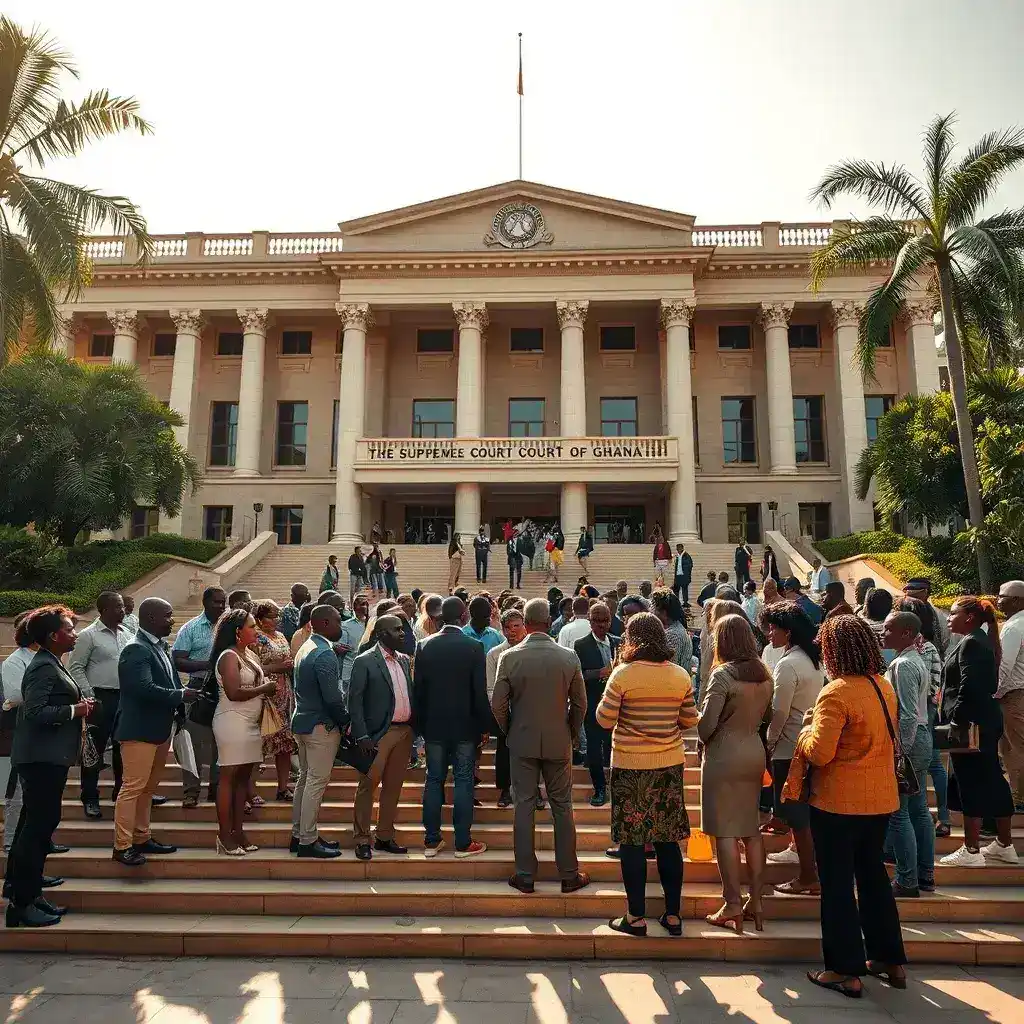
Accra, Ghana – A seven-member panel of the Supreme Court, led by Chief Justice Paul Baffoe-Bonnie, has granted an application for 14 civil society organisations (CSOs) to join a significant constitutional challenge against the Office of the Special Prosecutor (OSP). The case, known as Adamtey v Attorney-General, questions the legal foundation of the OSP, an independent body established to combat corruption.
Context of the Challenge
The substantive suit was initiated by a private citizen, Adamtey, who is challenging the constitutional validity of the OSP’s establishment and operational framework. The OSP was created by the Office of the Special Prosecutor Act, 2017 (Act 959), with the mandate to investigate and prosecute corruption-related offenses, particularly those involving public officials and politically exposed persons.
Since its inception, the OSP has emerged as a prominent anti-corruption agency in Ghana, undertaking several high-profile investigations and prosecutions. Its existence and operations are central to the nation’s efforts to enhance accountability and deter corruption.
CSOs Join as Amici Curiae
The 14 CSOs sought to join the case as interested parties, arguing through their counsel, Kizito Beyuo, that they possess crucial expertise and institutional knowledge. Beyuo contended that these independent bodies have long-standing interests in governance, accountability, and anti-corruption efforts, making their input vital for the Supreme Court’s determination.
The apex court’s decision to admit the CSOs is seen as a move to enrich the proceedings with diverse perspectives. Their participation is expected to provide valuable insights into the broader public interest implications of the OSP’s mandate and effectiveness.
Broadening Legal and Public Interest Dimensions
The inclusion of these CSOs is anticipated to significantly broaden the legal and public interest dimensions of the case. Many of these organisations have been at the forefront of advocating for robust anti-corruption reforms and demanding greater institutional accountability in Ghana.
This case has garnered considerable public attention due to the profound implications any ruling could have on the future operations, legal standing, and overall effectiveness of the Office of the Special Prosecutor. The OSP’s role in Ghana’s governance landscape makes this constitutional challenge a matter of national significance.
Expert Perspectives and Data
While specific data points were not detailed in the initial report, the CSOs’ argument hinges on their sustained engagement with anti-corruption issues. Transparency International Ghana, for instance, has consistently published reports on corruption perception and advocated for strengthening anti-graft institutions. Similarly, IMANI Centre for Policy and Education has frequently commented on governance structures and the efficacy of public institutions.
The legal arguments presented by the CSOs are likely to focus on interpretations of constitutional provisions related to independent bodies, the rule of law, and the separation of powers. Their involvement as ‘friends of the court’ (amici curiae) aims to ensure that the court considers the wider societal impact of its decision on Ghana’s anti-corruption architecture.
Implications for Ghana’s Anti-Corruption Fight
The Supreme Court’s decision to allow the CSOs to participate underscores the importance placed on a comprehensive understanding of the issues at stake. A ruling that upholds the OSP’s constitutionality could reinforce its mandate and operational capacity, potentially strengthening Ghana’s fight against corruption.
Conversely, any ruling that curtails the OSP’s powers or questions its foundational legality could have significant repercussions. It might necessitate legislative amendments or a restructuring of the agency, potentially creating uncertainty and slowing down ongoing anti-corruption efforts. The public interest in accountability and the integrity of state institutions makes this case a critical juncture for Ghana’s governance reforms.
What to Watch Next
All eyes are now on the Supreme Court as it prepares to hear the substantive arguments in Adamtey v Attorney-General, with the newly admitted CSOs set to present their perspectives. Observers will be keen to see how the court navigates the complex legal questions surrounding the OSP’s constitutional basis and what precedent this case might set for similar challenges to independent governance institutions in Ghana. The eventual ruling is expected to shape the future trajectory of anti-corruption efforts and institutional accountability in the country.








Leave a Reply