
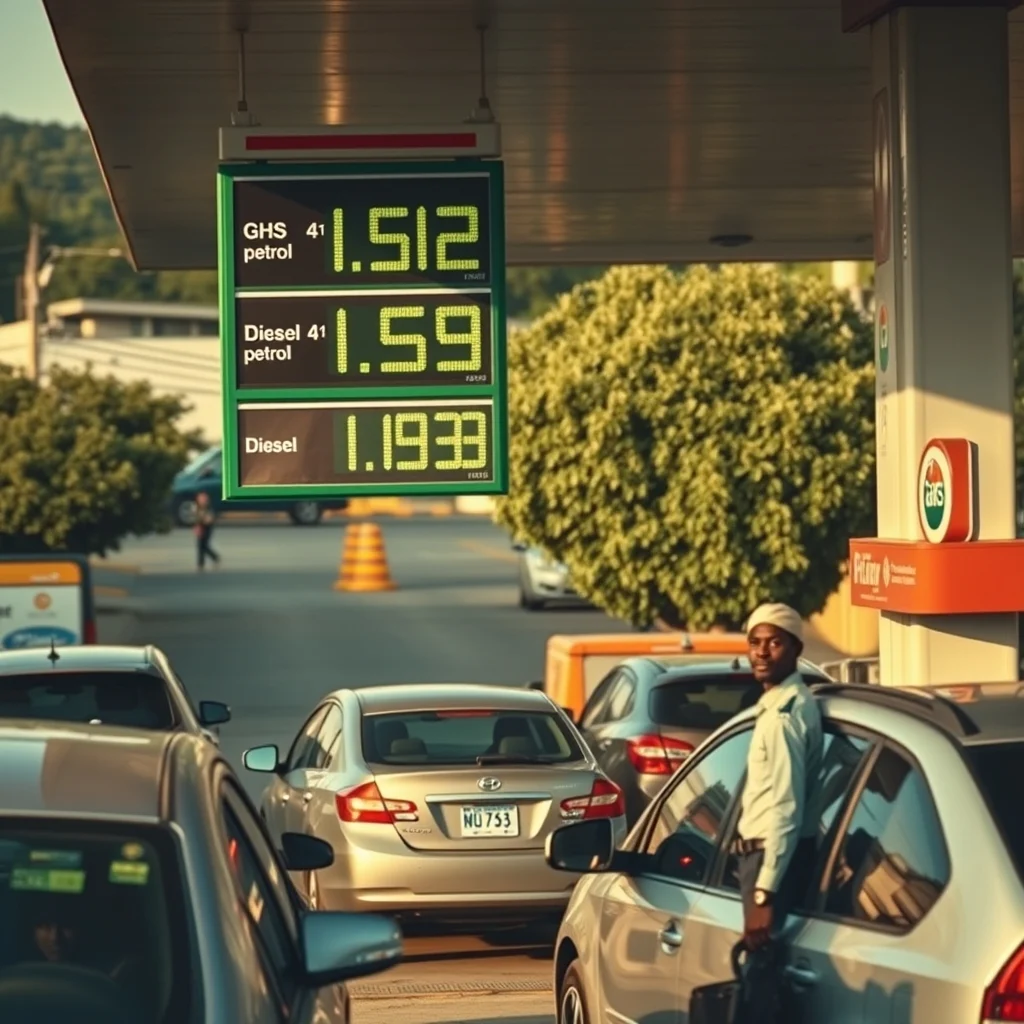
Fuel prices are poised for a substantial increase starting May 16, 2026, as projected by the Chamber of Oil Marketing Companies (OMCs) on May 15. This rise occurs despite the government’s decision to extend its intervention aimed at cushioning consumers, according to insights obtained by JOY BUSINESS.
Pricing Outlook Reveals Upward Trend
Data from the Chamber of Oil Marketing Companies indicates a significant hike across key petroleum products. Petrol prices are expected to climb between 5.29% and 7.30%, potentially pushing the retail price to GHS 15.42 per litre. Diesel is forecast to see an even steeper increase of up to 7.30%, with a litre possibly reaching GHS 17.83. Liquefied Petroleum Gas (LPG) is also not spared, with an anticipated 3% rise, bringing the price to GHS 17.10 per kilogramme.
These projections are based on the purchasing patterns of OMCs, which often acquire products on credit from bulk oil distributors.
Factors Driving Price Increases
The Chamber of Oil Marketing Companies attributes the impending price hikes primarily to two factors: elevated international market prices for crude oil and the recent depreciation of the Ghana cedi against major international currencies.
The local currency experienced a slight dip in the May 16, 2026 pricing window, moving from GHS 11.2057 to GHS 11.3133 against the US dollar, a depreciation of 0.95%. This follows a trend where the cedi’s year-to-date depreciation averaged 7.8% against major foreign currencies as of May 8, 2026, a notable acceleration compared to the 2.5% recorded over the same period in the previous year.
Contrasting this, average crude oil prices saw a marginal decrease in mid-May, falling from $113.80 per barrel to $112.07 per barrel, a 1.52% decline. However, this dip has been overshadowed by ongoing geopolitical tensions.
The disruption of shipping routes, particularly the near halt of traffic through the Strait of Hormuz during a recent 10-week conflict, continues to impede the global flow of crude oil, gas, and refined fuels. This supply chain disruption is a significant driver of increased energy prices worldwide and fuels concerns about rising inflation.
Government Intervention Extended but Insufficient
In an effort to mitigate the impact on consumers, the government announced on May 15, 2026, the continuation of measures to cushion the public from rising fuel costs. The decision was made following a Cabinet meeting chaired by President John Dramani Mahama, where global petroleum market developments were reviewed.
Previously, the government implemented a temporary subsidy effective April 16, 2026, absorbing GHS 2.00 per litre on diesel and GHS 0.36 per litre on petrol. This initial intervention was slated to end on May 15, 2026.
Under the renewed intervention, the government will continue to absorb GHS 1.07 per litre on diesel, effective May 16, 2026. This revised subsidy is scheduled to remain in effect for two pricing windows, subject to further review based on international market conditions.
Despite this extended support, the subsidy is not enough to prevent an increase in pump prices this weekend. Dr. Riverson Oppong, Chief Executive of the Chamber of Oil Marketing Companies, acknowledged that without the government’s intervention, pump prices would have been considerably higher than the projected figures.
Implications and Future Outlook
The persistent rise in fuel prices, even with government intervention, signals ongoing economic pressure on households and businesses in Ghana. Consumers can expect to pay more for transportation and goods, potentially impacting inflation across various sectors.
The continued reliance on international markets and the vulnerability of the local currency mean that fuel price volatility is likely to remain a significant concern. The effectiveness and duration of the government’s subsidy program will be closely watched, as will the broader global geopolitical landscape and its impact on energy supplies. Observers will be keen to see if further measures are considered if global prices continue to climb or if the cedi experiences further depreciation.










Leave a Reply