
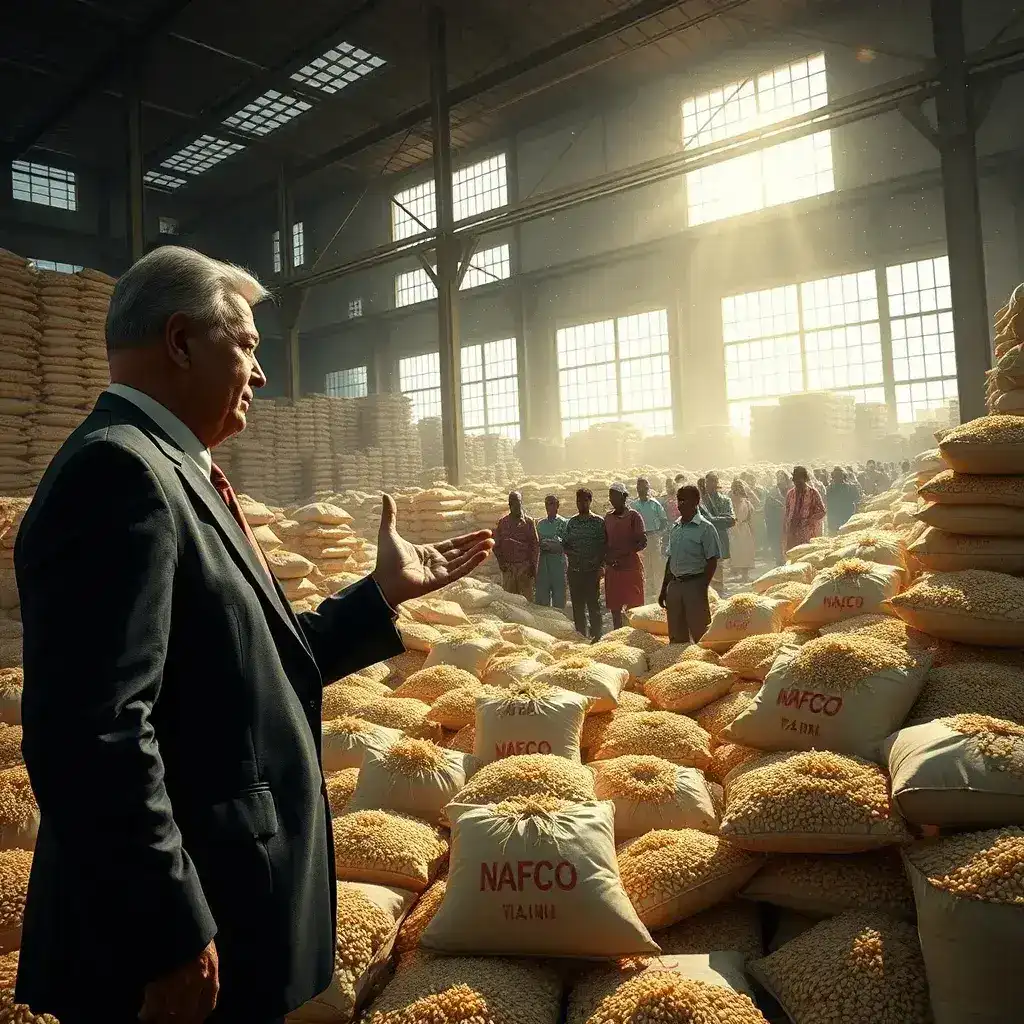
Accra, Ghana – May 5, 2026 – The National Food Buffer Stock Company (NAFCO) is facing a significant financial challenge, requiring at least GH¢770 million to address a considerable surplus of locally produced rice following the 2025 and 2026 farming seasons. This comes as the company continues to procure grains with an initial GH¢100 million allocation released by the government in 2025, according to Emmanuel Arthur, Senior Manager in charge of Corporate Affairs at NAFCO.
Context of the Rice Glut
Ghana has experienced a substantial increase in rice production in recent seasons. This surge has led to a surplus that local market mechanisms and existing government procurement systems are struggling to absorb. The situation is exacerbated by ongoing imports of cheaper, often smuggled, rice, which undercuts local producers.
A recent report by Business and Financial Times on May 4, 2026, highlighted concerns from agricultural stakeholders. Dr. Terence Adda-Balinia, an executive member of the Association of Ghana Rice Producers and Processors, alleged that NAFCO had overlooked a presidential directive to prioritize locally grown rice. This, he claimed, has forced some millers to cease operations and resulted in significant losses for farmers.
NAFCO’s Procurement and Funding Challenges
Emmanuel Arthur confirmed in a Citi FM interview on Tuesday, May 5, 2026, that NAFCO is actively purchasing rice from Ghanaian farmers. He stated that the GH¢100 million allocated in 2025 has not yet been fully utilized, with procurement operations still underway.
However, Arthur emphasized that this amount is insufficient to clear the current glut. “If we had told the government that we needed not less than GH¢770 million to mop up the surplus, that was what the farmers wanted,” he explained. The government initially provided GH¢100 million as a matching fund.
Furthermore, an additional GH¢200 million announced in the 2026 Budget by the Minister of Finance, Dr. Cassiel Ato Forson, in November 2025 has not yet been released. “We are waiting for it. The GH¢200 million has not come yet,” Arthur added, underscoring the critical funding shortfall.
Addressing Accusations and Ensuring Transparency
Arthur strongly refuted claims that NAFCO was procuring smuggled rice. “Everything that we have bought has been from Ghanaian farmers,” he asserted. He detailed NAFCO’s operational model, which involves licensed buying companies procuring grain on their behalf and delivering it to designated warehouses.
He invited journalists to inspect NAFCO’s storage facilities in locations such as Buipe, Bono, Ashanti regions, Jute in the Volta Region, and Tamale to verify the quantities of grain purchased with the GH¢100 million. “I will be happy to take your crew to these locations and you will see the quantity of grain we have bought with the GH¢100 million,” he stated.
Ivan Sakitei, former Executive Secretary of the Ghana Rice Interprofessional Body, shared his experience of having thousands of unsold rice bags from the December 2025 harvest. He mentioned a meeting on April 15, 2026, with the Greater Accra Regional Minister, but reported no progress in selling the rice.
Acknowledging these concerns, Arthur attributed the slow progress to insufficient funding. “The amount of money is not enough,” he admitted. “It is difficult for people to feel the impact of what we are doing because the funds are not enough. If we had the means today, we would mobilise all the grain farmers have.”
Program host Bernard Avle suggested that NAFCO publish a list of farmers and mills from which grain has been procured. “So long as you cannot give us that information and these recognised bodies say no one is buying their rice, it is difficult to clear yourself of that accusation,” Avle commented. Arthur indicated that the company would consider this suggestion.
Support and Future Procurement
The World Food Programme is currently assisting NAFCO in rehabilitating its storage facilities. This initiative is aimed at preparing the company for increased procurement in the future.
Major rice-producing areas like Akuse and Asutsuare, part of the Kpong Irrigation Scheme, are significant contributors to the local rice supply. These areas support over 2,000 smallholder farmers.
Presidential Directive and Program Distinction
President John Dramani Mahama issued a directive on March 5, 2026, to centralize rice procurement for schools under NAFCO, with a clear emphasis on prioritizing locally produced rice for the School Feeding Programme and the Free Senior High School (SHS) initiative.
Arthur clarified a potential misunderstanding, stating that the GH¢100 million allocation is specifically for the national food reserve, which is distinct from the Free SHS supply chain. However, he reiterated that the directive to use local rice applies to both programs.
NAFCO’s Mandate and Historical Context
Established in 2010 under President John Evans Atta Mills, NAFCO’s mandate is to maintain a national food reserve and provide a stable market for farmers. Arthur noted that the company had historically struggled to build substantial reserves until the recent surge in production prompted government intervention.
Implications and Future Outlook
The current rice glut and NAFCO’s funding challenges highlight a critical need for improved agricultural financing and market intervention strategies in Ghana. The gap between the required GH¢770 million and the available funds indicates a potential for continued distress among rice farmers if not adequately addressed.
The government’s commitment to prioritizing local rice for educational institutions is a positive step, but its effectiveness hinges on sufficient and timely release of funds to NAFCO. The transparency measure suggested by Bernard Avle, involving the publication of procurement details, could be crucial in rebuilding trust with farmer associations and the public. Stakeholders will be watching closely to see if the promised GH¢200 million is released and how NAFCO plans to manage the substantial surplus and prevent future market distortions.










Leave a Reply