
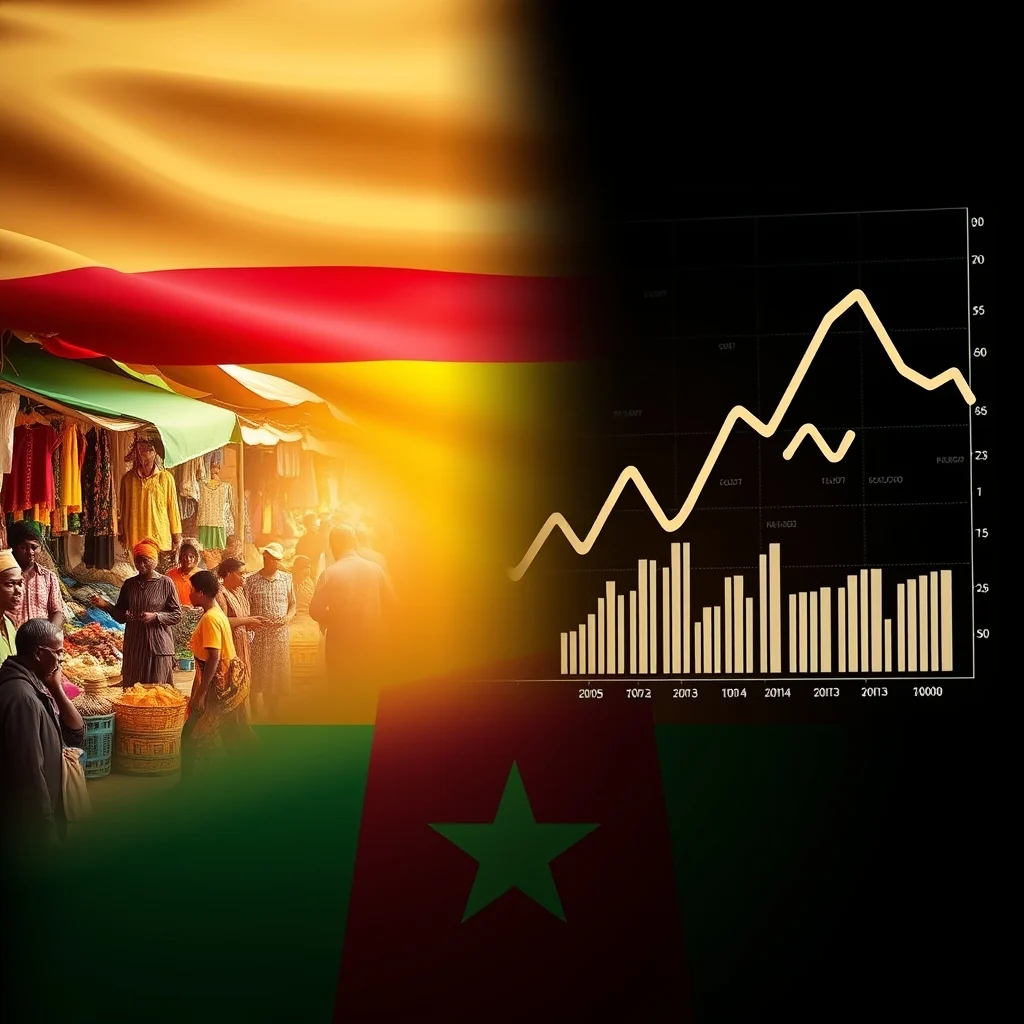
Ghana is poised for new tax measures in its mid-year budget as government expenditure outpaces revenue collection in early 2026, despite strong economic growth and macroeconomic stability. The Bank of Ghana’s May 2026 Summary of Economic and Financial Data reveals a widening fiscal gap, with cumulative revenue and grants at just 3.6% of GDP by the end of March 2026, while total government expenditure reached 3.9% of GDP in the same period, indicating a first-quarter deficit.
Context of Economic Performance
The first quarter of 2026 presented a stark contrast between Ghana’s headline economic achievements and its underlying fiscal health. Inflation had dramatically decreased to 3.8% from 23.8%, the Ghanaian Cedi appreciated by 40.7% against the US dollar, and the economy experienced robust growth of 6.0%, the highest in six years. This positive macroeconomic environment included strong real GDP growth of 5.8% in Q4 2025 and 7.1% for non-oil GDP. The Composite Index of Economic Activity also showed significant growth at 12.6% in March 2026, with both business and consumer confidence indices well above the 100 mark.
Revenue Shortfall Despite Growth
Despite this vibrant economic activity, Ghana’s tax revenue collection is lagging. Tax revenue stood at a mere 3.0% of GDP after three months, projecting an annualized rate below the 13.1% of GDP recorded for the full year 2025. This suggests that the expanding economy is not translating into proportionally higher tax receipts. Conventional logic dictates that a growing economy should bolster tax revenues, but Ghana’s current fiscal data challenges this assumption.
Structural Weaknesses in the Tax System
The persistent revenue gap is attributed to structural weaknesses within Ghana’s tax architecture. A significant informal sector, estimated to comprise over half of economic activity, largely operates outside the formal tax net. Furthermore, generous tax exemptions diminish the effectiveness of Value Added Tax (VAT) and corporate taxes. Compliance issues across income taxes and import duties also contribute to the shortfall. Consequently, the benefits of a stronger cedi and declining interest rates are not being fully captured by the national treasury.
Limited Options for Expenditure Reduction
Reducing government spending is not a viable solution for closing the fiscal gap. Capital expenditure, crucial for infrastructure development, has already been compressed to near-minimal levels, reaching only 1.4% of GDP for the entire year 2025 and a scant 0.5% of GDP in Q1 2026. Further cuts would risk violating development commitments, jeopardizing funding from international partners like the World Bank and African Development Bank, and potentially leading to public discontent.
Recurrent expenditures, including wages, debt servicing, and health subsidies, are also largely inflexible. Unresolved arrears for the National Health Insurance Scheme (NHIS) and the necessity of maintaining public sector wages present ongoing fiscal pressures. Debt servicing alone consumes a substantial portion of government revenue.
IMF Programme and Fiscal Discipline
Ghana’s Extended Credit Facility (ECF) program with the International Monetary Fund (IMF), which has seen disbursements of approximately $2.8 billion, mandates adherence to a primary surplus trajectory and specific revenue targets. Any significant deviation from these revenue benchmarks, as indicated by mid-year data, could jeopardize the sixth ECF review scheduled for late 2026. This could threaten future disbursements, negatively impact Ghana’s recently upgraded credit ratings from S&P (B-) and Moody’s (positive outlook), and undermine the fragile investor confidence that has been carefully rebuilt.
The IMF’s fiscal framework effectively rules out borrowing to cover the revenue shortfall or allowing the deficit to widen unchecked. This leaves revenue enhancement as the primary and most feasible policy lever for the government.
Implications and Future Outlook
The current fiscal arithmetic points towards an inevitable introduction of new or expanded revenue measures in Ghana’s mid-year budget. The government must address the fact that economic growth is occurring in sectors and services, including digital commerce and informal trade, that the existing tax system is not designed to capture efficiently. The historically low tax-to-GDP ratio is unlikely to improve significantly in 2026 without deliberate intervention.
Potential measures could include a digital financial services levy, an expansion of the VAT base, increased excise duties on products like alcohol and tobacco, or a financial sector tax, or a combination thereof. The economic conditions—low inflation, falling interest rates, and positive growth—suggest that the economy can absorb new taxes. The critical challenge is to implement these measures in a way that does not jeopardize the IMF program and the hard-won macroeconomic stability. The choice in the upcoming mid-year budget will not be whether to tax, but rather who will be taxed and through which mechanisms.
Moving forward, the focus will be on the specific tax policies introduced and their effectiveness in boosting revenue mobilization without stifling economic activity or undermining investor confidence. The government’s ability to navigate these fiscal challenges will be a key determinant of Ghana’s continued economic recovery and stability.







Leave a Reply