
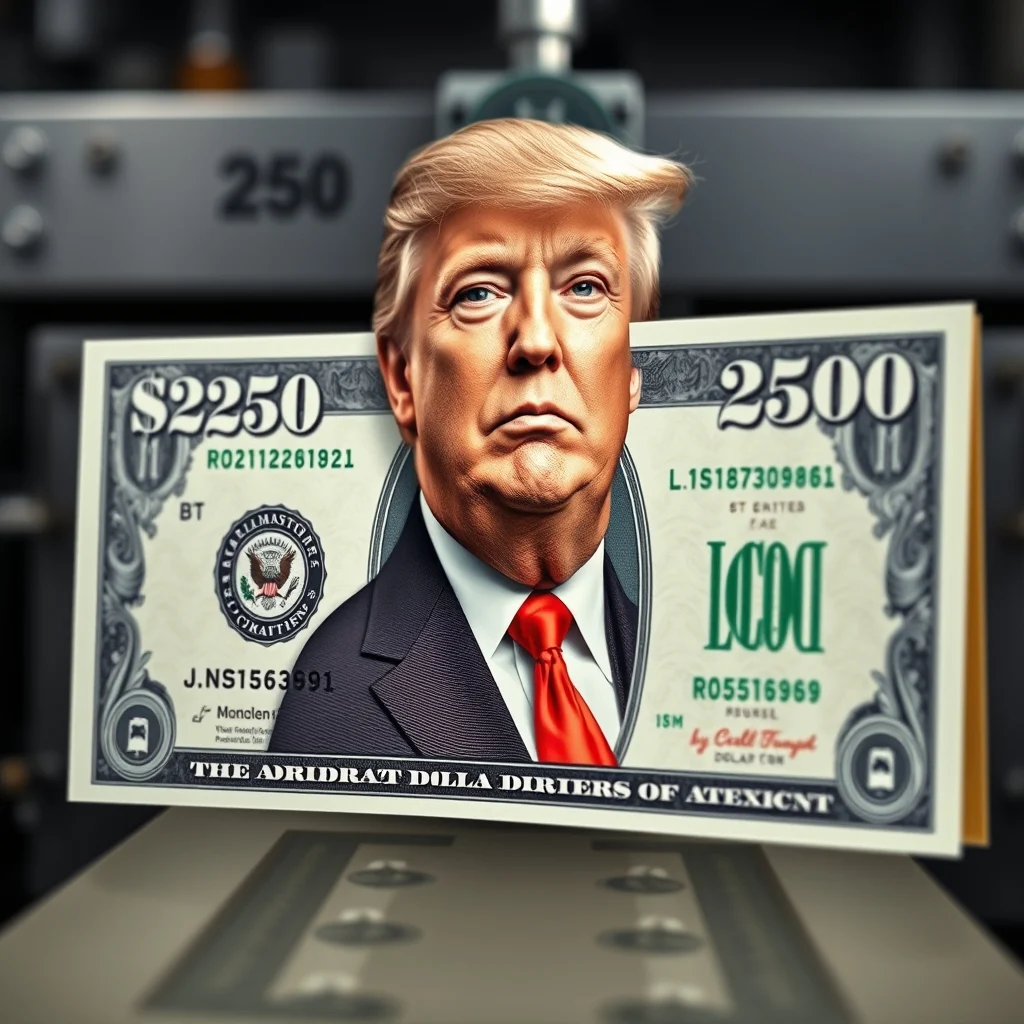
The Trump administration is reportedly preparing for the potential printing of a new $250 denomination bill, which could feature President Donald Trump’s portrait. This move hinges on the passage of legislation currently before Congress that seeks to create an exception to federal law prohibiting the image of a living person on U.S. currency. A Treasury Department spokesperson confirmed to the BBC that the agency is undertaking “appropriate planning and due diligence” in anticipation of this legislative possibility.
Legislative Context and Rationale
The proposed legislation, introduced by Republican Representative Joe Wilson of South Carolina, aims to commemorate the nation’s 250th anniversary. Allies of President Trump have suggested the $250 bill amount would symbolically align with this milestone. Trump’s signature is already slated to appear on U.S. paper notes as part of the semiquincentennial celebrations.
Treasury Secretary Scott Bessent stated that the department’s preparations are contingent on Congressional approval and adherence to the law. He indicated no impropriety in featuring the image of the sitting president on a bill marking a national anniversary.
Potential Legal and Practical Hurdles
Beyond the existing federal law barring living individuals on currency, the proposed $250 denomination itself deviates from currently authorized denominations. Federal law dictates which denominations can be produced, and $250 is not among them. While larger denominations like $500, $1,000, and $10,000 have been issued in the past, they were discontinued in 1969 and are no longer in general circulation.
The development of new currency notes is a lengthy process, typically involving multiple agencies such as the Federal Reserve Board and the U.S. Secret Service. Designs are traditionally kept confidential until about six to eight months before release to prevent counterfeiting and ensure market readiness, according to the Bureau of Engraving and Printing (BEP). It remains uncertain if such a note could be produced in time for the July 4th anniversary.
Criticism and Political Undercurrents
The initiative has drawn sharp criticism from some lawmakers. Senator Mark Warner, a Democrat from Virginia and a member of the Senate Banking Committee, voiced his opposition. He argued that the focus on such a bill distracts from pressing economic concerns faced by American families, such as the rising costs of gas, groceries, housing, and healthcare.
Warner stated, “As Americans struggle with the rising cost of gas, groceries, housing, and health care, President Trump’s priorities for taxpayer dollars are completely detached from the challenges families face every day.” He suggested that the energy spent on promoting the president’s image could be better directed towards addressing these economic hardships.
Critics also point to a pattern of the Trump administration and its allies seeking to place the president’s likeness on national institutions and symbols. Examples cited include the renaming of the Kennedy Center to include Trump’s name, the inclusion of his portrait on U.S. passports, and the repainting of Air Force One in colors preferred by the president.
Implications and Future Outlook
The potential issuance of a $250 bill featuring President Trump, if it overcomes legal and legislative challenges, would represent a significant departure from historical norms in U.S. currency design. It raises questions about the politicization of national symbols and the priorities of government spending.
The process will require navigating existing statutes and potentially creating new ones, involving scrutiny from both houses of Congress. The public reaction and the outcome of these legislative efforts will be closely watched. Furthermore, the BEP’s adherence to its established design release timelines will be a key factor in determining the feasibility and timing of any such commemorative note, especially in relation to the 250th anniversary deadline.










Leave a Reply