
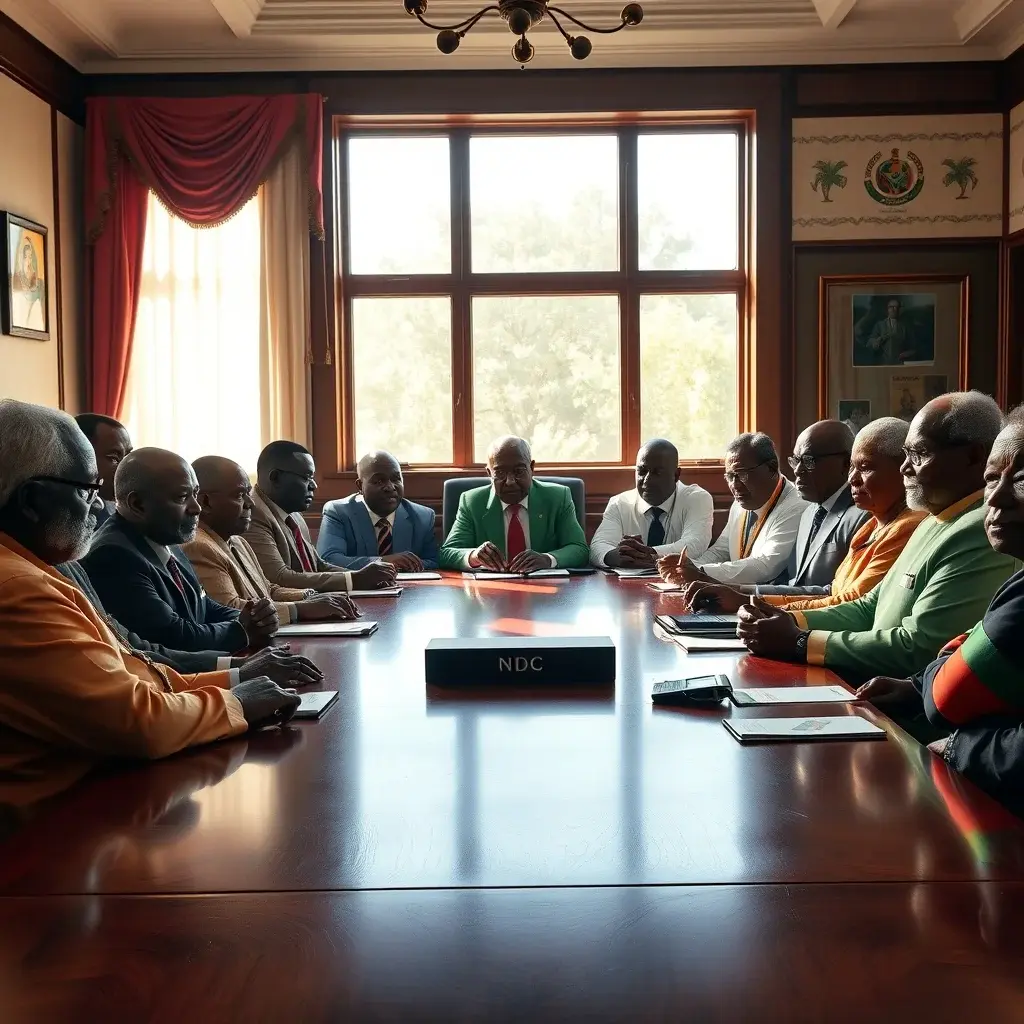
Accra, Ghana – The recent directive from the National Democratic Congress (NDC) Council of Elders discouraging early presidential campaign activities is being interpreted by the New Patriotic Party (NPP) as a clear sign of President John Dramani Mahama’s deep concern over escalating divisions within his own party. NPP Deputy General Secretary Haruna Mohammed stated on Joy FM’s Top Story on Monday, June 1 that the Council’s letter was not an independent move but had the President’s explicit backing, indicating his worry about the party’s internal dynamics.
Underlying Tensions Surface
Mohammed asserted that the directive from the Council of Elders points to significant underlying tensions within the NDC. These tensions are reportedly fueled by various factions positioning themselves for future presidential primaries, creating a landscape of competing interests.
“If you read the letter correctly, it means that President Mahama is worried about what is going on,” Mohammed explained. “He took part in the decision-making, he consented to what they had written and that is why it is out there.”
He further elaborated on the perceived rift, stating, “And again, if you see what is happening, it tells you that there is a clear division within the NDC… President Mahama is doing something, the National Chairman and some other groups are doing something else.” This suggests a disconnect between the President’s agenda and other influential party figures.
Mahama’s Stake in Succession
The NPP official also contended that President Mahama, along with some government members, likely harbors preferences for specific candidates in the upcoming presidential race. Mohammed argued that it would be improbable for the President not to have a vested interest in who eventually succeeds him as the NDC’s flagbearer.
“President Mahama has a casting vote in the NDC presidential primaries,” Mohammed stated. “So most definitely, he has a candidate. As I said earlier, he is very much concerned about who will succeed him as a flagbearer.” This highlights the President’s potential influence and personal investment in the party’s leadership succession.
Directive as a Serious Signal
Mohammed emphasized that the President’s participation in the discussions leading to the Council of Elders’ directive underscores the gravity with which Mahama views the emerging internal situation. The issuance of the letter, therefore, serves as a direct reflection of his considerable concern.
“So for him to participate in the meeting and raise those particular concerns before him, and this has occasioned a letter to be issued, it tells you how concerned he is,” Mohammed added. “And that is why he took part in that particular decision.” The involvement of the President in such a directive signals a strategic effort to manage internal party conflicts and potentially shape the future leadership landscape.
Implications for NDC’s Future
The NPP’s interpretation suggests that the NDC is grappling with significant internal challenges that could impact its cohesion and electoral prospects. The Council of Elders’ directive, backed by the President, may be an attempt to curb infighting and present a united front. However, it also reveals the extent of the divisions that necessitate such intervention.
For observers, this situation highlights the complex dynamics of party politics, particularly concerning leadership transitions. The perceived influence of the incumbent President in succession planning is a common theme, but the explicit nature of this alleged involvement raises questions about democratic processes within the party.
The effectiveness of this directive in quelling internal dissent remains to be seen. It is possible that such an intervention could exacerbate tensions if certain factions feel their ambitions are being unfairly curtailed. The coming months will likely reveal whether the NDC can successfully navigate these internal divisions or if they will become a significant impediment to its political future.





Leave a Reply