
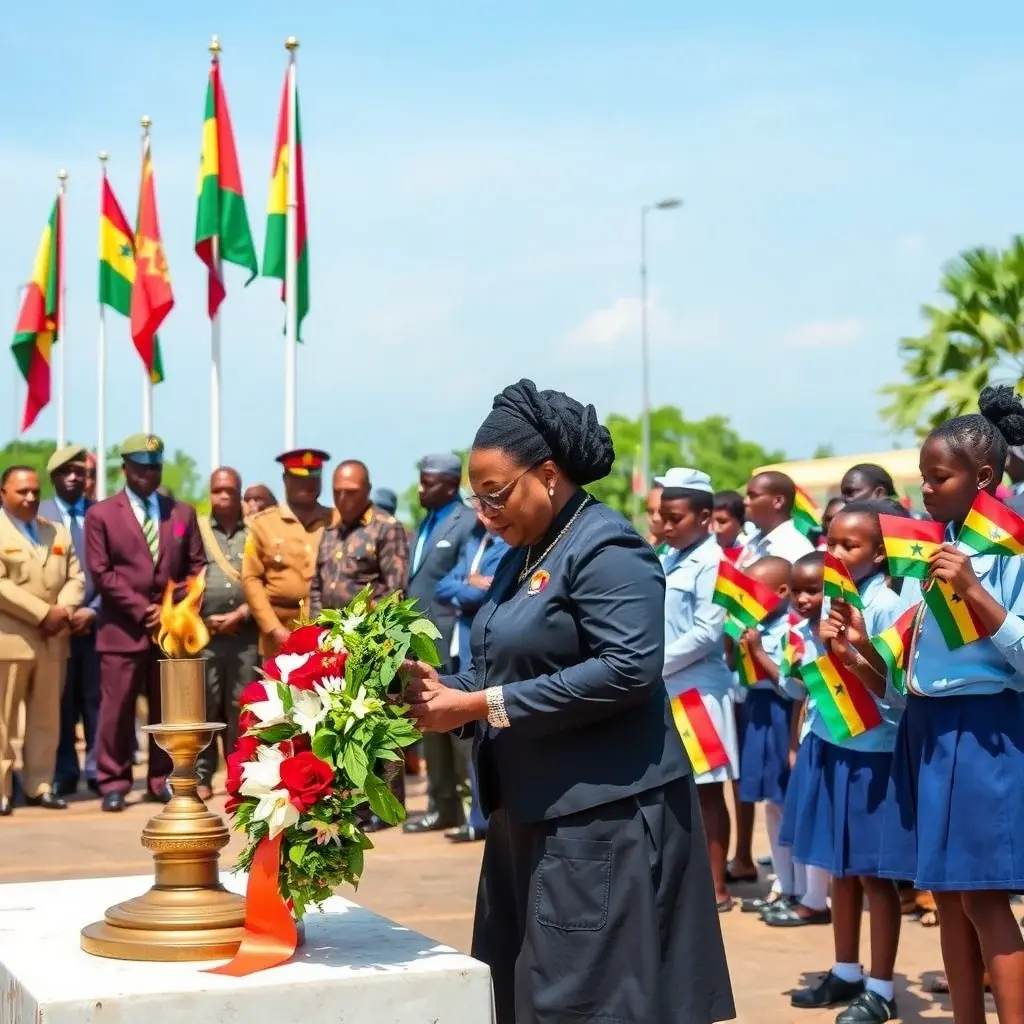
Vice President Professor Jane Naana Opoku-Agyemang led the nation in observing the 47th anniversary of the June 4 Uprising on Thursday, laying a wreath at Banda-Ahenkro in the Bono Region. The commemoration, attended by National Democratic Congress (NDC) leadership and members, honored the ideals of probity, accountability, and social justice championed by the 1979 revolution, which was initiated by the late former President Flight Lieutenant Jerry John Rawlings.
Commemoration Highlights and Theme
This year’s event, themed “Strengthening State Institutions: Lessons from the June 4, 1979 Uprising,” included a reveille ceremony, the hoisting of miniature Ghana flags, and the lighting of a perpetual flame. A minute of silence was observed to remember national figures who contributed to the country’s democratic development.
The ceremony featured a vibrant parade display by students from Drobo Our Lady of Providence Senior High School and Bandaman Senior High and Technical School. In total, seven wreaths were laid to honor national heroes and the principles of the uprising.
Wreath Laying and Representation
Mr. Johnson Asiedu Nketiah, the National Chairman of the NDC, ignited the perpetual flame. Wreaths were laid on behalf of various groups, symbolizing broad national representation. Colonel Asumah Yeboah, National Security Coordinator, laid a wreath for the security services.
Mr. Kusi Appiah, a cadre, represented the Cadre Corps. Traditional authorities were honored by Nana Tolee Gyato II, Kyidomhene of the Banda Traditional Area. Farmers and fishers were represented by Mr. Fred Kwakwo Shie, the 2025 Banda District Best Farmer.
Wreaths for women and the youth were jointly laid by Madam Hajia Adisa and Mr. Tchinatchi Hogan. The late former President Rawlings was specifically memorialized with a wreath laid by Mr. Fiifi Fiavi Kwetey, General Secretary of the NDC.
Historical Context and Objectives
The June 4 Uprising in 1979 was a pivotal moment in Ghana’s history, aimed at rectifying widespread corruption, economic mismanagement, and soaring inflation. The revolution sought to implement a radical reform agenda to restore integrity and fairness in governance.
The commemoration underscored the ongoing relevance of these objectives. A march-past involving NDC women’s groups, youth organizations, students, and cadet corps further highlighted the broad support and continued engagement with the ideals of the uprising.
Expert Perspectives and Data
While this year’s event focused on official commemorations, historical analysis of the June 4 Uprising often highlights its complex legacy. Scholars and political commentators frequently cite the period as a critical juncture that exposed deep-seated issues of governance and accountability in Ghana.
The emphasis on strengthening state institutions, as reflected in the theme, aligns with contemporary discussions on good governance. Reports from organizations like Transparency International consistently point to corruption and institutional weakness as ongoing challenges for many African nations, underscoring the enduring relevance of the issues addressed by the June 4 Uprising.
Implications and Future Outlook
The 47th anniversary serves as a reminder of the persistent need for vigilance against corruption and economic mismanagement. The focus on strengthening state institutions suggests a national commitment to building more resilient and accountable governance structures.
As Ghana navigates its current economic and political landscape, the lessons drawn from the June 4 Uprising are likely to continue informing policy discussions and public discourse. Observers will be watching to see how effectively these historical ideals are translated into concrete actions to foster greater probity and social justice in the years to come.








Leave a Reply