
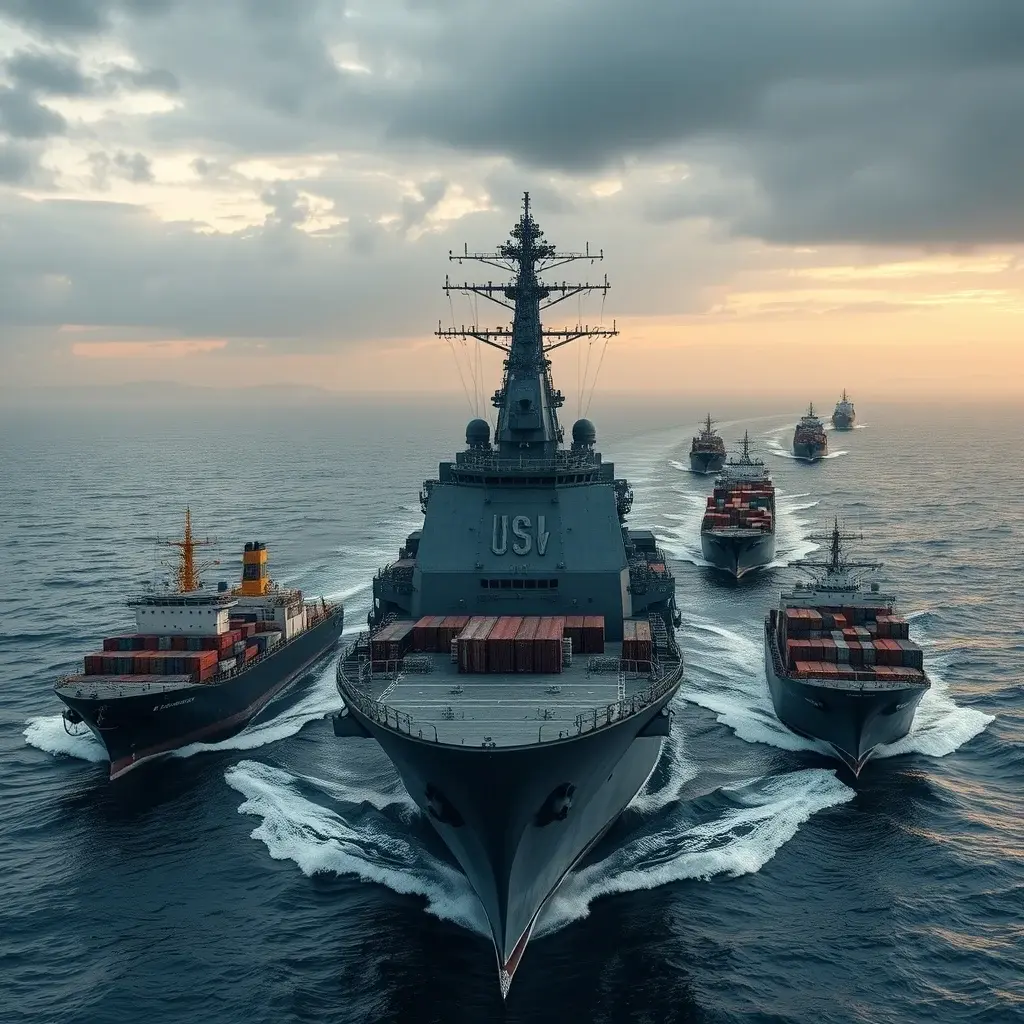
President Donald Trump announced Monday that the United States will initiate ‘Project Freedom,’ a humanitarian operation aimed at freeing merchant ships stranded by Iran’s closure of the critical Strait of Hormuz shipping channel. The initiative, involving approximately 15,000 US service personnel, guided-missile destroyers, and over 100 aircraft, seeks to reopen the vital waterway which has seen global fuel prices surge and thousands of sailors trapped.
Context of the Strait of Hormuz Blockade
The Strait of Hormuz, a narrow waterway between Iran and Oman, is a globally significant chokepoint for oil and natural gas transport. Approximately 20% of the world’s oil and liquefied natural gas typically passes through this strait. Iran’s decision to close the channel, which began at the start of a recent conflict, has had immediate and far-reaching economic consequences.
The blockade has left an estimated 2,000 ships stranded, trapping around 20,000 sailors. Growing concerns have emerged regarding dwindling supplies and the deteriorating physical and mental health of these seafarers. The United Kingdom Maritime Transportation Operation (UKMTO) reported Sunday that a tanker had been struck by an “unknown projectile” within the strait, though its crew remained safe.
‘Project Freedom’ and Diplomatic Maneuvers
President Trump characterized ‘Project Freedom’ as a “humanitarian gesture,” emphasizing that any interference with the operation would be met with a forceful response. He stated that countries worldwide had requested US assistance in freeing the neutral and innocent vessels caught in the blockade.
This operation unfolds against a backdrop of ongoing diplomatic efforts. A temporary ceasefire between the US and Iran commenced on April 8th, with both nations reportedly engaged in discussions for a permanent peace plan. Trump indicated that US representatives were holding “very positive” talks with Iran, suggesting potential breakthroughs.
However, the situation remains tense. The Iranian military claimed Monday to have prevented American and Israeli “enemy destroyers” from entering the strait, according to state media. Iran had previously warned that any foreign forces entering the strait, particularly the “aggressive US army,” would face attack. A senior Iranian official cautioned that any US attempt to interfere would be viewed as a violation of the ceasefire.
Peace Proposals and Confidence-Building Measures
The US move comes shortly after Iranian state-linked media reported Tehran had received a US response to its latest peace proposal. This response, delivered via Pakistan, was reportedly under review by Iran. While the US has not formally confirmed sending a reply, reports suggest President Trump found the Iranian proposal unacceptable.
Iran’s peace plan, detailed in a 14-point proposal, reportedly called for the withdrawal of US forces from near its borders, an end to the naval blockade of Iranian ports, and a cessation of all hostilities, including Israeli actions in Lebanon. The proposal also aimed for an agreement within 30 days, focusing on ending the current war rather than extending the ceasefire.
Notably, Iran’s foreign ministry spokesman stated that “at this stage, we do not have nuclear negotiations,” a key US demand. Iran has consistently denied pursuing nuclear weapons, asserting its program is for peaceful purposes, despite enriching uranium to near weapons-grade levels.
In a separate development, Pakistan announced that 22 crew members from the Iranian container ship Touska, seized by the US last month as part of the blockade, would be handed over to Iranian authorities. Iranian media confirmed 15 crew members had already returned. Pakistan described this repatriation as a “confidence-building measure by the United States of America.”
Implications and Future Outlook
The launch of ‘Project Freedom’ signals a potentially significant escalation in the US approach to the Strait of Hormuz situation, even as diplomatic channels remain open. The operation’s success could alleviate immediate humanitarian concerns for stranded sailors and ease global energy market pressures. However, it also carries the risk of reigniting direct confrontation with Iran, potentially jeopardizing the fragile ceasefire and peace talks.
The effectiveness of ‘Project Freedom’ and Iran’s response will be critical factors to watch. The ongoing diplomatic exchanges, particularly regarding the peace proposals and the contentious issue of Iran’s nuclear program, will shape the future trajectory of US-Iran relations and regional stability. The world will be observing closely whether these moves lead to lasting peace or a renewed period of conflict.








Leave a Reply