
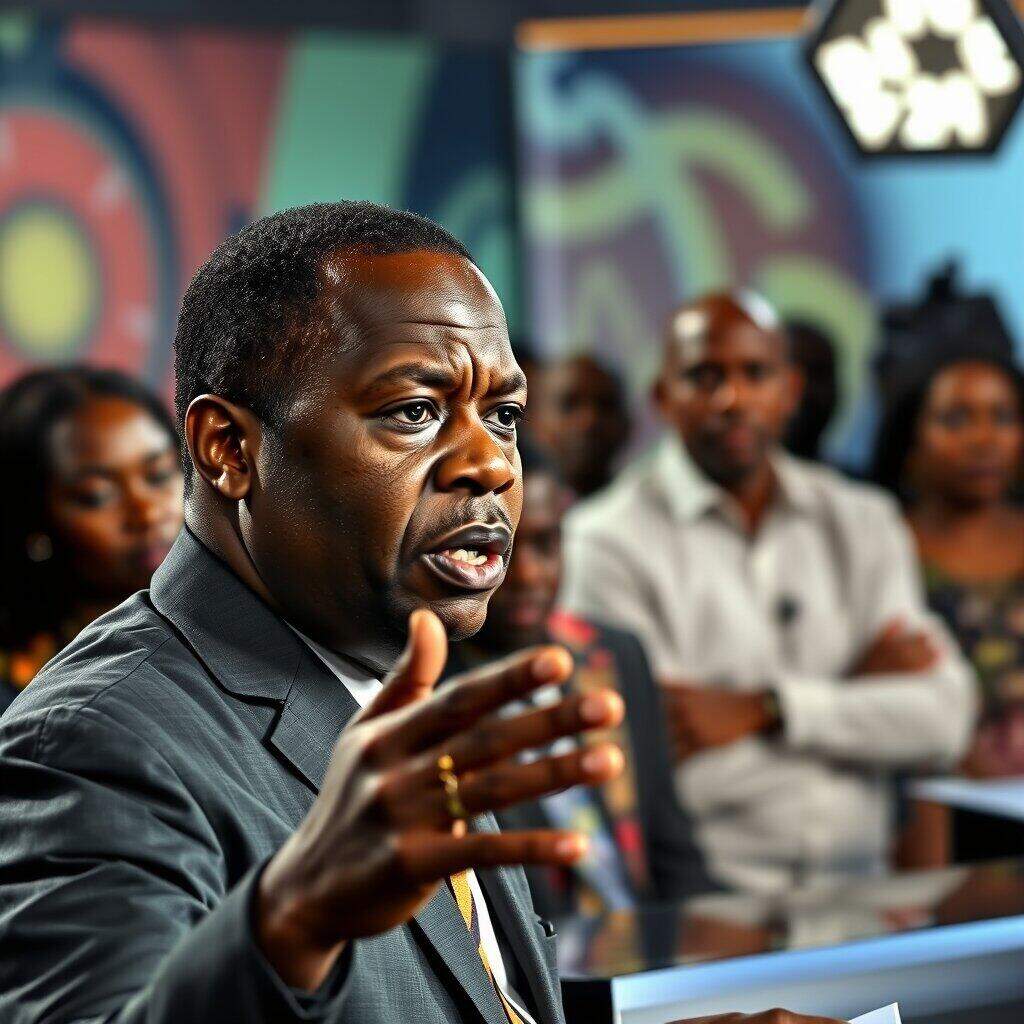
Accra, Ghana – A senior official within Ghana’s ruling New Patriotic Party (NPP) has sounded an alarm over a growing trend of “politics of insult” that he believes is undermining the nation’s democratic progress. Richard Ahiagbah, the NPP’s Director of Communications, stated on Tuesday that a culture of verbal aggression and intolerance in public discourse poses a significant threat that requires immediate national attention.
Erosion of Democratic Discourse
Speaking on Joy News’ PM Express, Ahiagbah articulated his concerns about the current state of political engagement in Ghana. He highlighted instances where individuals are attacked and disrespected not for their arguments, but simply for expressing their views.
This worrying trend has been amplified by a recent controversy involving remarks made by a political figure. The incident sparked widespread public outcry, culminating in an emotional apology from the Chief of Staff, reigniting a crucial debate about respect, free speech, and accountability within Ghana’s political sphere.
Ahiagbah emphasized that a healthy democracy thrives on the free and open exchange of ideas, not on intimidation or personal attacks. He argued that for Ghana to achieve the quality governance it aspires to through its democratic process, citizens must feel empowered to participate in public discourse.
“If we want to achieve the kind of quality governance that we want to gain from the democratic process as much as we want, then we must engage in a conversation that prioritises ideas that allow citizens to come to the arena and share their views to advance the solutions that governments supply themselves to,” Ahiagbah stated.
Beyond Apologies: The Need for Action
While acknowledging the significance of the Chief of Staff’s public apology in response to the recent incident, Ahiagbah stressed that an apology alone is insufficient to curb such behavior. He suggested that tangible consequences are necessary to deter future misconduct.
“To the extent that the Chief of Staff himself will have to take the mic, and apologise for this in front of the President… I think that it demonstrates how all of us Ghanaians reject the politics of insult,” he commented, noting the broad rejection of such tactics.
However, he firmly believes that the next step must involve more than just words. “The next step, respectfully, I’ll appeal to the Chief of staff… is for him to consider removing from a post,” Ahiagbah proposed. He posited that such decisive action would send an unambiguous message that disrespect and recklessness in public office have serious consequences.
Protecting Citizen Participation
Ahiagbah warned that a failure to implement meaningful consequences risks normalizing intimidation and stifling citizen participation in national conversations. He believes that decisive action is the only way to set a precedent and prevent a further degradation of public discourse.
“That is the only way we can mark this moment and say that never again will we degenerate our conversation into an arena such as that,” he asserted. He underscored that the constitutional right to express views on national issues should be protected for all citizens, regardless of their background or status.
“It doesn’t matter if they are Chief Priests of a shrine, or they are the bishop or their Reverend… they are, first of all, a citizen whose voice must not be silenced,” he added, emphasizing the universality of free speech.
Setting Precedents for Accountability
Describing the recent incident as reckless, Ahiagbah urged political leaders to establish and uphold clear standards of conduct. He invoked historical context, suggesting that Ghana has previously rejected similar behaviors, with individuals facing repercussions.
“There was a point in time when Ghana… rejected a certain behaviour, and somebody suffered for it. And so if I’m considering doing that tomorrow, I should know the consequences,” he remarked.
He reiterated that while the Chief of Staff’s apology was commendable, the removal of the official involved would serve as a powerful and “instructive” signal. This action, he believes, would clearly demonstrate that the political class values and respects input from all citizens, reinforcing the integrity of Ghana’s democratic institutions.
Looking Ahead
The call for accountability and decisive action highlights a critical juncture for Ghana’s democracy. The coming weeks and months will reveal whether the political leadership will heed these warnings and implement measures to curb the “politics of insult,” thereby safeguarding the nation’s democratic gains and fostering a more robust public sphere. The focus will be on whether apologies are followed by concrete actions that reinforce the importance of respectful discourse and citizen engagement.










Leave a Reply