
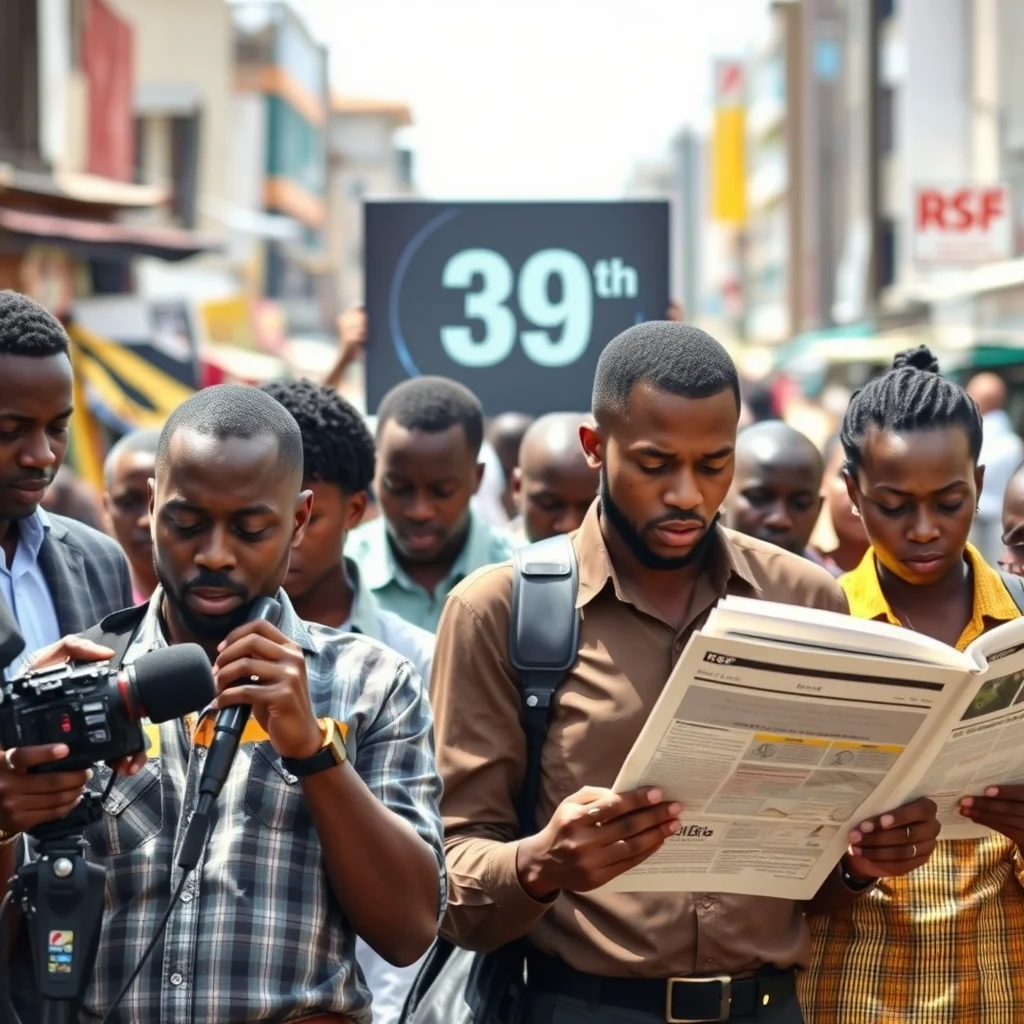
Ghana has climbed to 39th place out of 180 countries in the 2026 Reporters Without Borders (RSF) World Press Freedom Index, achieving a score of 72.20. This marks Ghana’s strongest performance in five years and a significant recovery from its 52nd position in 2025. The country continues to be recognized as one of Africa’s more resilient media democracies, navigating the evolving balance between constitutional ideals and practical realities.
This latest ranking is not an isolated event but the result of a five-year period characterized by fluctuations. Ghana’s position has oscillated, moving from 60th in 2022 and 62nd in 2023, to a recovery at 50th in 2024, a slight dip to 52nd in 2025, and now a sharp ascent by 13 places to 39th in 2026. This trajectory indicates a process of political and institutional recalibration, marked by periods of strain, adaptation, and gradual correction rather than a linear progression.
Context and Trajectory
Ghana’s press freedom journey over the past five years can be understood as a narrative of interrupted consolidation. The initial decline observed between 2022 and 2023 was largely attributed to worsening economic conditions within the media sector and growing concerns over the safety of journalists.
This was followed by a phase of cautious stabilization in 2024 and 2025, preceding the decisive rebound in 2026. This suggests an incremental restoration of confidence in the country’s media environment, rather than a sudden or transformative shift.
African and Global Comparisons
Within the African continent, Ghana’s current 39th position places it in the upper tier of press freedom performers. It joins countries like South Africa, Seychelles, and Namibia, which have consistently demonstrated stronger institutional protections for media independence. Ghana’s progress signifies a narrowing gap with these continental leaders, although structural vulnerabilities persist.
Compared to other African nations, Ghana exhibits a stronger constitutional framework for media protection than Kenya, though both face pressures from political influence and financing constraints. Nigeria ranks lower, affected by regulatory challenges and ongoing safety concerns for journalists. Morocco shows moderate progress within a more controlled communication environment, while South Africa maintains its leadership, supported by a robust judiciary and entrenched institutional safeguards.
Factors Driving Improvement
The improvement in Ghana’s 2026 ranking is primarily linked to advances in its legal and political environments. The constitution continues to offer strong normative guarantees for press freedom, and the Right to Information Act has enhanced formal access to public information. However, a gap between legal provisions and administrative practice remains, with bureaucratic delays and procedural hurdles still limiting the full realization of transparency rights.
Politically, the environment shows modest improvement, with reduced direct interference in media operations. Nevertheless, the influence of media ownership structures connected to political interests continues to be a concern, subtly shaping editorial content and raising questions about the independence of certain media outlets.
Persistent Challenges: Economic and Safety Concerns
Economically, the media sector remains on fragile ground. Despite the positive index ranking, many media organizations struggle with financial viability, uneven advertising markets, and a continued reliance on state advertising, which is often perceived as inconsistently allocated. This economic precarity contributes to low journalist remuneration, institutional instability, and the collapse of some media outlets, posing a significant threat to sustainable media independence.
Socially, Ghana boasts one of West Africa’s most diverse and vibrant media landscapes, featuring numerous radio stations, television networks, and digital platforms. This pluralism is reflected in relatively strong social indicators. However, increasing political polarization in media discourse is gradually eroding public trust, as audiences increasingly view segments of the media as politically aligned rather than institutionally neutral.
Journalist safety remains an enduring concern. While statistical indicators show improvement and better performance in this category compared to previous years, incidents of physical assault, harassment, and weak prosecution of offenders continue to undermine the sense of security among professionals. Journalists covering sensitive issues such as illegal mining, environmental degradation, corruption, and governance failures are particularly vulnerable, highlighting a persistent gap between formal protections and practical enforcement.
Advocacy and Institutional Roles
Throughout this period, various organizations, including the Ghana Journalists Association (GJA), the Ghana Independent Broadcasters Association, the Media Foundation for West Africa, the Private Newspapers and Online News Publishers Association of Ghana, and the National Media Commission, have played crucial advocacy roles. The GJA’s sustained engagement has kept press freedom, safety, and professional standards in national discourse, even as institutional reforms progress unevenly.
Implications and Future Outlook
Ghana’s rise to 39th in the 2026 RSF World Press Freedom Index represents a dual reality of achievement and caution, progress and fragility. While the constitutional framework offers strong guarantees, uneven enforcement of laws and the influence of politically connected ownership structures present ongoing challenges. The media landscape’s vibrancy is tempered by economic precarity, and journalist safety, though improving on paper, remains fragile in practice.
Sustaining this positive trajectory will require deeper structural reforms. Strengthening journalist protection mechanisms, accelerating the prosecution of attacks against media practitioners, enhancing transparency in state advertising allocations, and safeguarding the independence of regulatory institutions are critical imperatives. Furthermore, addressing the economic architecture of the media sector through diversified sustainability models is essential to reduce dependency on political entities and the state.
Ghana’s current standing is not a final destination but a significant milestone in an ongoing journey toward fully consolidated media freedom. Future progress will depend on continued commitment to these structural reforms and the consistent application of protections for journalists and media institutions.

Leave a Reply