
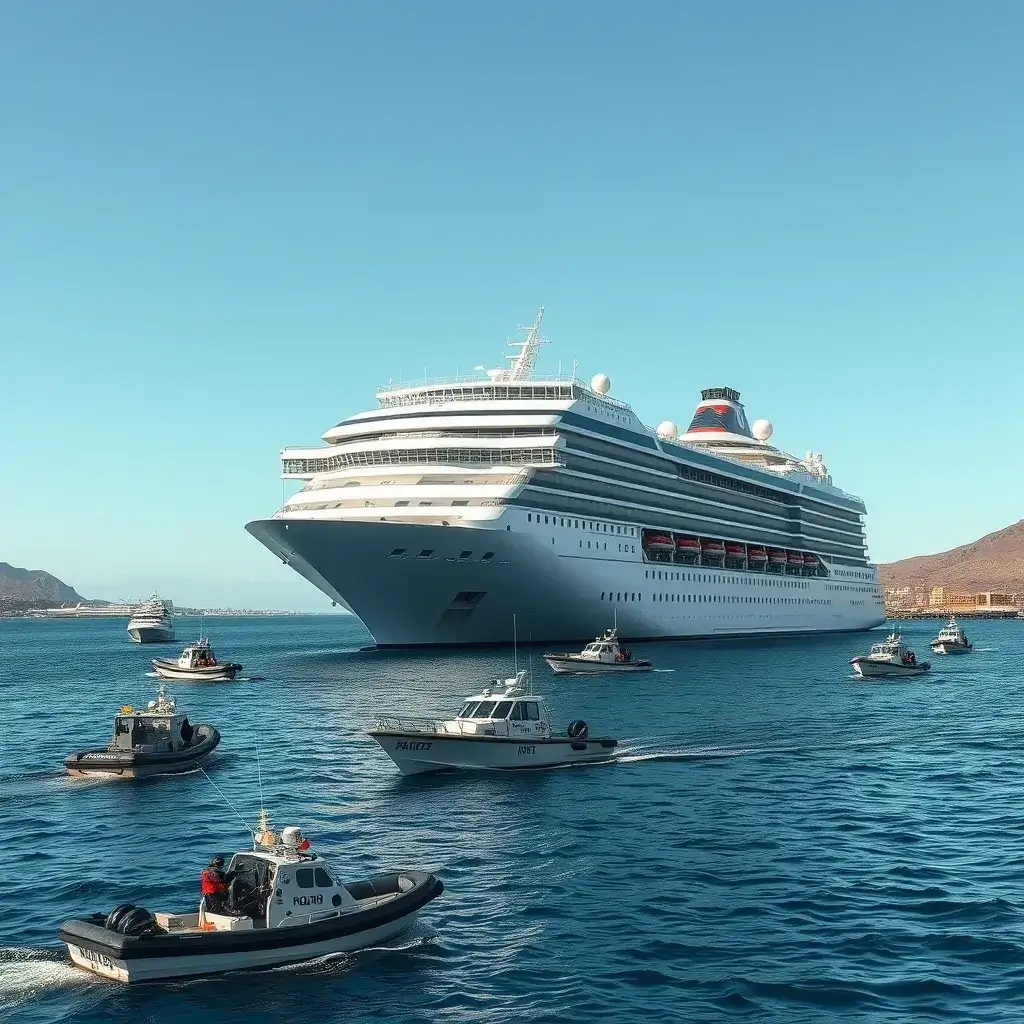
Spain has initiated a large-scale evacuation of passengers from the cruise ship MS Hondius, which is anchored near Tenerife in the Canary Islands due to a hantavirus outbreak. Health Minister Mónica García confirmed the operation is proceeding smoothly, with all passengers currently asymptomatic. The evacuation involves dividing passengers by nationality and transporting them to shore via small boats, from where charter planes will facilitate their repatriation.
The operation commenced with the disembarkation of fourteen Spanish nationals, followed by passengers being flown out by the Netherlands, including Dutch, Greek, and German individuals, along with a portion of the crew. Subsequent flights are scheduled for passengers bound for the UK and the US, with the final evacuation flight expected to depart for Australia on Monday.
Meticulous Preparations Amidst Public Health Concerns
The MS Hondius arrived off the coast of Granadilla before dawn on Sunday, a month after the first passenger reportedly died from the virus. A significant operation unfolded on land to manage the disembarkation of over 100 passengers and crew. Medical teams boarded the vessel around 7:00 AM on Sunday to screen everyone for signs of the virus.
Extensive preparations were made to receive the ship, which was not permitted to dock. A security perimeter of one nautical mile was established around the vessel as it approached the island. Dozens of intensive care specialists were on standby at the Candelaria hospital in Tenerife, equipped with a specialized isolation facility for infectious diseases, including testing kits and ventilators, in case any individuals became seriously ill during the transfer.
Dr. Mar Martin, chief intensive care doctor, stated, “We are absolutely ready. We’ve never seen [hantavirus] before – but it’s a virus, with some complications, just like we manage every day. We are fully trained for that.”
Unprecedented Operation to Contain Rare Virus
The complex operation, aimed at preventing the spread of the rare Andes strain of hantavirus, has been described as “unprecedented” by Spain’s health minister. She emphasized that the risk of contagion to the general population was low, cautioning against alarmism and misinformation.
Security measures were heightened at the port, an industrial facility in southern Tenerife. Spanish military police and disaster response teams established large reception tents, and access to the waterfront was restricted. Spanish nationals disembarking will be flown to Madrid for a mandatory quarantine at the Gomez Ulla military hospital, given the virus’s incubation period of up to nine weeks.
International Oversight and Local Reassurance
Tedros Adhanom Ghebreyesus, Director-General of the World Health Organization (WHO), who was in Tenerife to oversee the operation, praised the Spanish authorities for their “solid and effective response.” The outbreak has been traced to a landfill site in southern Argentina, a popular birdwatching spot, where rodents carry the virus. Human-to-human transmission is rare, but three cruise passengers have died.
Ghebreyesus urged the public to trust the authorities, acknowledging the lingering trauma from the COVID-19 pandemic but assuring that the risk of wider contagion was low due to the nature of the virus and Spain’s preparedness.
Navigating Local Opposition and Ensuring Safety
The decision to divert the Hondius to Tenerife faced some local opposition. Port workers protested on Friday, concerned about the adequacy of safety measures. The situation briefly became chaotic when the president of the Canary Islands initially refused to permit the ship into port, citing concerns about the disembarkation process taking longer than a day. The central government intervened to resolve the issue.
Despite initial concerns raised by local officials about the potential for a rodent to spread the virus, health officials reassured the public that such a scenario posed no significant risk. Public sentiment on the island generally reflects a cautious but reassured outlook, with residents trusting that close contact is required for transmission.
An End in Sight for Passengers, A New Beginning for Quarantine
Approximately 30 crew members will remain on board to sail the cruise ship back to the Netherlands. For the majority of passengers, the evacuation marks an end to weeks of fear and uncertainty at sea, ushering in the next phase: a period of quarantine that will extend for weeks.
The successful, albeit complex, evacuation highlights the challenges in managing rare infectious disease outbreaks in a globalized travel environment. The long-term implications for cruise line protocols and international health emergency response are likely to be significant, particularly in balancing public safety with the rights and well-being of travelers.










Leave a Reply