
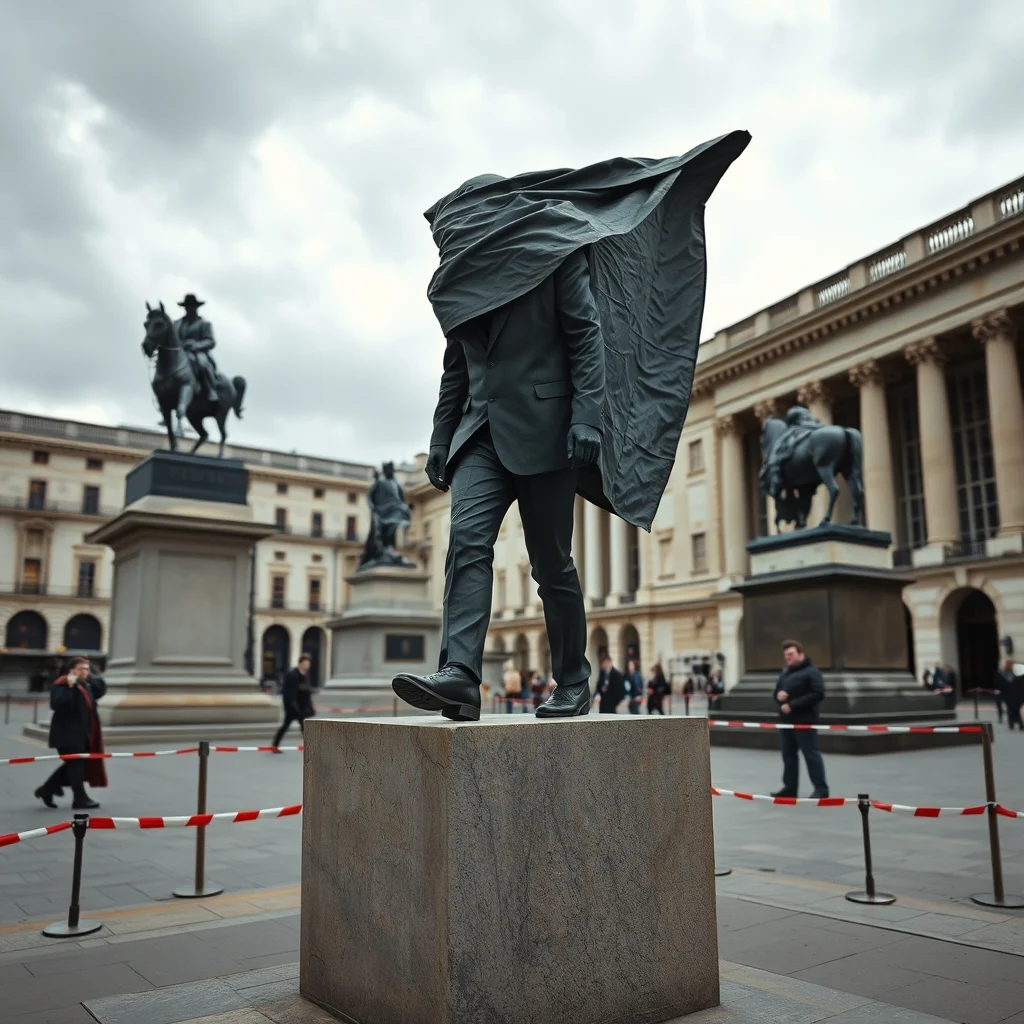
Street artist Banksy has confirmed a prominent statue that appeared in central London’s Waterloo Place is his latest work, featuring a suited figure walking off a plinth while obscuring his face with a flag. The piece, which appeared early Wednesday and was confirmed by Banksy’s representatives and the artist’s own Instagram on Thursday afternoon, is situated in an area historically dedicated to celebrating imperialism and military might.
A Strategic Placement
The newly unveiled sculpture, bearing Banksy’s signature, depicts a man in formal attire stepping forward, his visage completely hidden by a flag he carries. This deliberate choice of imagery and location, near monuments honoring figures like Edward VII and Florence Nightingale, invites commentary on Britain’s imperial past and the nature of nationalistic symbolism.
Banksy himself, in a characteristic understatement, noted the statue’s placement by stating, “There was a bit of a gap.” The covert installation occurred in the early hours of Wednesday, with crowds gradually gathering to view the artwork throughout Thursday.
Westminster City Council, responsible for the Waterloo Place area, acknowledged the artwork. “We’re excited to see Banksy’s latest sculpture in Westminster, making a striking addition to the city’s vibrant public art scene,” a spokesperson stated. “While we have taken initial steps to protect the statue, at this time it will remain accessible for the public to view and enjoy.” Safety barriers were erected around the sculpture on Thursday afternoon.
Artistic Commentary and Historical Context
James Peak, creator of the BBC podcast series “The Banksy Story,” highlighted the artwork’s powerful message. “Here, you’ve got a brilliant comment on a bumptious, chest puffed out man in power with the flag completely obscuring his vision, which is why he is about to fall off the plinth,” Peak explained.
He further praised Banksy for the “wonderfully framed moment in time” captured by the sculpture and called the positioning “absolutely knockout.” Peak also questioned the logistics of such an installation, asking, “How has he got a low-loader to there with all the security and put up a massive resin statue?”
Discussing the location’s significance, Peak added, “We’ve got to face up to the fact that Britain has an imperialistic history full of takeovers and part of that is the sort of extreme nationalism that Banksy absolutely abhors. Every (Banksy) piece is a campaign.”
Banksy’s London Interventions
This is not the first time the anonymous artist has left a sculptural intervention in London. In 2004, “The Drinker,” a parody of Rodin’s “The Thinker,” briefly appeared on Shaftesbury Avenue before being stolen.
The Waterloo Place statue continues a recent series of high-profile works by Banksy across London. In December, a mural depicting children on the ground appeared in Bayswater. Last September, he claimed responsibility for a piece on the Royal Courts of Justice complex showing a protester confronting a judge.
Earlier in 2024, Banksy orchestrated an “animal trail” across the capital, featuring various animal-themed artworks. Each of these pieces, like the current statue, appeared covertly and was later confirmed via his Instagram account.
Banksy’s works, often installed on public or private property without permission, are widely interpreted as political statements. They are frequently removed by authorities shortly after their appearance.
Looking Ahead
The installation of the Waterloo Place statue raises questions about the future of public art interventions in historically significant locations and the ongoing dialogue Banksy provokes regarding national identity and historical narratives. The temporary nature of many of his works means that the public’s engagement with this piece will likely be time-limited, prompting speculation about its longevity and the artist’s next move in the urban landscape.










Leave a Reply