
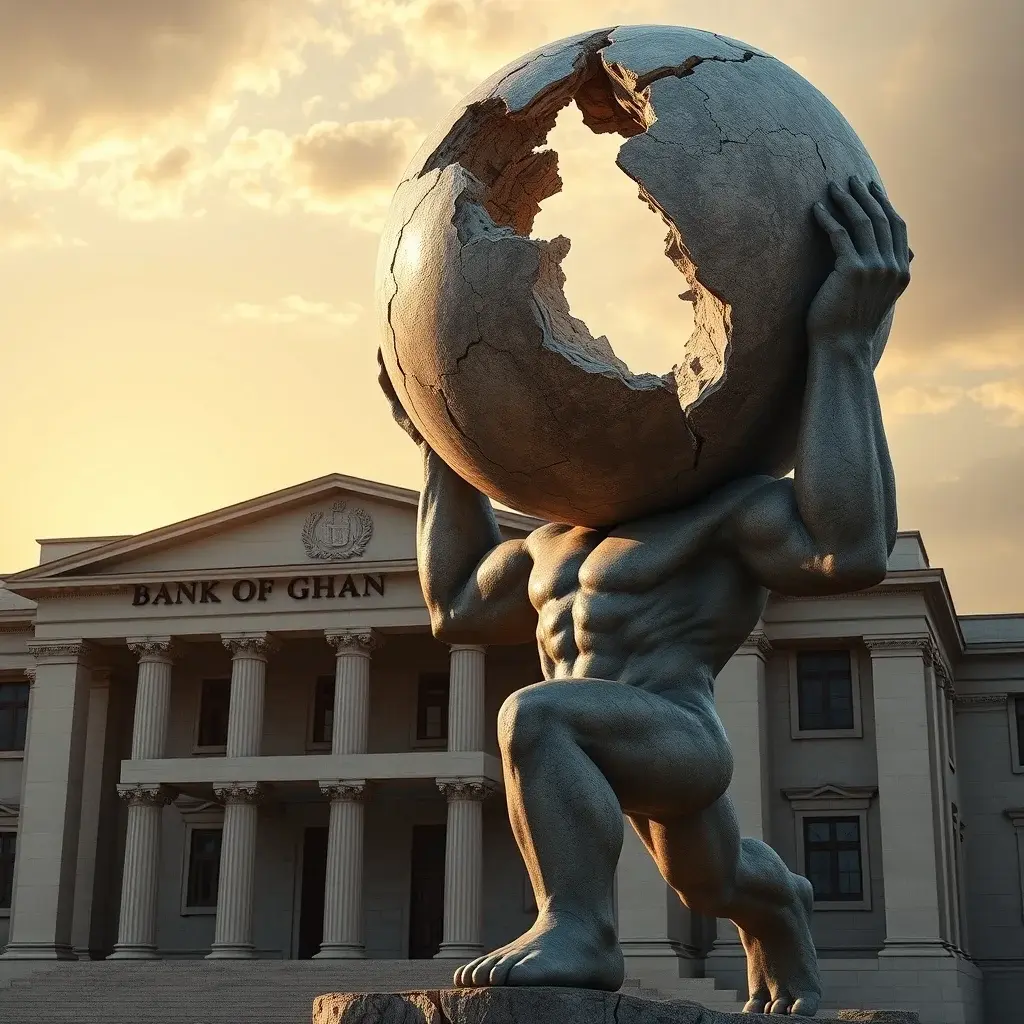
Accra, Ghana – In the year 2025, the Bank of Ghana (BoG) reported a significant financial loss of GH¢15.6 billion, a stark contrast to the nation’s improving economic indicators such as easing inflation and a more stable exchange rate. This situation raises critical questions about the central bank’s role and the potential cost of its efforts to stabilize Ghana’s economy during a turbulent period.
The Anatomy of a GH¢15 Billion Loss
The substantial loss incurred by the Bank of Ghana in 2025, reaching approximately GH¢15.63 billion, was not the result of a single event but rather the cumulative impact of aggressive macroeconomic stabilization policies. The central bank’s disclosures indicate that costs associated with sterilizing excess liquidity and managing monetary supply alone amounted to roughly GH¢16.73 billion.
Further pressures stemmed from adjustments in the valuation of foreign reserves and the financial repercussions of the Domestic Debt Exchange Program (DDEP). Consequently, the BoG’s negative equity position worsened significantly, deteriorating from about GH¢61.3 billion at the start of 2025 to approximately GH¢93.82 billion by year’s end, highlighting the immense strain on its balance sheet.
Why Central Bank Losses Do Not Necessarily Mean Policy Failure
A central bank’s financial performance is fundamentally different from that of a commercial institution. As noted by the Bank for International Settlements (BIS), central banks can operate with negative equity while still fulfilling their mandates, provided public trust in their monetary management capabilities remains intact.
Globally, several major central banks have recorded substantial losses in recent years. These often follow aggressive monetary tightening cycles, driven by increased interest payments on reserves and intervention costs. For instance, the U.S. Federal Reserve reported operating losses totaling $114 billion in 2023, followed by $77.6 billion in 2024 and $18.7 billion in 2025, primarily due to paying higher interest on reserves while holding lower-yield assets.
The European Central Bank (ECB) also recorded a loss of €7.9 billion in 2024, its second consecutive year of losses. The Bank of England similarly faced significant losses, necessitating financial support from the U.K. Treasury.
The primary objective of a central bank is safeguarding economic and financial stability, not profit maximization. International bodies like the International Monetary Fund (IMF) emphasize that a central bank’s profitability is secondary to its effectiveness in controlling inflation and managing exchange rates.
Ghana’s moderation in inflation and easing of exchange rate volatility by 2025 are seen as direct dividends of the BoG’s interventions. As former Bank of England Governor Mervyn King argued, the price of economic stabilization is often visible on the central bank’s balance sheet, but its true value is reflected in restored economic confidence.
A profitable central bank amidst runaway inflation poses a greater economic danger than a financially strained institution that successfully restores order. In crisis periods, central bank balance sheets frequently absorb the economic adjustment costs. The losses reported by the BoG, akin to those of the Fed and ECB, underscore the cost of stabilization rather than a failure of policy.
Stability Is Never Free
Economic stabilization is often perceived as an abstract policy goal, detached from tangible institutional sacrifices. In reality, stabilization entails significant financial costs, frequently borne by the central bank during periods of severe macroeconomic turbulence. Nobel laureate Milton Friedman’s assertion that “there’s no such thing as a free lunch” aptly describes the fiscal implications of monetary tightening.
Ghana’s recent inflation crisis necessitated an aggressive policy response, including higher policy rates to curb demand and anchor inflation expectations. However, these higher rates increased the central bank’s interest expenses, particularly through liquidity sterilization operations, which alone cost over GH¢16 billion in 2025.
Defending currency stability amidst external vulnerabilities also added to the burden. Interventions to stabilize the Ghana Cedi, coupled with reserve valuation adjustments, resulted in estimated losses of approximately GH¢8.3 billion related to reserves. These figures reflect the impact of exchange rate movements on the local currency value of foreign assets.
Ironically, some of these costly stabilization measures contributed to visible macroeconomic improvements. Inflationary pressures moderated, and Ghana’s gross international reserves recovered to cover about four and a half months of import, a significant improvement from the crisis period’s depletion.
This paradox is characteristic of modern crisis-era central banking. Former IMF Chief Economist Raghuram Rajan has highlighted how successful stabilization efforts can financially strain central banks, even as inflation declines and confidence returns.
While the public often focuses on the losses, the alternative—runaway inflation, currency collapse, and financial instability—represents a far greater economic peril. Stabilization thus involves a trade-off between immediate institutional financial strain and the avoidance of systemic collapse.
Gold, Gold Reserves, and the Expanding Burden of Stabilisation
Central banks traditionally focus on monetary policy, but in times of severe economic distress, their role can expand into broader national development financing. Ghana’s experience illustrates how the BoG increasingly supported interventions related to reserve accumulation, foreign exchange stabilization, and domestic gold purchases.
The financing arrangements associated with the Domestic Gold Purchase Program (DGPP) exemplify this expanding role. GoldBod’s financial statements indicated liabilities of over GH¢3.78 billion payable to the BoG under the DGPP by the end of 2025. This program reportedly increased Ghana’s gold reserves from approximately 30.53 tonnes in January 2025 to over 38 tonnes by October 2025, strengthening reserve buffers.
However, such interventions carry financial consequences. Public disclosures suggest cumulative losses exceeding GH¢7 billion for the DGPP between 2022 and 2024. These, combined with liquidity support and exchange rate management, constrained the BoG’s balance sheet flexibility when sterilization costs were already high.
The situation was further complicated by reports of the BoG liquidating part of its gold reserves in 2025, generating estimated realized gains of about GH¢9.57 billion. While this demonstrated pragmatic reserve management during a difficult cycle, it also underscored the intense pressures on the institution. When strategic reserve assets are used to cushion operational strain, the line between prudent crisis management and institutional exhaustion blurs.
This is the challenging reality for modern central banks during crises. They often act as the economy’s ultimate shock absorbers, undertaking responsibilities beyond orthodox monetary policy. The key challenge is ensuring that extraordinary crisis interventions do not become permanent institutional burdens.
Who Guards the Guardian?
The BoG’s financial deterioration prompts critical national discussions on governance, institutional safeguards, and the future resilience of monetary policy administration. If central banks are expected to absorb extraordinary stabilization burdens, transparency and operational independence become paramount.
Questions arise regarding the extent of quasi-fiscal responsibilities a central bank should undertake and the limits on strategic interventions. These are not unique to Ghana; former Federal Reserve Chair Ben Bernanke’s interventions during the 2008 global financial crisis also highlighted how central banks can become the primary stabilization machinery during severe market strain.
Ultimately, the credibility of a central bank hinges not only on its intervention capacity but also on the strength of institutional frameworks protecting it from excessive political and financial strain. Ghana faces a delicate balancing act: preserving macroeconomic stability while safeguarding the long-term institutional health of the very entity tasked with maintaining it.
Atlas, Exhaustion, and the Price of Economic Survival
The BoG’s 2025 losses may symbolize the hidden institutional cost of stabilizing Ghana’s economy during a particularly turbulent period. The irony is that as inflation moderated and confidence returned, the balance sheet of the institution driving this recovery weakened considerably.
The debate surrounding the BoG’s financial situation requires intellectual honesty. While losses warrant scrutiny, transparency, and accountability, they must also be understood within the broader context of crisis-era economic management, where central banks often serve as the first line of defense against systemic instability.
Like the mythological Atlas, the Bank of Ghana may have succeeded in preserving stability for the nation but absorbed significant strain in the process. The deeper lesson from the BoG’s financial statements is that economic survival sometimes comes at a price, and the guardian institution may bear a substantial part of that cost.








Leave a Reply