
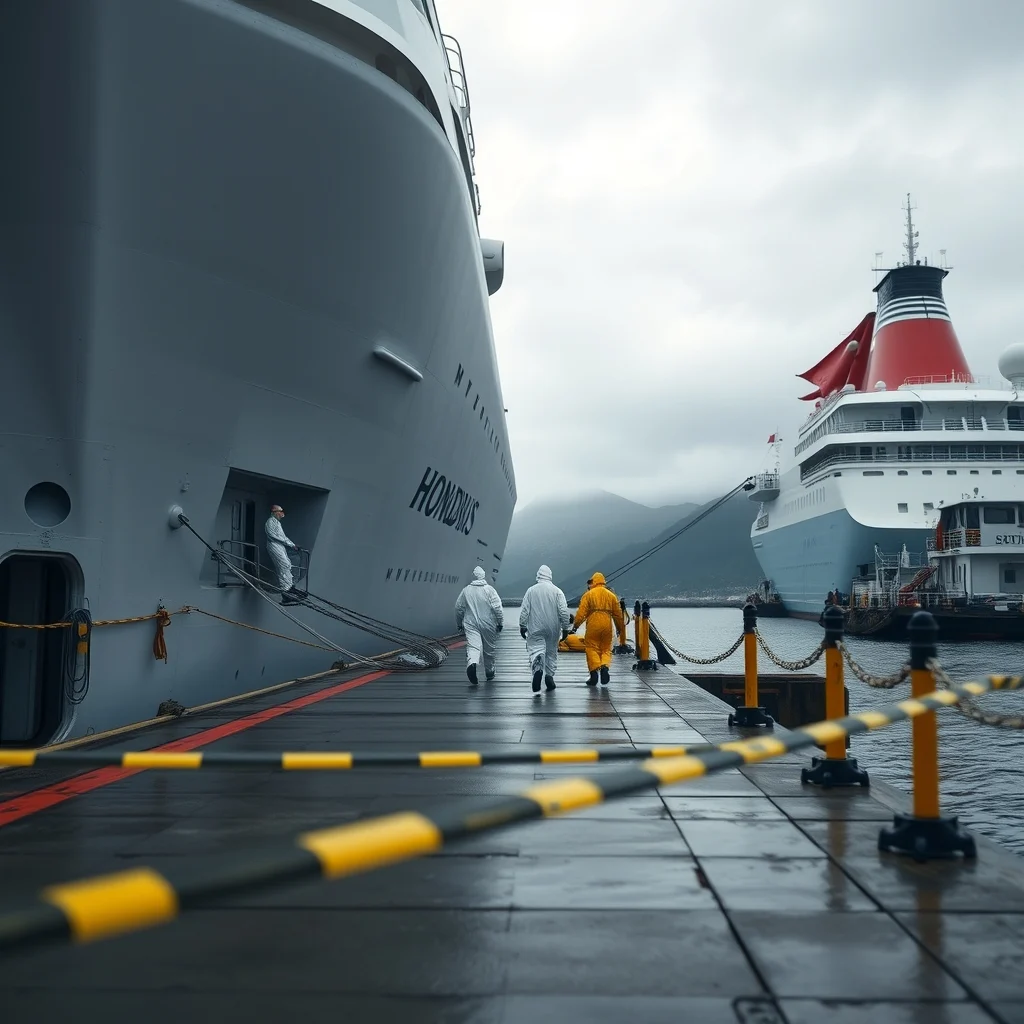
The last passengers have disembarked the MV Hondius, a cruise ship grappling with a hantavirus outbreak, as health authorities confirmed three additional positive cases linked to the virus. The ship, which had been docked in Spain’s Canary Islands, departed Tenerife for the Netherlands on Monday after its final six passengers and some crew members left the vessel.
Context of the Outbreak
The hantavirus outbreak has resulted in at least three confirmed passenger deaths. The virus, typically carried by rodents, can cause severe illness in humans, with symptoms including fever, fatigue, muscle aches, and respiratory distress. The Andes strain, believed to be responsible for some cases on the MV Hondius, has the potential for human-to-human transmission, though officials deem a widespread outbreak unlikely.
The MV Hondius, operated by Oceanwide Expeditions, departed Ushuaia, Argentina, on April 1st with 147 passengers and crew from 23 countries. The outbreak came to light as passengers began to experience symptoms and disembark in various locations, prompting international health responses and repatriation efforts.
Detailed Coverage of Disembarkation and Cases
The final group of six passengers, comprising four Australians, one Briton, and one New Zealander, along with some crew, left the ship in Tenerife. Over 90 passengers have been repatriated in recent days, with varying quarantine and monitoring protocols implemented by different nations.
Confirmed cases have emerged in multiple countries. The World Health Organization (WHO) reports seven confirmed hantavirus cases linked to the MV Hondius, with two additional suspected cases. Spain’s health ministry reported a Spaniard quarantining in Madrid provisionally tested positive. The US health department confirmed two American nationals on a repatriation flight showed mild symptoms and were transported in biocontainment units.
France reported a woman isolating in Paris with deteriorating health, leading to the tracing of 22 contacts. Two British nationals with confirmed cases are receiving treatment in the Netherlands and South Africa. A German woman and an elderly Dutch man, who is believed to have been the first infected, died on board the ship. The Dutch man’s wife, who disembarked earlier, later died in South Africa and is a confirmed case.
International Response and Quarantine Measures
Repatriation flights have carried passengers to various destinations, including Canada, the United States, and Europe. Canadian passengers landed in Victoria, British Columbia, and are self-isolating for at least three weeks. Seventeen US citizens arrived in Nebraska for clinical assessment, joining seven other US passengers already under monitoring.
The WHO recommended a 42-day isolation period for those leaving the MV Hondius. However, the US Centers for Disease Control (CDC) opted for a less stringent approach, emphasizing the rarity of human-to-human transmission and differentiating the situation from COVID-19.
British nationals flown to Manchester were taken to Arrowe Park Hospital for a 72-hour isolation period, with no reported symptoms. Fourteen Spaniards are in mandatory quarantine at a military hospital in Madrid. A flight carrying Dutch nationals and others arrived in the Netherlands on Sunday.
Crew Status and Operator’s Statement
As of Monday evening, 27 individuals, including 25 crew members and two medical staff, remained on board the MV Hondius. These include individuals from the Philippines, the Netherlands, Ukraine, Russia, and Poland. Ukraine’s foreign ministry stated that its citizens on board would assist with the ship’s transfer to the Netherlands and undergo quarantine upon arrival, showing no signs of illness.
In a video message, the captain of the MV Hondius expressed condolences to those who had passed away and described the recent weeks as “extremely challenging.” He commended the patience, discipline, and kindness demonstrated by the crew during the crisis.
Implications and Future Watch
The conclusion of passenger disembarkation marks a significant step in managing the hantavirus outbreak on the MV Hondius. The varying quarantine protocols highlight the ongoing debate and differing approaches to managing infectious disease risks in travel scenarios. The incident underscores the importance of rapid health assessments and coordinated international responses when novel outbreaks occur in mobile populations like cruise ship passengers.
Moving forward, attention will likely focus on the health status of the remaining crew, the ship’s disinfection and future operations, and any further epidemiological findings from the confirmed cases. The differing national responses to quarantine recommendations will also be a point of interest for future public health preparedness strategies in the cruise industry and beyond.










Leave a Reply