
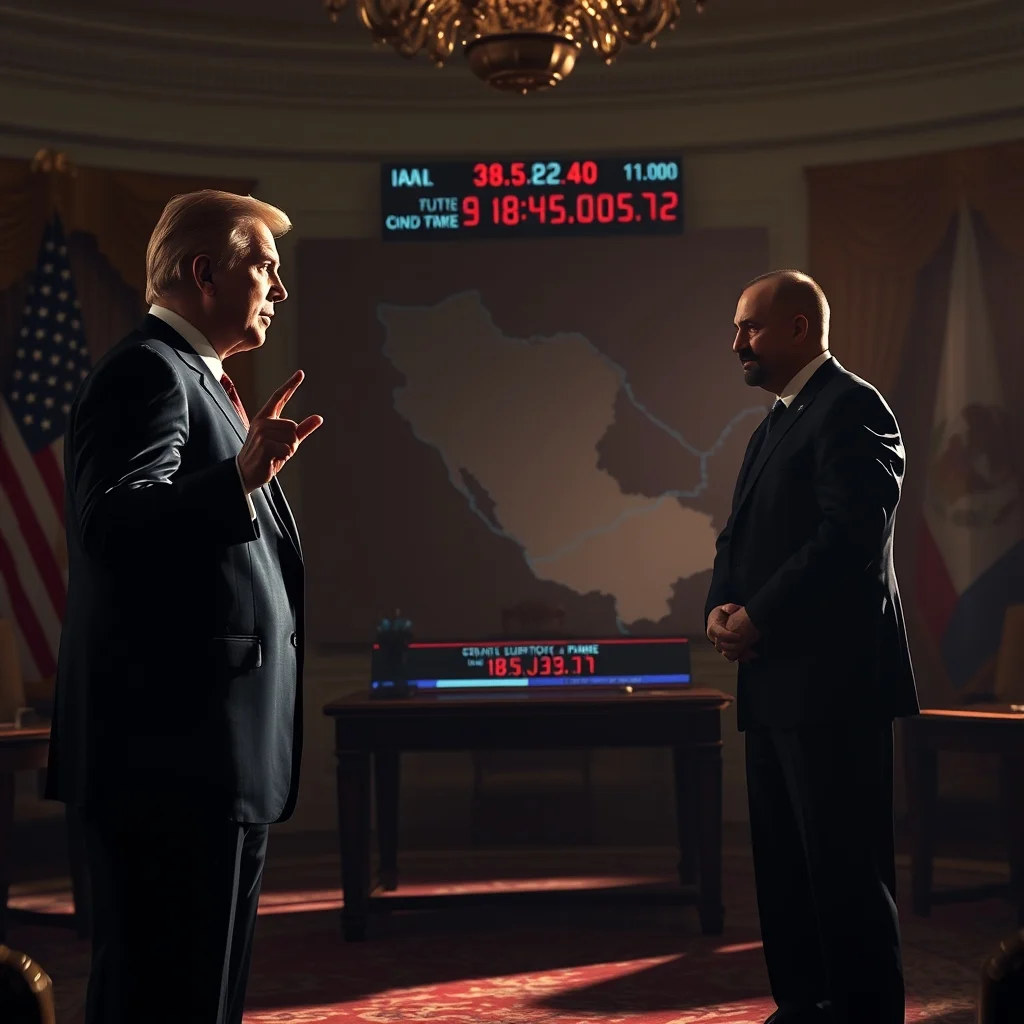
WASHINGTON D.C. – U.S. President Donald Trump stated on Monday that the month-long ceasefire between the United States and Iran is precariously balanced, describing its status as being on “massive life support.” While the ceasefire has largely held since its inception in April, occasional exchanges of fire have strained the fragile agreement.
Negotiations Reach Critical Juncture
The delicate situation escalated Sunday when Iran presented a counter-offer to the U.S. outlining its demands for ending the conflict and reopening the vital Strait of Hormuz. President Trump swiftly rejected the proposal, labeling it “totally unacceptable” and “a piece of garbage” in a post on Truth Social.
Iran’s foreign ministry spokesperson, Esmail Baghaei, countered Trump’s dismissal, asserting that Tehran’s proposals were “responsible” and “generous.” According to Iran’s semi-official Tasnim news agency, Tehran’s offer includes an immediate cessation of hostilities on all fronts, an end to the U.S. naval blockade of Iranian ports, and guarantees against further attacks on Iran.
Further reported demands from Iran include compensation for war damages and an assertion of Iranian sovereignty over the Strait of Hormuz. In response to Trump’s harsh criticism, Baghaei stated that Iran would act “in any way necessary to secure our interests.”
Trump Expresses Deep Skepticism
Speaking to reporters in the Oval Office, Trump characterized the ceasefire’s condition with a stark analogy. “I would say the ceasefire is on massive life support… when the doctor walks in and says, ‘Sir, your loved one has approximately a 1 percent chance of living,'” he stated.
The President voiced strong distrust of Iran’s leadership, calling them “very dishonourable people.” He indicated that dealing with Iranian representatives has been challenging due to their perceived inconsistency. “That piece of garbage they sent us – I didn’t even finish reading it,” Trump remarked.
Adding another layer of contention, Trump accused Iran of reneging on an agreement concerning the removal of its enriched uranium stockpile. He reiterated the U.S. stance that Iran “will never have a nuclear weapon.” However, Tasnim news agency quoted a source close to the Iranian negotiating team denying any such agreement, stating, “There is no such thing in Iran’s proposal as accepting taking out enriched nuclear material.”
Strait of Hormuz and Uranium Enrichment at Core
The U.S. had previously proposed a memorandum, reportedly a one-page, 14-point document, which included provisions for suspending Iranian nuclear enrichment, lifting sanctions, and restoring free passage through the Strait of Hormuz, according to Axios. U.S. officials cited by Axios indicated that many of these terms were contingent on reaching a final agreement.
The Strait of Hormuz remains a critical chokepoint for global energy, with approximately 20% of the world’s oil and liquefied natural gas typically passing through it. Iran’s continued blockade has contributed to a rise in global oil prices. Concurrently, the U.S. has maintained a naval blockade of Iranian ports, a move that has significantly angered Tehran.
Background of the Conflict
The current tensions stem from massive air strikes launched by Israeli and U.S. forces against Iran on February 28th. The subsequent ceasefire, which came into effect last month, has been the primary focus of recent diplomatic efforts.
Israeli Prime Minister Benjamin Netanyahu has emphasized that Iran’s enriched uranium stockpile must be “taken out” before the conflict can be considered truly over. “There’s still enrichment sites that have to be dismantled,” Netanyahu stated in a recent interview.
Implications and Future Outlook
The current impasse raises serious concerns about the sustainability of the ceasefire and the potential for renewed hostilities. The rejection of Iran’s counter-offer and the U.S. president’s dire assessment suggest that diplomatic channels are strained to their limits. The future of maritime security in the Strait of Hormuz and the global energy markets remains uncertain.
Key points to watch include whether either side makes concessions, the potential for further escalation of military actions, and the impact on international oil prices. The stance of international partners and the progress of Iran’s nuclear program will also be critical factors in the unfolding situation.










Leave a Reply