
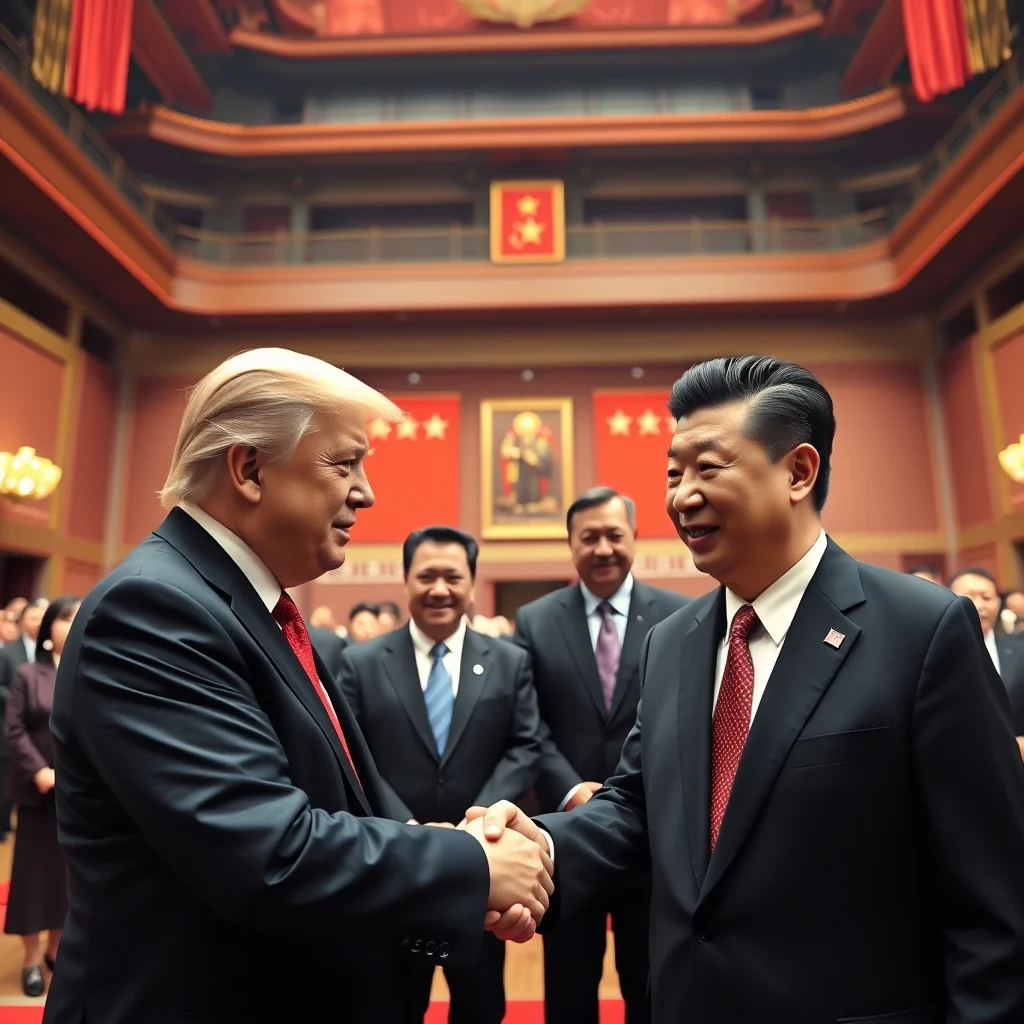
US President Donald Trump met with Chinese President Xi Jinping on Thursday in Beijing for over two hours of discussions, a summit described by the White House as “highly productive” and by Trump as potentially “the biggest summit ever.” Despite the high-level engagement and symbolic gestures, the meeting concluded without a sweeping trade breakthrough or significant new business agreements, though a fragile trade truce remains in place.
Symbolism and Key Attendees
The visit was heavily characterized by symbolism, with notable figures accompanying President Trump. Tech leaders Elon Musk, CEO of Tesla, and Jensen Huang, CEO of Nvidia, were present, even stepping off Air Force One ahead of senior cabinet officials. Their presence highlighted the sensitive economic areas of electric vehicles, artificial intelligence (AI), and semiconductor microchips that are central to the US-China economic relationship and subject to US export controls.
Musk’s and Huang’s companies have significant exposure to the Chinese market and are at the forefront of technological competition. Huang’s inclusion, reportedly not on the original delegation list, fueled speculation that AI and chip access were more prominent discussion points than initially anticipated.
Fragile Trade Truce Continues
While no major trade deal was inked, both sides indicated continuity of the October trade truce. Under this agreement, the US suspended tariff increases on Chinese goods, and China eased restrictions on rare earth exports. The White House announced the leaders agreed to establish a “Board of Trade,” a mechanism intended to manage the bilateral economic relationship without immediate tariff renegotiations. However, US officials cautioned that this board requires substantial work before becoming fully operational.
US Treasury Secretary Scott Bessent anticipated announcements of “large Boeing orders” and increased Chinese purchases of US energy and agricultural products during the visit. These potential deals aim to bolster US exports and address some of the trade imbalances.
Market Access and Cooperation
Discussions reportedly included expanding market access for US companies in China and encouraging Chinese investment in US industries. Beijing signaled a willingness to increase purchases of US agricultural and energy goods. While US farmers are seeking greater access for products like soybeans, beef, and poultry, specific details on these commitments were not immediately announced.
Bessent downplayed expectations of major new agricultural breakthroughs, suggesting some commitments were already covered by previous agreements. He noted, however, that there is potential for China to increase its purchases of US energy, including liquefied natural gas (LNG).
According to Chinese state media Xinhua, President Xi Jinping stated that China’s “doors will open wider” for American firms, offering “broader prospects” in the Chinese market. Xi also called for expanded cooperation in areas such as trade, agriculture, healthcare, tourism, and law enforcement, characterizing the bilateral ties as “mutually beneficial” and delivering “win-win results.” For American businesses, China remains a crucial market, albeit one with operational challenges due to regulations, bureaucracy, and geopolitical uncertainty.
Taiwan: The Most Sensitive Issue
A significant point of emphasis from the summit was China’s linkage of Taiwan directly to the broader US-China economic relationship. Previously, Taiwan was one of several friction points, including US collaboration with semiconductor firms and arms sales to Taipei. However, Chinese messaging from this meeting suggests Taiwan is increasingly framed as a prerequisite for a stable US-China trade relationship.
According to Beijing’s readout, Xi stated that the two sides had agreed to a “new positioning” for relations based on “constructive strategic stability.” Yet, he reiterated that Taiwan remains the most sensitive issue. “The Taiwan question is the most important issue in China-US relations,” Xi warned, adding that “if mishandled, the two nations could collide or even come into conflict.”
Unresolved Technological and Geopolitical Fault Lines
Technology remains a primary area of divergence. US export controls on advanced semiconductors and chipmaking equipment, designed to curb China’s access to cutting-edge AI capabilities, remain in effect. Beijing continues to advocate for greater access to advanced technologies and criticizes what it perceives as US efforts to impede its industrial development.
President Trump also sought Chinese cooperation on the Iran conflict and global oil market stability. Volatile oil prices and supply disruptions have increased import costs for China and driven up global prices. Trump has suggested China could leverage its influence to encourage Iran to stabilize energy flows through the Strait of Hormuz. Chinese readouts indicated that the Middle East was discussed, though specific outcomes were not detailed.
Looking Ahead
The summit underscored the complex and often contradictory nature of the US-China relationship. While a formal trade war was averted and a fragile truce maintained, deep-seated issues in technology, national security, and geopolitical flashpoints like Taiwan persist. The establishment of a “Board of Trade” offers a potential avenue for ongoing dialogue, but its effectiveness will depend on the willingness of both sides to engage constructively and address underlying disagreements. Future developments will likely hinge on how these sensitive issues, particularly Taiwan and technology access, are managed, and whether the “constructive strategic stability” framework can withstand the inherent tensions.










Leave a Reply