
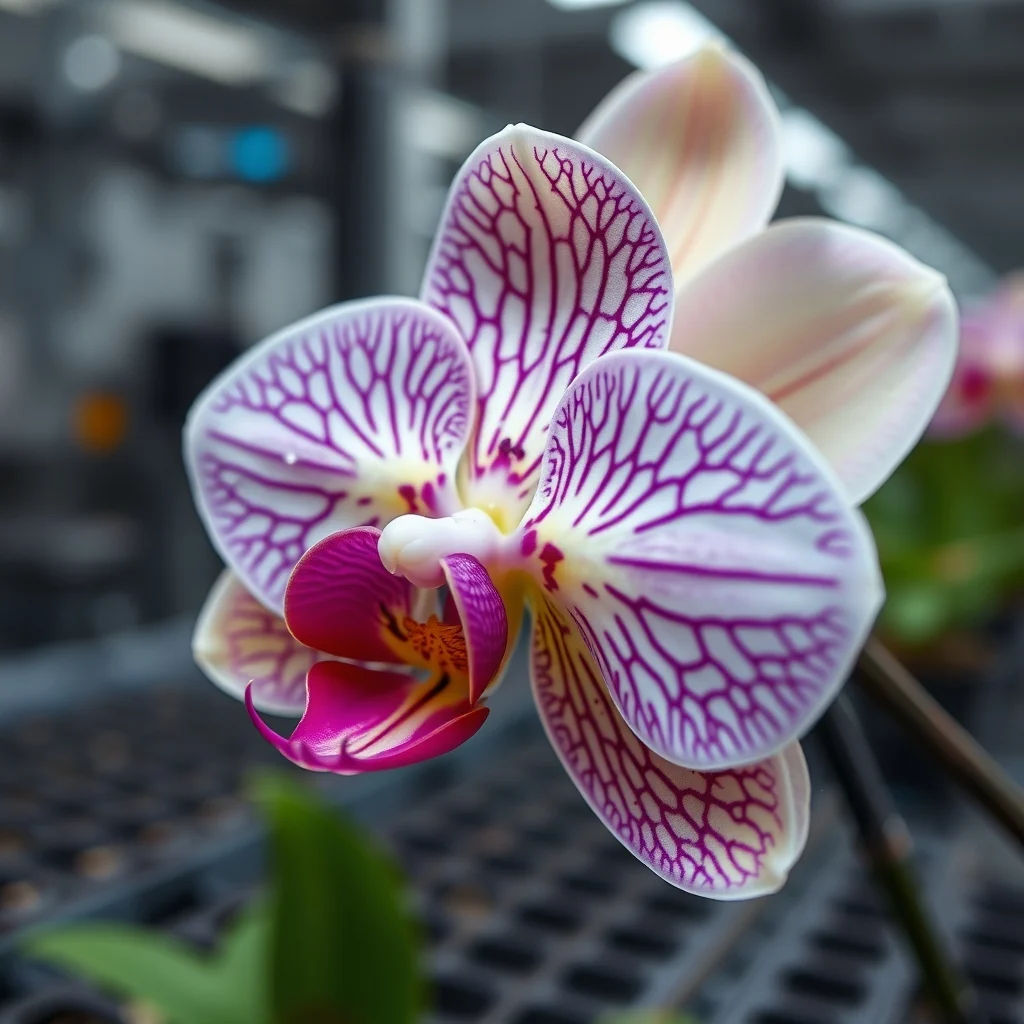
In the competitive and high-value global orchid market, estimated to be worth hundreds of millions of dollars, Dutch firm Floricultura is leveraging advanced genetic research to accelerate the decade-long process of developing new orchid varieties. This innovation aims to overcome the genetic unpredictability of commercially bred orchids, allowing breeders to identify desirable traits like color, shape, and disease resistance in young plants, thereby streamlining selection and reducing development time.
The Challenge of Orchid Genetics
Centuries of selective breeding have resulted in a complex and often unpredictable genetic background for many commercial orchids. This complexity makes it challenging for breeders to reliably predict the characteristics of new plant offspring. According to Floricultura, this genetic “disaster” necessitates new approaches to breeding.
Introducing Genetic Markers
To address this, companies like Floricultura are developing genetic markers. These markers act as indicators for specific desirable traits. By screening very young plants for these markers, breeders can quickly identify and select promising candidates, discarding those that do not meet their criteria early in the development cycle.
Wart van Zonneveld, Floricultura’s research and development manager, explains that a large number of cross-breeds can be screened using these markers. “It’s an indication of a certain trait that you want, or you do not want, depending on what’s easier to find,” he notes.
Proprietary Secrets and Scientific Foundations
The specific genetic markers and breeding techniques are closely guarded trade secrets, representing significant investment for each company. This proprietary approach is crucial for developing unique varieties that offer a competitive edge. While these novel techniques are cutting-edge, they build upon traditional breeding methods.
Paul Arens, an ornamental plant breeding researcher at Wageningen University, highlights that the foundation remains traditional cross-breeding. “The foundation is still what we have been doing for 100 years already. You take two plants, you look at their characteristics, and you make a cross,” he states. However, he adds that modern breeders incorporate advanced research with markers and genomics.
Intellectual Property and Distinctness
Genetic analysis also plays a role in protecting intellectual property. In Europe, breeders’ rights and in the U.S., patents, are granted for new varieties. To qualify, a new variety must be distinct, stable, and uniform.
While legal protection is based on physical descriptions, DNA analysis can aid in comparing new plants to existing market products. “It’s just like what we do in forensic science. You run markers that are at different positions in the DNA and that give you a pattern, and then you have a chance to match it or not,” Arens explains.
The Long Road to Market
Floricultura operates a business-to-business model, supplying new varieties to cultivators rather than directly to consumers. With over 180 varieties in their catalog and hundreds more in development, the company emphasizes the relentless demand for novelty.
Stefan Kuiper, Floricultura’s breeding manager, states, “You can’t stop, because it takes so long to develop new varieties. You have to go on, [or] you will be behind the rest.” The development process involves several stages, taking approximately nine years from initial cross-breeding to market readiness.
From Seedlings to Clones and Global Evaluation
After initial genetic screening and selection, promising plants, initially siblings from the parent orchids, take about three years to grow in laboratory and greenhouse conditions. The selection process involves discarding unsuitable plants, a process Arens likens to “the art of throwing away.” Surviving plants are then cloned using meristematic cells to ensure exact copies.
The cloned seedlings undergo further cultivation and selection over several years. To confirm characteristics such as flower shape, size, color, stem count, and disease resistance, young plants are sent for evaluation to facilities in Poland and India. This global evaluation process is resource-intensive, requiring controlled environments for light, heat, water, and nutrients.
Sustainability and Automation
Floricultura is also focusing on sustainability. They harvest rainwater from greenhouse roofs and are implementing water and nutrient recycling systems. The company utilizes a geothermal well that provides significant energy, with potential for local community heating projects.
Automation is prevalent in their operations, with automated systems managing plant trays and delivering them sequentially through cultivation stages. However, the final decision on which varieties make it into the commercial catalog, after years of development, remains a human judgment.
The Human Touch in Breeding
Despite advanced technology, the ultimate assessment of a new orchid’s market potential rests on its aesthetic appeal. “A plant can have tick all the genetic boxes and produce all the right traits, but it has to be beautiful to sell – and that’s a judgement made by people,” Kuiper notes.
Kuiper acknowledges the element of chance involved, stating, “Breeding is a little bit [like] gambling.” This human element, combining scientific rigor with an aesthetic sensibility, continues to define the art of orchid breeding.
Looking Ahead
The integration of genetic marker technology, coupled with sustainable practices and automation, signals a future where orchid development is more predictable and efficient. However, the essential human eye for beauty and market appeal will likely remain a critical factor in bringing the next generation of prized orchids to market. Continued advancements in genomics and breeding techniques will be key watchpoints for the industry.










Leave a Reply