
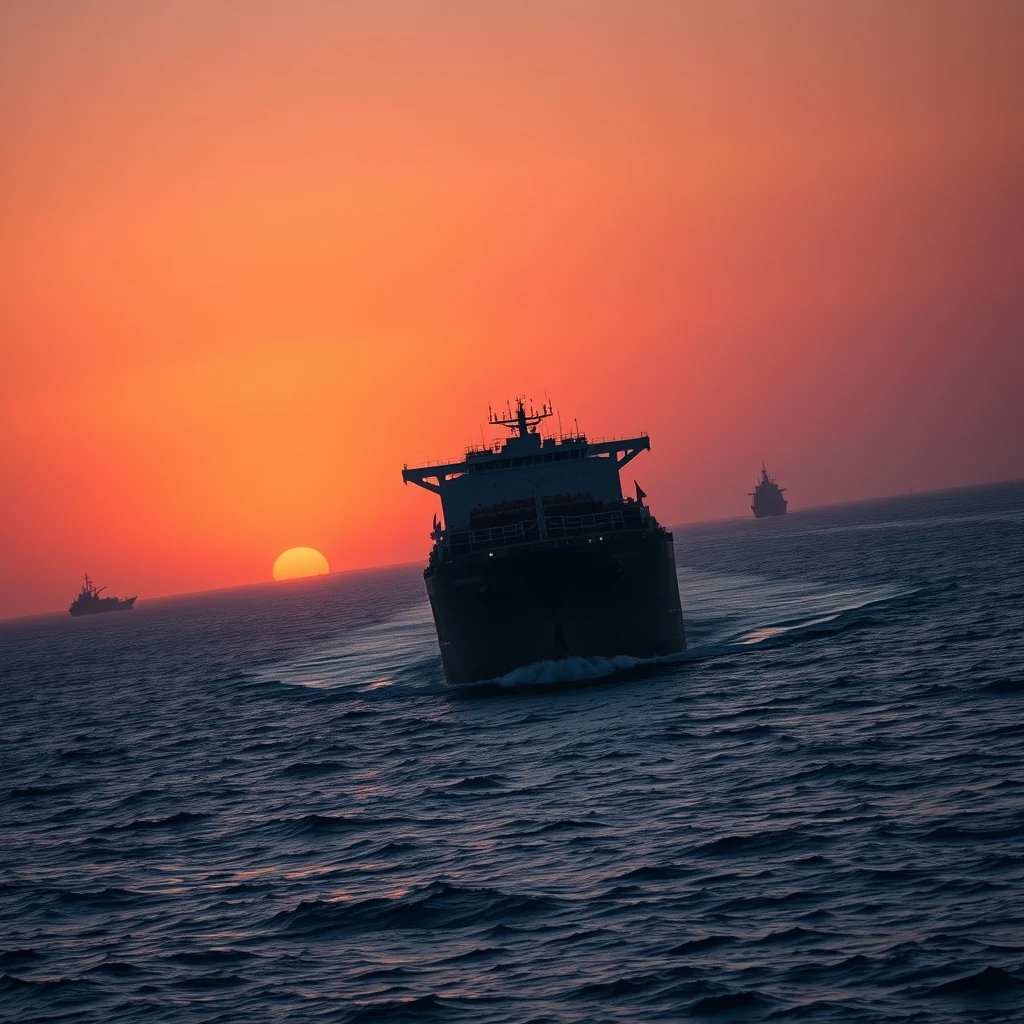
Oil prices saw an uptick on Friday, driven by persistent fears of maritime attacks and seizures in the vital Strait of Hormuz. This occurred despite Iran’s assertion that approximately 30 vessels had successfully navigated the waterway, while U.S. President Donald Trump and Chinese President Xi Jinping engaged in crucial talks in Beijing.
Geopolitical Tensions Escalate in Key Shipping Lane
Brent crude oil futures climbed 60 cents, or 0.57%, to settle at $106.32 a barrel by 0100 GMT. Concurrently, U.S. West Texas Intermediate futures rose 54 cents, or 0.53%, reaching $101.71.
The market’s unease was amplified by reports of a ship being seized by Iranian personnel off the coast of the United Arab Emirates on Thursday, with the vessel reportedly headed towards Iranian waters. This incident followed the sinking of an Indian cargo ship carrying livestock from Africa to the UAE, which occurred on Wednesday in waters near Oman.
Adding to the complex geopolitical landscape, White House officials confirmed that U.S. President Donald Trump and Chinese President Xi Jinping had, during their ongoing discussions, acknowledged the importance of maintaining open access to the Strait of Hormuz.
Iran Claims Increased Vessel Traffic, Market Remains Cautious
Iran’s Revolutionary Guards reported that around 30 vessels had transited the Strait of Hormuz since Wednesday evening. While this number is significantly lower than the typical pre-war daily average of 140, it represents a notable increase if confirmed.
Analysts suggest that despite this reported increase in traffic, underlying market concerns have not been fully allayed. The broader trend influencing oil prices remains one of tight supply, a factor that continues to underpin market stability.
Underlying Supply Concerns Drive Market Trends
Yang An, an analyst at Haitong Futures, commented on the market’s volatility, noting that oil prices experienced fluctuations throughout the previous day but ultimately closed near their highest points. “Ships passing through the strait eased some market concerns, but not enough to change the strong trend driven by tight supply,” An stated.
The ongoing trade discussions between the U.S. and China also cast a shadow over the energy markets. U.S. Trade Representative Jamieson Greer indicated in a Bloomberg interview that China was adopting a pragmatic approach to its dealings with Iran. Greer emphasized that maintaining open shipping lanes through the Strait of Hormuz is of significant importance to China’s economic interests.
Implications for Global Trade and Energy Markets
The persistent tensions in the Strait of Hormuz, a critical chokepoint for global oil supplies, underscore the fragility of energy security. Any disruption in this region can have immediate and far-reaching consequences on global oil prices and trade flows.
The dual pressures of geopolitical instability and fundamental supply constraints suggest that oil markets will remain sensitive to developments in the Middle East and major international trade relations. Investors and industry watchers will be closely monitoring further incidents in the Strait of Hormuz and the outcomes of diplomatic efforts aimed at de-escalating tensions.
Looking ahead, the market will be watching for sustained increases in vessel traffic through the Strait, further statements from involved nations, and any potential impact on global oil production and demand. The interplay between geopolitical risk and supply fundamentals will continue to shape oil price movements in the coming weeks and months.










Leave a Reply