
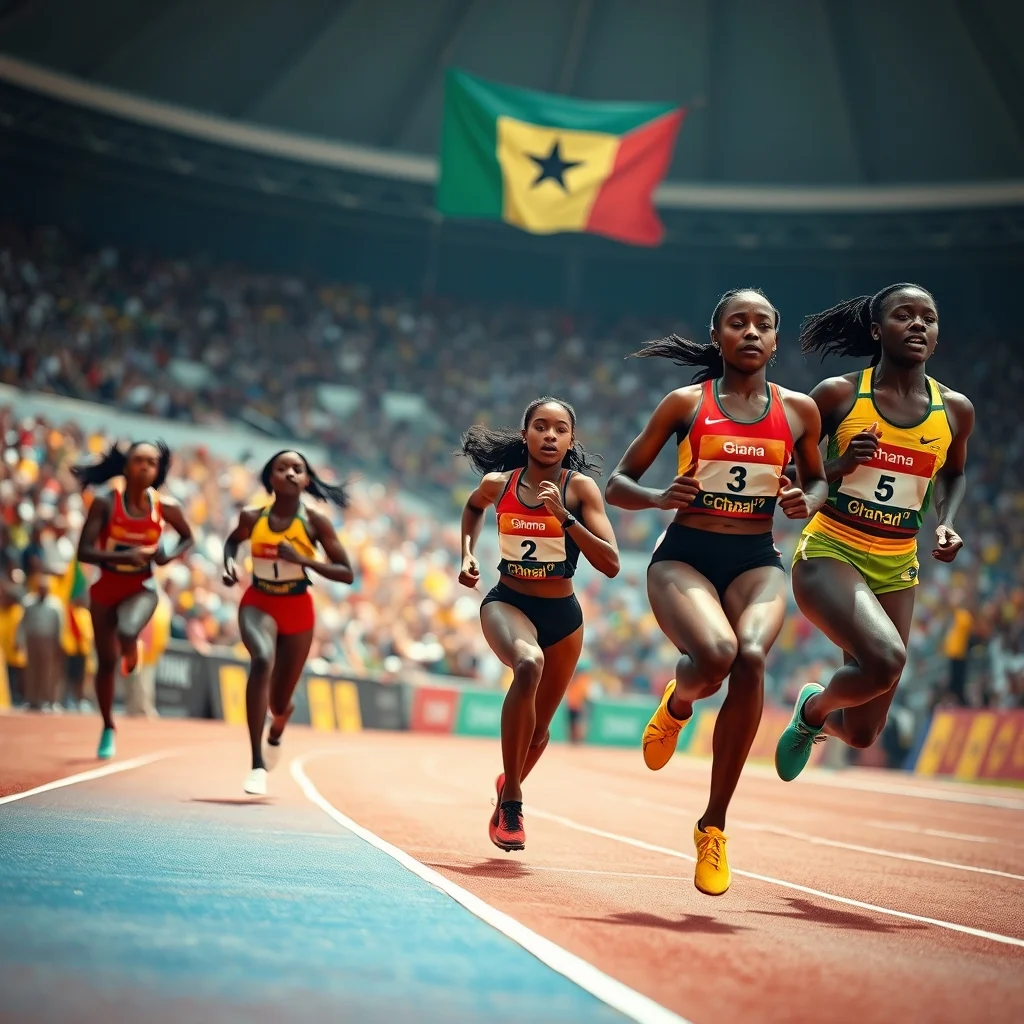
Ghana’s women’s 4x100m relay team secured a bronze medal at the African Championships held at the University of Ghana Stadium, showcasing a promising blend of emerging student athletes and experienced competitors. The team’s performance, clocking 44.85 seconds, silenced earlier criticisms and highlighted a long-standing tradition within Ghana Athletics of integrating young talent into elite competitions.
A Mixed Bag of Talent and Experience
The bronze-winning quartet comprised three first-year students: Gladys Boateng, known as “Gaza,” from St. Louis; Aisha Jafar, or “Odo Broni,” from T. I. Amass; and Janet Dakoa Kwarteng from the University of Cape Coast. The experienced member, Janet Mensah, who is part of the security services, also contributed to the team. This mix of youth and experience, competing on home soil before an enthusiastic crowd, marked a significant moment for the athletes and the sport in Ghana.
A Tradition of Early Exposure
Ghana Athletics has a history of introducing athletes to high-level competition at a young age, a strategy that has yielded success in the past. The article draws a parallel to Vida Anim, who, as a 15-year-old student, represented Ghana at the 1999 African Games. Her career trajectory saw her win silver at the African Athletics Championships a year later, set a national record at the 2004 Athens Olympics, and eventually claim gold medals at both the African Championships and African Games, along with multiple IAAF Continental Cup medals.
This approach, while sometimes met with skepticism about overwhelming young athletes, has consistently provided a pathway for talent development. The recent performance by the women’s relay team appears to be another instance of this successful strategy in action.
The Path Forward: Development and Resources
Despite the celebratory bronze medal, the article emphasizes that the real challenge lies in the athletes’ progression. For many, like Aisha Jafar, balancing elite athletic pursuits with academic responsibilities, such as the upcoming West Africa Senior School Certificate Examinations (WASSCE), presents a significant hurdle.
The hope is that these athletes, particularly those like Janet Darkowaa at the University of Cape Coast, will follow the path of athletes like Joseph Paul Amoah and Benjamin Azamati, potentially securing scholarships to train in the United States. However, the article cautions that even international training opportunities may not be sufficient without dedicated, high-level coaching.
The Need for Investment in Local Talent
The cautionary tale of Edwin Gadayi, a sprinter with immense raw talent who has struggled to reach his potential due to a lack of elite training environments in Ghana, underscores the critical need for investment. Gadayi’s situation highlights how raw power, without refinement from professional coaches, can lead to athletes falling behind their peers who have access to better resources.
The article argues that Ghana’s Sports Ministry must adequately resource Ghana Athletics to build a robust and well-equipped training system within the country. This would ensure that talented athletes who cannot travel abroad still have the opportunity to hone their skills and reach their full potential.
Looking Ahead: Commonwealth Games and Ministry Commitment
The upcoming 2026 Commonwealth Games in Glasgow presents a tangible opportunity to assess the commitment of the Sports Ministry. The pre-tournament camp for the relay team, which will include Odo Broni, Gaza, Darkowaa, and Mensah after their WASSCE exams, will serve as a critical indicator of whether the ministry’s support extends beyond mere rhetoric.
The success of these young athletes hinges not only on their dedication and talent but also on the establishment of a sustainable development system. The focus now shifts to how Ghana will nurture this promising generation of sprinters and provide them with the resources needed to compete on the global stage.






Leave a Reply