
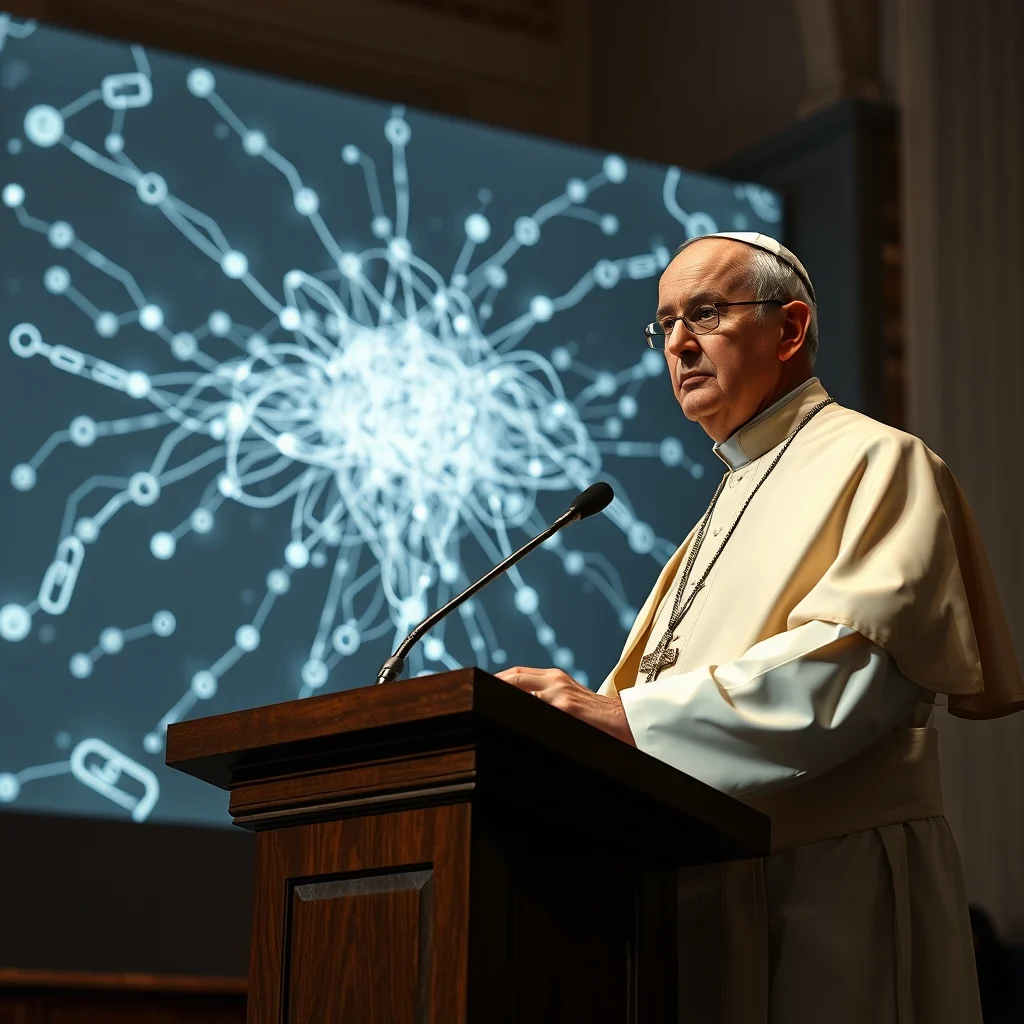
Pope Leo issued his first major teaching document, titled “Magnifica Humanitas” (Magnificent Humanity), at the Vatican on [Insert Date, e.g., Tuesday], directly addressing the urgent need to regulate artificial intelligence and warning it must be “disarmed.” The encyclical, presented alongside AI experts including Christopher Olah of Anthropic, also included a profound apology for the Catholic Church’s historical role in slavery, drawing parallels between past exploitation and emerging digital threats.
Context: The Pope’s Bold Stance on AI and Historical Wrongs
Encyclicals, traditionally letters to Catholic bishops, have evolved into significant global messages from the papacy. Pope Leo’s “Magnifica Humanitas” marks a pivotal moment by focusing heavily on the burgeoning field of artificial intelligence. The document’s strength lies not only in its directness but also in its deliberate use of strong language, such as “disarmed,” to capture attention regarding AI’s potential perils.
Unusually, Pope Leo chose to unveil the encyclical himself at the Vatican, underscoring its importance. He was joined by prominent AI figures, including Christopher Olah, co-founder of the AI company Anthropic. This public presentation signals a direct engagement between religious leadership and the technological sector.
‘Digital Slaveries’ and Moral Crossroads
A striking element of the encyclical is the Pope’s explicit linkage between historical slavery and the potential for “new digital slaveries.” He warned that humanity risks normalizing exploitation once again, both in the creation and application of AI technologies. This analogy highlights a perceived moral crossroads, mirroring past failures to confront injustice promptly.
The Pope drew a stark parallel to the “delay with which both society and the Church came to denounce the scourge of slavery.” He also invoked the concept of “digital colonialism,” suggesting a continuity of exploitative practices from the colonial era into modern technological advancements.
AI in Warfare and Politics Under Scrutiny
Pope Leo condemned the use of AI in warfare, arguing that reducing human control over weaponry makes conflicts increasingly difficult to deem “just.” He cautioned against initiating an AI arms race, stating, “No algorithm can make war morally acceptable.” The document asserts that AI does not remove the “intrinsic inhumanity” of war but risks escalating conflicts and dehumanizing victims by reducing them to data.
Furthermore, the encyclical addresses AI’s impact on politics, particularly its use in manipulating images and videos. This manipulation can expose individuals to biased or misleading perspectives, undermining informed public discourse.
Expert and Developer Perspectives
Christopher Olah, speaking at the event, acknowledged that AI labs operate within incentives and constraints that can sometimes conflict with ethical imperatives. He stressed that the profound questions raised by AI extend far beyond the AI research community itself.
Pope Leo issued a “special appeal” to AI developers, emphasizing their “particular ethical and spiritual responsibility.” He stated that “every design choice reflects a vision of humanity,” placing a significant moral burden on those creating these technologies.
Implications and Future Outlook
The Pope has established a commission to advance the work outlined in “Magnifica Humanitas.” However, the effectiveness of these directives remains a significant question amidst the rapid pace of technological development. The Vatican’s past efforts, such as Pope Francis’s 2015 encyclical on climate change, highlight the challenges of translating urgent calls to action into tangible progress, a sentiment echoed by Pope Francis’s later expressions of disappointment over inaction.
As Pope Leo champions the need to rein in AI, the world will be watching to see if his “disarming” call can avert the potential pitfalls of a technology that promises immense progress but carries profound ethical risks. The coming years will reveal whether this landmark teaching can foster a more responsible and humane approach to artificial intelligence development and deployment.









Leave a Reply