
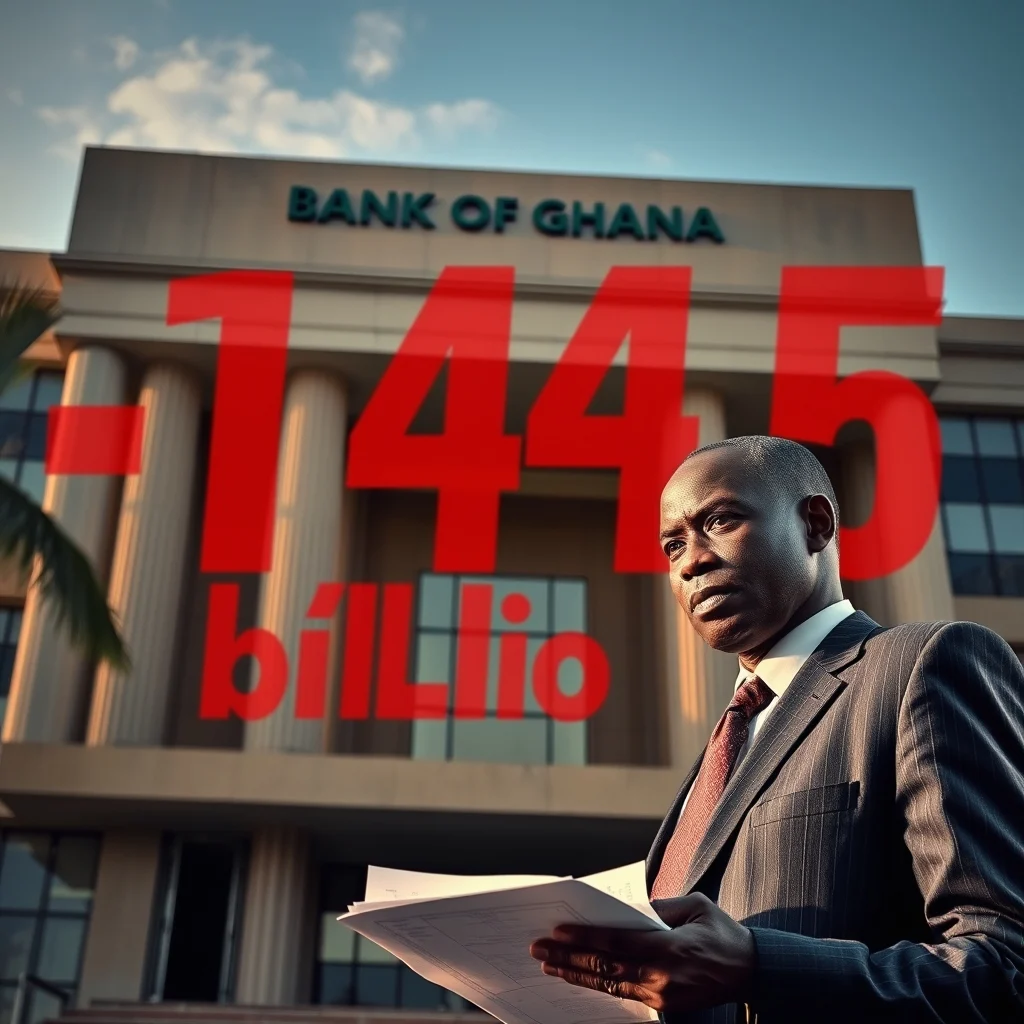
Accra, Ghana – A prominent Member of Parliament has challenged the Bank of Ghana’s (BoG) reported 2025 financial loss, asserting that the actual deficit is substantially greater than the GHc15.6 billion officially disclosed. Dr. Gideon Boako, a member of the Finance Committee, claims that when accounting for losses in Other Comprehensive Income (OCI) and excluding certain income streams, the central bank’s total loss for 2025 could reach as high as GHc44.5 billion.
Discrepancy in Reported Figures
The Bank of Ghana’s financial statements, released on May 1, 2026, revealed a loss of GHc15.6 billion for the fiscal year 2025. This figure was already noted as the second-highest loss recorded since the redenomination of the Ghanaian Cedi in 2008.
However, Dr. Boako, representing Tano North constituency, argues that this reported figure does not present the full financial picture. He points to an additional loss of GHc19.32 billion within the Other Comprehensive Income (OCI) section of the financial statements.
Boako’s Calculation of Total Loss
“Do not buy the propaganda that the loss BoG made is only GHc15.63 billion,” Dr. Boako stated on his Facebook page. He elaborated that the inclusion of the OCI loss brings the total deficit to GHc34.95 billion. This, he contends, explains the significant deterioration of the bank’s negative equity, which worsened from GHc58.62 billion in 2024 to GHc93.82 billion in 2025.
Furthermore, Dr. Boako suggests that the reported loss of GHc34.95 billion does not account for income generated from gold sales. He claims that an income of GHc9.57 billion from the sale of 18 tons of gold was reflected in the statements. Excluding this, he calculates the true total loss for 2025 to be GHc44.52 billion.
Questioning the Nature of Income
Dr. Boako questions the inclusion of income from gold sales, describing it as an “accounting gimmick to hide the policy insolvency of the Bank.” He argues that such income does not represent operational performance and was used to mask the extent of the bank’s financial difficulties.
He highlighted that in the previous year, 2024, the OCI section recorded a gain of GHc4 billion, contrasting sharply with the substantial loss experienced in 2025. This shift, according to Dr. Boako, indicates a deeper financial strain on the central bank.
Expert and Public Scrutiny
Dr. Boako has been a vocal critic of the Bank of Ghana’s financial management, frequently writing about its financial standing. Months prior to these revelations, he had predicted that the bank’s financial statements would expose significant losses.
The implications of these revised loss figures are substantial for Ghana’s economic stability and public trust in its financial institutions. A central bank operating with such a significant negative equity raises concerns about its ability to manage monetary policy effectively and maintain financial sector stability.
Broader Economic Context
The Bank of Ghana’s financial health is intrinsically linked to the nation’s overall economic performance and its ability to secure international financial support. Substantial losses and negative equity can impact credit ratings, investor confidence, and the cost of borrowing for the government.
Analysts are now scrutinizing the accounting practices employed by the central bank and the transparency of its financial reporting. The debate initiated by Dr. Boako prompts a closer examination of how central bank losses are calculated and presented to the public, particularly in the context of economic challenges.
Looking Ahead
The public and financial markets will be closely watching for a response from the Bank of Ghana to Dr. Boako’s assertions. Further clarification on the accounting treatment of OCI and income from asset sales is expected. The situation also raises questions about the regulatory framework governing central bank financial reporting and the need for robust oversight to ensure accuracy and transparency in such critical institutions.










Leave a Reply