
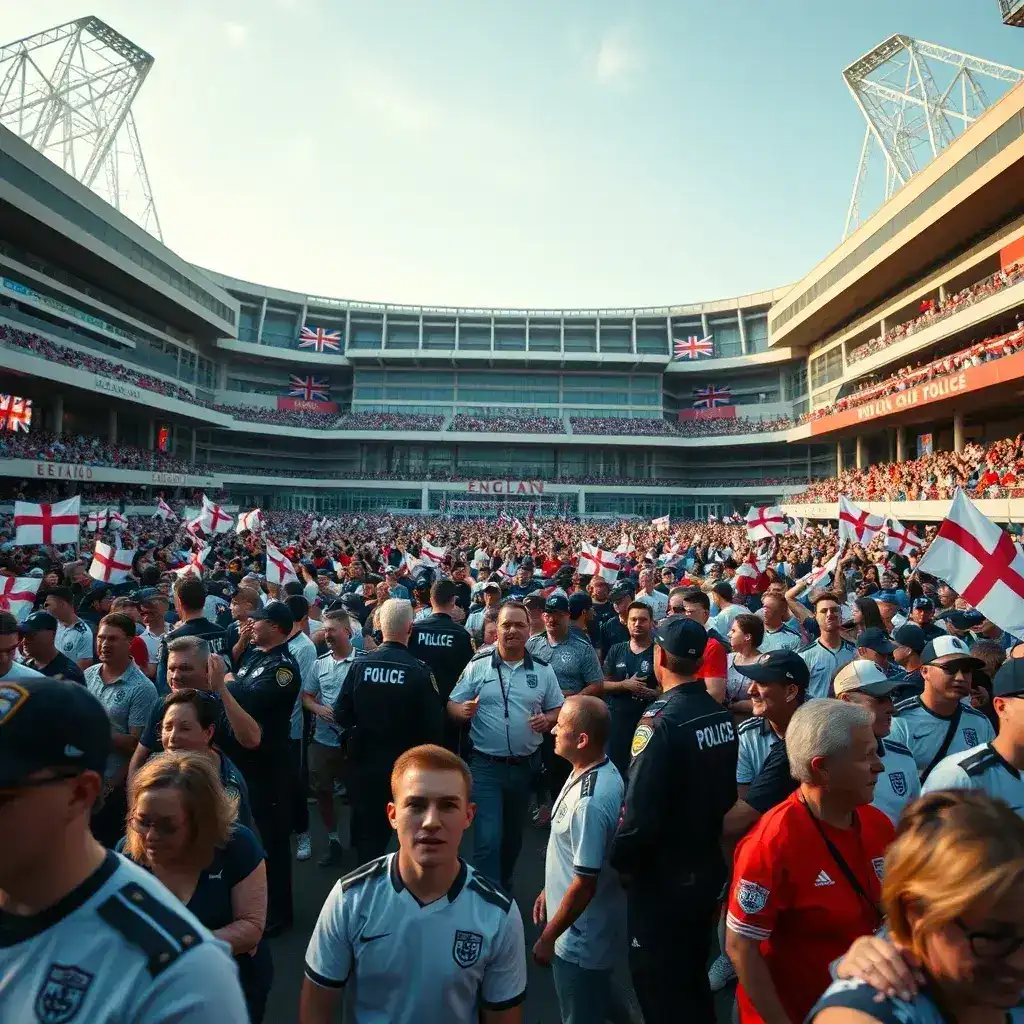
Just three UK police officers will accompany an estimated 10,000 England fans to the United States for the 2026 World Cup, a significant reduction from previous tournaments, following a refusal by American authorities to fund the deployment of ‘spotter’ officers.
This decision means a reduction of 37 officers compared to the 2024 Euros in Germany, where the host nation covered the costs for a larger delegation. Despite criticism over high ticket and travel prices, over 10,000 England fans have secured tickets for each of the team’s group games scheduled in Dallas, Boston, and New Jersey.
Reduced Police Presence
Chief Constable Mark Roberts, the national football lead, expressed a desire for a larger contingent, stating, “We would like more [officers].” He explained that a smaller deployment limits the ability to effectively monitor fan movements and provide support.
“If there were more there, we could try and reduce the risk and make it a bit easier for everyone, but it is what it is, and we’ll clearly do the best we can with the resources we deploy,” Roberts told BBC Sport.
Roberts contrasted the current situation with Germany, where 40 officers were funded by the hosts. “In this case, the Americans are not sold on the idea of the mobile delegations. They’re not funding it, so it’ll be a smaller deployment,” he noted.
While acknowledging that the US will be policing the event, Roberts highlighted the value of UK spotter officers. “We see the benefit of spotters, as I think most of the European countries do, because it gives us the opportunity to have a greater coverage of really good experienced people who will liaise with the supporters and the FA,” he said.
The limited number of officers restricts their ability to be in multiple locations simultaneously, such as monitoring fans leaving city centres and then being present at the stadium. An ideal deployment, according to Roberts, would involve six to 10 officers on the ground, covering stadiums, city centres, and transport hubs.
This contrasts with previous World Cups, which saw six spotters in Russia in 2018 and 16 in Qatar. In addition to the on-the-ground team, the UK will maintain the usual presence of two officers at an international police co-ordination centre (IPCC).
Understanding Fan Culture Differences
Roberts pointed out the difference in football fan culture between the UK and the US. “We know fan behaviour. The States isn’t necessarily a football fan culture in the same way. It’s very different,” he stated.
He also noted the vast number of law enforcement agencies in the US, suggesting varying levels of experience in managing large crowds. “There are 18,000 law enforcement agencies in the US, so they will have had different exposure to crowds managing things,” Roberts observed.
Despite potential challenges, Roberts indicated that England fan behaviour at recent tournaments has been exemplary. “The behaviour of our fans in tournaments over recent years has been pretty well exemplary, so we start from a good place,” he said.
The UK police delegation aims to brief local law enforcement on typical fan behaviour. “I think one of the key reasons we’re so keen to send a team out there is that it gives us the opportunity to brief local law enforcement,” Roberts explained.
This liaison is crucial for distinguishing between potentially offensive behaviour and normal fan celebrations. “So we always like to be there to communicate with fans if their behaviour is causing offence. Equally, to say to local law enforcement, ‘this isn’t a problem. This is normal behaviour.’ So we’re going to be more limited in that,” he added.
US Perspective and Fan Concerns
A spokesperson for the White House World Cup Task Force affirmed that American law enforcement will lead security operations to “ensure the safest environment for stadiums and fanfests.” The task force also encouraged host cities to “leverage UK expertise in international football event security.”
The UK Football Policing Unit revealed that between 12,000 and 15,000 England fans are expected at each group match. This includes 3,000 to 4,000 members of the official England Supporters Club per game.
Thomas Concannon, representing the Football Supporters’ Association England fan group, expressed disappointment with the fan numbers, suggesting they could have been higher given the anticipation. “We probably would have wanted that to be a bit higher,” he said.
However, Concannon acknowledged the dedication of fans who are attending despite the costs. “We thought there would be more… but given the costs it’s still a brilliant number of fans that have dedicated themselves to go,” he commented.
The high cost of attending games was a significant concern. “When you look at the sheer cost of it there will have been a lot of people priced out of it. We’re really disappointed that the cost of attending games is as high as it is,” Concannon stated.
Licensing Laws Relaxed
Chief Constable Mark Roberts also voiced criticism regarding the UK government’s decision to relax licensing laws during the tournament. He believes this move is “probably unnecessary and does increase the risk to some degree.”
Pubs in England and Wales will be permitted to stay open late for any home nation knockout matches. Roberts indicated that police advice against this blanket exemption was not heeded.
“We were consulted, as I have been on every tournament I can remember, and then our advice wasn’t heeded,” Roberts said. He explained that such exemptions remove a crucial check factor.
“The concern over this is that when you give a blanket exemption, it removes that check factor. So it will undoubtedly lead to busier, longer, and later shifts for police officers,” he warned.
Roberts highlighted the known link between alcohol consumption and poor behaviour during tournaments, including an increase in domestic abuse reports. “We know that alcohol is a factor in poor behaviour around tournaments. We know there is an increase in domestic abuse reports. There are risk factors, and we think they could have been sensibly mitigated, whilst allowing a degree of freedom from licensees by relying on the tried and trusted methods,” he concluded.
The reduced UK police presence and concerns over relaxed licensing laws raise questions about how security and fan conduct will be managed throughout the 2026 World Cup. As the tournament approaches, attention will focus on the effectiveness of US-led security measures and the ability of UK authorities to liaise with local law enforcement under these new constraints.










Leave a Reply