
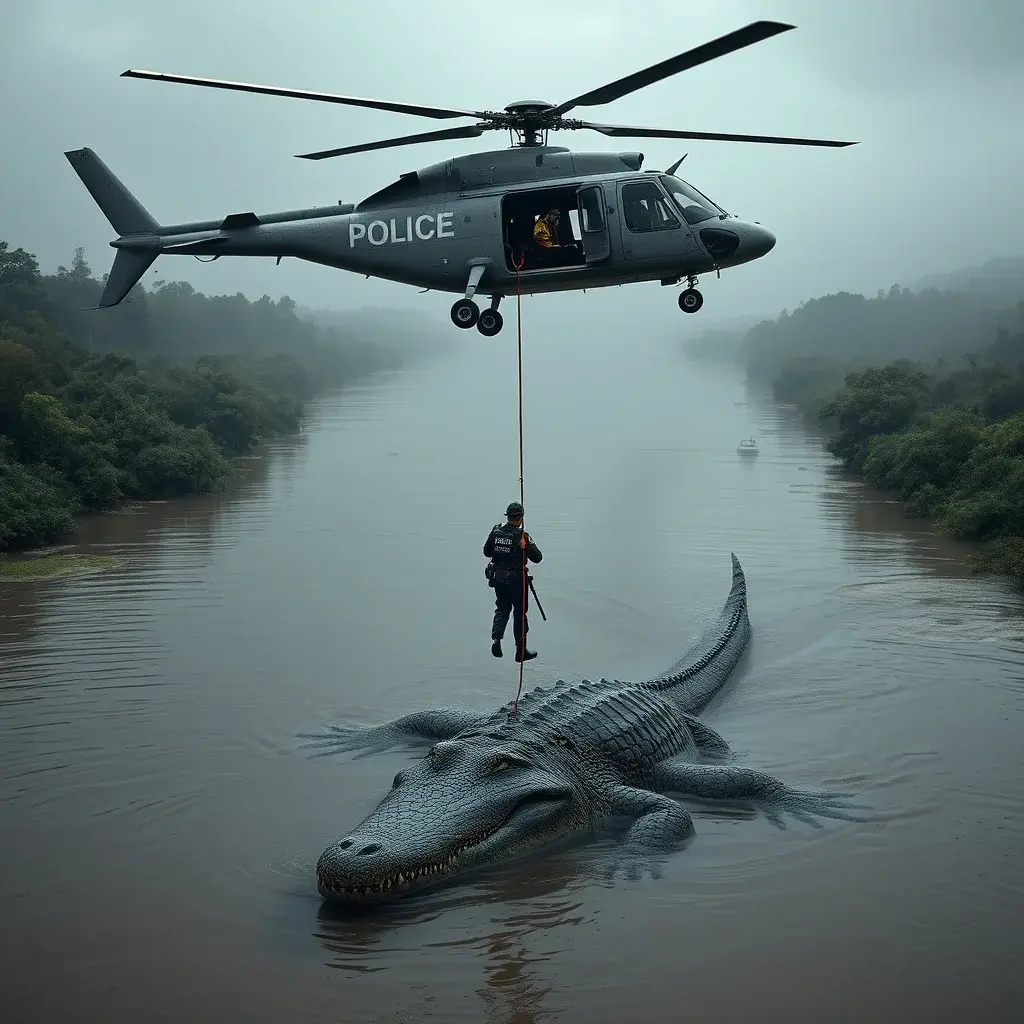
A police officer was dramatically lowered by helicopter into South Africa’s crocodile-infested Komati River to recover human remains, believed to be those of a businessman swept away by floodwaters last week. The high-risk operation concluded with the recovery of what are suspected to be body parts from a massive crocodile, which had already been killed.
Context of the Search
The incident began when a businessman’s car became stranded while attempting to cross a low bridge on the flooded Komati River. By the time authorities arrived, the vehicle was empty, leading to suspicions that the driver had been swept away by the powerful currents. This prompted an extensive search mission involving drones and helicopters.
Identifying a Suspect
During the aerial search, police noticed a small island where several crocodiles were observed basking. Captain Johan “Pottie” Potgieter, commander of the police diving unit, noted that one particular crocodile appeared to have recently fed. “Besides having a massively full tummy, he didn’t move around or try to slip into the river despite the noise of the drones and the chopper,” Potgieter told News24.
A Dangerous Recovery Operation
Based on this observation and years of experience, the police targeted the large reptile. The crocodile was killed, and then Captain Potgieter undertook the perilous task of being lowered by rope from a helicopter to secure the animal. He described the experience as nerve-wracking, stating, “The sharp end of a crocodile is not the best place to approach it.”
The massive crocodile, measuring 4.5 meters (15 feet) and weighing approximately 500 kilograms (1,100 pounds), was then airlifted to the nearby Kruger National Park. It was there, during an examination of the animal’s stomach, that human remains were discovered.
Further Discoveries and Questions
In addition to the suspected human body parts, six different types of shoes were found inside the crocodile. While this could suggest the animal had preyed on multiple victims, Captain Potgieter cautioned that crocodiles are opportunistic feeders and may swallow foreign objects. “A crocodile will eat or swallow anything,” he noted.
DNA tests are now pending to definitively confirm if the recovered remains belong to the missing businessman. Mpumalanga provincial police spokesperson Colonel Mavela Masondo confirmed the details of the incident to SABC, emphasizing the complexity of the operation.
Praise for Bravery
South Africa’s acting police chief, Lieutenant-General Puleng Dimpane, commended Captain Potgieter for his exceptional bravery during what police officials termed a “highly dangerous and complex operation.” The successful recovery, despite the extreme risks, highlights the lengths to which authorities will go in search and recovery missions.
Implications and Future Watch
This incident underscores the significant dangers posed by wildlife, particularly large predators, in areas affected by natural disasters like floods. It also highlights the innovative and often dangerous methods employed by emergency services to resolve critical situations. The pending DNA results will provide closure for the victim’s family and confirm the extent of the crocodile’s predatory behavior. Moving forward, authorities may reassess protocols for search and rescue in environments with such high risks, and public awareness campaigns regarding flood safety and wildlife encounters could be intensified.










Leave a Reply