
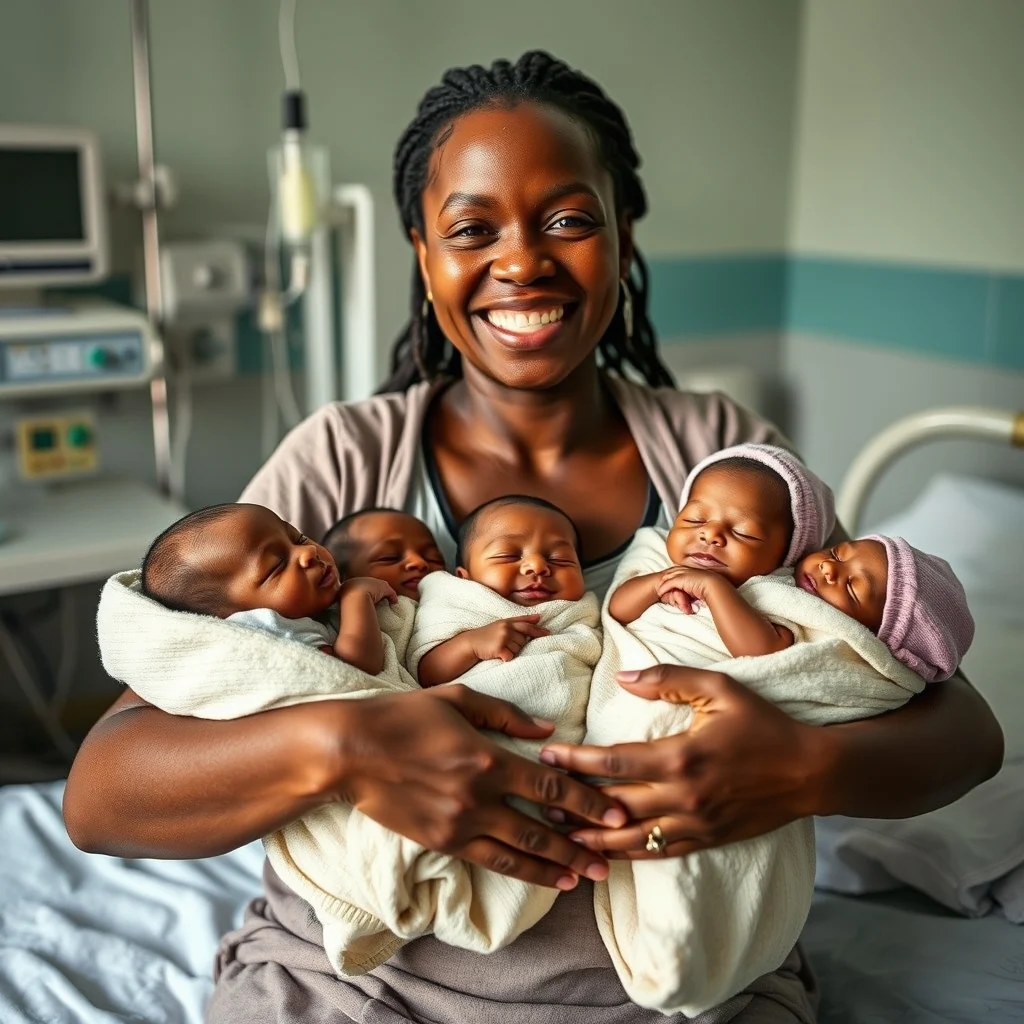
A 35-year-old Ethiopian woman, Bedriya Adem, has given birth to quintuplets—four boys and one girl—at the Hiwot Fana Specialised Hospital in Ethiopia’s Harari Regional state. The extraordinary birth occurred on Tuesday evening after Adem and her husband endured 12 years of trying to conceive, a period marked by emotional distress and societal pressure. All five newborns, weighing between 1.3 and 1.4 kilograms, are reported to be in good health and under medical observation.
A Long-Awaited Blessing
The arrival of quintuplets is an exceptionally rare event, with natural conception occurring only about once in 55 million times. Bedriya Adem described her joy as inexpressible, stating that her prayers were finally answered after years of what she termed “depression and pain.” She recalled being initially informed of a four-baby pregnancy, only to discover a fifth child during the delivery. “I prayed for just one child, and Allah gave me five,” she shared, referring to the newborns as “blessings.”
Hospital medical director Dr. Mohammed Nur Abdulahi confirmed that the mother and babies are receiving care at the hospital. He reassured that newborns weighing over one kilogram have a strong prognosis for survival and healthy development. Dr. Abdulahi also noted that Adem conceived naturally, as the hospital does not offer advanced fertility treatments like in vitro fertilization (IVF), which can sometimes increase the likelihood of multiple births.
Overcoming Infertility and Societal Stigma
Bedriya Adem’s journey to motherhood was fraught with challenges. She is a first-time mother, though her husband has a child from a previous marriage. The inability to conceive had taken a significant emotional toll, exacerbated by questions and judgments from her village. “He used to tell me that having [the other child] was enough and that I should not worry, but deep inside I was suffering – psychologically and emotionally – as the entire village questioned my inability to give birth,” Adem revealed.
The 12-year ordeal left her feeling isolated and in constant prayer for a child. “I spent 12 years in pain, hiding myself, and praying constantly for children – at last, Allah heard me,” she expressed, emphasizing how the past hardships now feel like a distant, unwanted memory.
Support and Future Hopes
The quintuplets, named Naif, Ammar, Munzir, Nazira, and Ansar, represent a profound shift in Adem’s life. As a subsistence farmer, she expressed uncertainty about how she will provide for her significantly enlarged family. However, she remains hopeful, believing that support will come from her community, the government, and divine providence. “But I believe Allah will provide, through the support of my community and the government,” she stated.
The birth was conducted via Caesarean section, and Adem received regular medical attention throughout her pregnancy. Dr. Abdulahi highlighted the dedication of the medical team in providing assistance and monitoring the high-risk pregnancy. The emotional state of the mother, described as “excitement” by the doctor, underscores the culmination of her long-held desire for a family.
Implications and Looking Ahead
This remarkable birth brings attention to the profound emotional and societal pressures faced by individuals experiencing infertility, particularly in communities where childbearing is highly valued. It also highlights the resilience of individuals and the importance of medical support, even in facilities without advanced reproductive technologies. For Bedriya Adem and her family, the immediate future will involve navigating the immense practicalities of raising five infants simultaneously, relying on community and governmental support. The story serves as a powerful testament to the enduring hope and the extraordinary outcomes that can arise from persistent faith and medical care. Observers will be watching how the community and government rally to support this unique family and the long-term health and development of the quintuplets.










Leave a Reply