
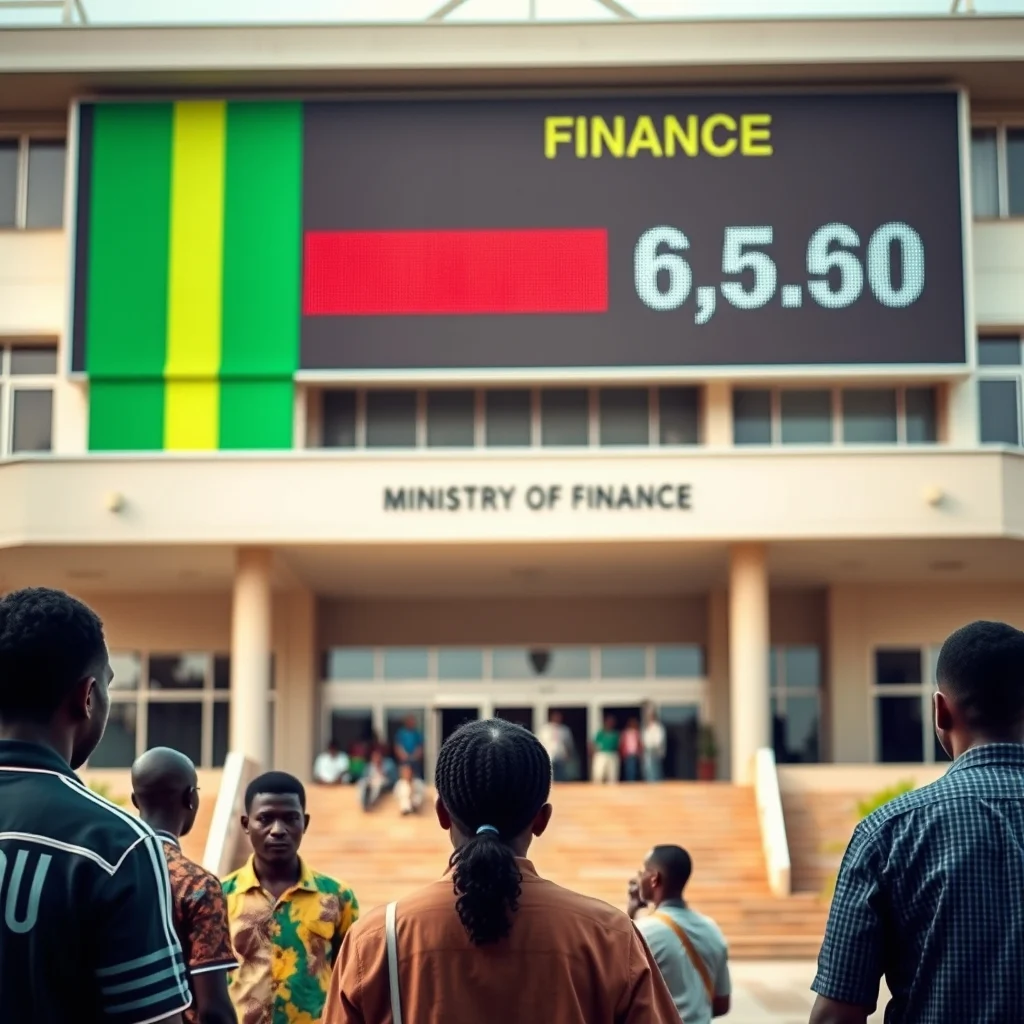
The Ghanaian government failed to spend nearly GH₵24 billion of its first-quarter 2026 budget and collected GH₵2.7 billion less revenue than targeted, according to recent fiscal data from the Ministry of Finance. The underspending represents approximately 27 percent of the GH₵89.97 billion allocated for the period, which covers a range of expenditures including goods and services, debt repayment, and arrears clearance.
Context of Fiscal Performance
This fiscal performance report for January to March 2026 comes at a critical juncture, marked by public disagreements between the Finance Ministry and the Ministry of Food and Agriculture regarding the actual disbursement of funds to spending agencies. The data reveals a total revenue and grants collection of GH₵57.5 billion against a programmed target of GH₵60.3 billion, indicating a shortfall of 4.5 percent.
Capital Expenditure Heavily Impacted
Capital expenditure bore the brunt of the budget cuts, with only GH₵7.3 billion spent against a planned GH₵12.6 billion, a significant shortfall of 41.9 percent. The “Big Push” capital expenditure program, intended to drive major infrastructure projects, fell short by over GH₵1 billion from its GH₵4.25 billion budget.
A stark disparity emerged in the financing of these capital projects. Foreign-financed initiatives saw a dramatic underspend, with only GH₵0.6 billion disbursed against a planned GH₵5.3 billion, a deficit of 88.3 percent. This suggests a slowdown in securing project loans and donor grants. In contrast, domestically financed capital projects performed better, missing their target by only 8.4 percent, with GH₵6.7 billion spent.
Statutory Funds Face Shortfalls
Transfers to other government units, which include essential earmarked funds, also experienced a shortfall. A total of GH₵12.3 billion was disbursed against a programmed GH₵15.2 billion, a reduction of 19.1 percent. Key funds were directly affected, with the National Health Insurance Fund receiving GH₵1.6 billion against a planned GH₵2.7 billion (a 39.2 percent gap) and the Ghana Education Trust Fund getting GH₵1.6 billion against GH₵2.3 billion (down 29.9 percent).
Other affected funds include the Road Fund, which suffered a GH₵160.75 million shortfall, and the District Assemblies Common Fund, which fell short by approximately GH₵21.16 million.
Operational Spending and Wages
Spending on goods and services, crucial for the day-to-day operations of ministries and agencies, decreased by 35.3 percent, amounting to GH₵1.3 billion against a programmed GH₵2.0 billion. Compensation of employees, typically a rigid budget item, stood at GH₵21.1 billion against a programmed GH₵22.7 billion, a shortfall of 6.8 percent, largely driven by lower-than-budgeted wages and salaries.
Social benefits, which had a programmed allocation of GH₵0.5 billion, saw no expenditure during the quarter.
Debt Servicing Lags Behind Projections
The government’s debt servicing obligations also fell below targets. Amortisation, the repayment of loan principal, amounted to GH₵3.0 billion against a scheduled GH₵8.8 billion, leaving approximately two-thirds of planned repayments outstanding. Interest payments reached GH₵17.2 billion against a programmed GH₵21.7 billion, a shortfall of 20.4 percent.
The external debt servicing gap was particularly pronounced, with only GH₵0.3 billion paid out of a GH₵3.0 billion interest bill, leaving 91.4 percent unpaid. Domestic interest payments, however, were closer to the programmed amount at GH₵17.0 billion. The reasons for the significant external debt servicing shortfall remain unclear, though data from the Bank of Ghana indicates the Cedi remained relatively stable against major currencies between the fourth quarter of 2025 and the first quarter of 2026.
Revenue Shortfalls Across Key Sectors
On the revenue side, domestic taxes on goods and services proved to be the largest disappointment, falling GH₵2.6 billion below target, a gap of 13.1 percent. Value Added Tax (VAT) accounted for GH₵0.8 billion of this shortfall. Taxes on international trade generated GH₵6.2 billion against an expected GH₵7.2 billion, a 14.0 percent decrease attributed to lower import receipts.
Non-tax revenue, which includes fees and dividends, also underperformed, reaching GH₵6.2 billion against a programmed GH₵7.5 billion, a shortfall of 17.7 percent. Oil revenue was proportionally the weakest performer, realizing GH₵2.8 billion against a programmed GH₵4.5 billion, a gap of 37.6 percent. Programmed grants of GH₵0.6 billion failed to materialize entirely.
Conversely, taxes on income and property exceeded projections, coming in at GH₵24.9 billion against a target of GH₵24.4 billion, boosted by company taxes that outperformed the program by 7.0 percent.
Public Dispute Over Fund Releases
The discrepancy between budgeted and actual spending has erupted into a public dispute between the Finance Ministry and the Ministry of Food and Agriculture. The Finance Ministry asserts it has released over GH₵1.67 billion to the agriculture ministry for goods and services and capital expenditure, representing about 85 percent of its allocation.
The Ministry claims high execution rates, with 94.73 percent of goods and services funds and 74.66 percent of capital expenditure funds utilized, as evidence of strong budget implementation. It also maintains that fund requests were initiated through the government’s GIFMIS financial management system and processed under standard procedures.
However, the Ministry of Food and Agriculture disputes these figures and the Finance Ministry’s narrative. It accuses the Finance Ministry of fabricating data and engaging in “infantile propaganda.” The agriculture ministry counters that its records show a Commitment Authorisation on February 15, but subsequent budget allotment letters capped its expenditure for the first half of the year at GH₵910 million, with actual spending limited to approximately GH₵453 million for the first quarter. This sum was designated to cover compensation, operational expenses, and contractual obligations.
The Ministry has detailed its approved framework, listing specific, significantly lower allocations for its flagship programs, such as GH₵172.5 million for Farmer Service Centres and GH₵77.3 million for fertilizer and certified seeds, without any subsequent authorization or revised allotments to support the Finance Ministry’s higher release claims.
Looking Ahead
The substantial budget underspending and revenue shortfalls, coupled with inter-ministerial disputes over fund allocation, raise critical questions about the efficiency of public financial management and the government’s ability to execute its fiscal plans. Observers will be closely watching for any revisions to the budget framework, measures to address the revenue gaps, and resolutions to the ongoing disagreements between key ministries, which could impact the delivery of essential public services and the progress of critical development projects in the coming quarters.



Leave a Reply